Саймон Моуэр - Prague Spring
Здесь есть возможность читать онлайн «Саймон Моуэр - Prague Spring» весь текст электронной книги совершенно бесплатно (целиком полную версию без сокращений). В некоторых случаях можно слушать аудио, скачать через торрент в формате fb2 и присутствует краткое содержание. Город: London, Год выпуска: 2018, ISBN: 2018, Издательство: Little, Brown Book Group, Жанр: Историческая проза, на английском языке. Описание произведения, (предисловие) а так же отзывы посетителей доступны на портале библиотеки ЛибКат.
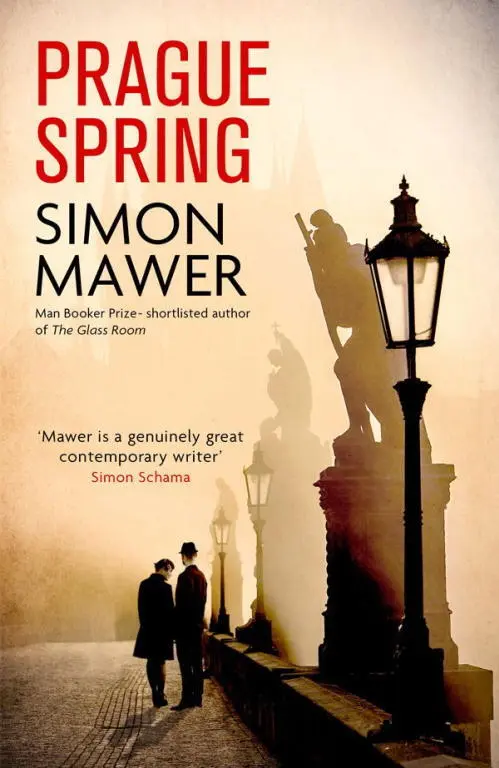
- Название:Prague Spring
- Автор:
- Издательство:Little, Brown Book Group
- Жанр:
- Год:2018
- Город:London
- ISBN:978-1-4087-1113-2
- Рейтинг книги:3 / 5. Голосов: 1
-
Избранное:Добавить в избранное
- Отзывы:
-
Ваша оценка:
Prague Spring: краткое содержание, описание и аннотация
Предлагаем к чтению аннотацию, описание, краткое содержание или предисловие (зависит от того, что написал сам автор книги «Prague Spring»). Если вы не нашли необходимую информацию о книге — напишите в комментариях, мы постараемся отыскать её.
In the summer of 1968, the year of Prague Spring with a Cold War winter, Oxford students James Borthwick and Eleanor Pike set out to hitchhike across Europe, complicating a budding friendship that could be something more. Having reached southern Germany, they decide on a whim to visit Czechoslovakia, where Alexander Dubček’s “socialism with a human face” is smiling on the world.
Meanwhile, Sam Wareham, First Secretary at the British embassy in Prague, observes developments in the country with a diplomat’s cynicism and a young man’s passion. In the company of Czech student Lenka Konečková, he finds a way into the world of Czechoslovak youth, with all its hopes and new ideas; now, nothing seems off-limits behind the Iron Curtain. But the great wheels of politics are grinding in the background; Soviet leader Leonid Brezhnev is making demands of Dubček, and the Red Army is massing on the borders.
This shrewd, engrossing, and sensual novel once again proves Simon Mawer is one of today’s most talented writers of historical spy fiction.
Prague Spring — читать онлайн бесплатно полную книгу (весь текст) целиком
Ниже представлен текст книги, разбитый по страницам. Система сохранения места последней прочитанной страницы, позволяет с удобством читать онлайн бесплатно книгу «Prague Spring», без необходимости каждый раз заново искать на чём Вы остановились. Поставьте закладку, и сможете в любой момент перейти на страницу, на которой закончили чтение.
Интервал:
Закладка:
X
44
There’s a noise in the city, an undercurrent like the coming of a flood. And then the immediate fact of someone knocking on their door and calling them to wake up. The phone is ringing in the other room. James can hear Zdeněk answering, speaking rapidly in Czech to whoever’s on the line.
‘Something’s happening,’ Jitka calls. She edges the door open. Her face, pale with anxiety, hangs in the shadow of the opening. Beside him Ellie emerges from the cocoon of her sleeping bag, looking confused. ‘What time is it?’
‘Early.’
‘What’s happening? What’s going on?’
‘The barbarians,’ Jitka says. ‘The barbarians are coming.’ Which seems uncommonly dramatic, poetic almost, words from the hand of Cavafy. But in Cavafy’s poem the barbarians didn’t come and everyone in the city was left in a kind of limbo, not knowing what to do. Here it is different. The barbarians have actually come and still no one knows what to do. ‘Russians,’ Jitka explains more coherently. ‘They’ve invaded the country. Soldiers, thousands of them, tanks, planes.’
In the next room Zdeněk puts the phone down, calls out something and leaves the flat, slamming the door behind him. James and Ellie are scrabbling for their clothes. Disaster is in the air, or in the ground, shaking the foundations. What do the tremors presage? Earthquake or tornado? Jitka is on the phone now. Rusi , she says to whoever is on the other end, rusi .
Then she’s asking if they’re ready because she has to go – unless they want to stay here. Maybe that would be better. But no, they’ll go with her. So, barely understanding what the hell’s going on, they follow her downstairs and out through the main door onto the pavement.
Dawn paints the street in the pallid colours of panic. There are people around, walking in the same direction, as though drawn to the epicentre of an earthquake, perhaps to rescue people from the rubble. Words are exchanged with passers-by. The tone is an untidy mixture of panic and anger. They feel like children being barely tolerated by an adult.
‘Where are we going?’ Ellie asks.
Jitka is distracted by what she has heard and what’s rumoured, saying things they half-catch and don’t understand. ‘ Václavské náměstí ,’ she says, and then, a concession to foreigners: ‘Wenceslas Square.’
‘But what the fuck’s going on?’ James demands. Then, turning a corner, they discover what the fuck is going on because it is there, a presence across the end of the street, a metallic alien thing amongst the nineteenth-century façades of the New Town. A tank. James thinks of The War of the Worlds , of Martian tripods tramping through London streets. Another part of him thinks arthropod , then reptile turning its empty gaze (half-blind, peering through small openings in the carapace) up the street and pointing its proboscis straight at them, the muzzle forming a perfect O. Then T-54, he thinks. This from another part of his mind, the part that used to play war-games. Surely it is not about to fire. That would be ridiculous. But still he shouts ‘Move!’, grabs Jitka’s hand and pushes Ellie in the back. They run across the street and press themselves into a doorway while the turret turns and the proboscis shifts back and forth as though sniffing the air, perhaps even trying to work out where the humans have gone. Then a remarkable thing happens: a hatch on the top of the machine opens and a head emerges, cased in a black leather helmet. The head looks round at the buildings and the watching people, then takes a moment to consult a map before looking back at the buildings and then down to the map. The man, the arthropod itself, the reptile, the T-54 battle tank and all who travel in her, has lost its way.
People gather, some just to watch in sullen silence, others to shout. The smell of diesel exhaust and despair fills the air. The figure in the turret takes no notice and after a moment drops back inside. With a roar and a cloud of black smoke the beast shifts, its tracks screeching on the tarmac and pavement. Figures emerge from a side street and run round it, like dogs at a bear-baiting. From somewhere out of sight a glass bottle arcs through the air and smashes against the flank of the beast. A blossom of flame erupts below the hull with a low wumph of exploding petrol. The machine bellows in anger, grinds kerbstones to dust and roars out of sight.
Václavské náměstí, Wenceslas Square, with dawn leaching between the buildings and flooding the space. The great sloping boulevard is filling with people. Trams are stopped, while crowds gather, talking, wondering what the hell is going on when what is going on is plain for all to see as tanks gouge their way up the slope and arrange themselves as though for battle. Saint Wenceslas dominates the scene from his pedestal in front of the museum at the top end of the square, but even he, at the moment of greatest need, when he is meant to emerge from the Blaník mountain, is powerless before the armour. There is the stench of diesel, clouds of black smoke as the tanks manoeuvre, the awful clangour of their tracks. A kiosk sells bread rolls and sausages while young men and women argue with soldiers.
‘Why have you come here?’
‘What do you think you’re doing?’
‘Do you even know where you are?’
The soldiers have stock answers to hand as though they’ve been on a language course and have painstakingly learned the phrases without a glimmer of comprehension:
We are here to maintain order.
We are here to suppress the counter-revolution.
We are obeying orders.
We come as friends.
A whole litany of platitude.
A youth appears with a sheet daubed with the slogan идите домой! and manages to drape it on the rear of a tank. People cheer.
‘What does it mean?’ asks Ellie.
Jitka provides the translation. ‘ Idite domoy. Go home. But they won’t, will they? They’re here for good.’
The air is stained with sound and fumes. From somewhere comes a sharp burst of gunfire. The crowd utters a collective gasp, as though there is a sudden shortage of oxygen. Some people run, others stand still. Perhaps a moving target is easier to spot than a motionless one. But the shots aren’t repeated, just the grinding of the tanks and the gruff sound of their engines. Others come into the square bringing news, so Jitka says, of the Central Committee headquarters under siege, of leaders being rounded up, of Dubček himself being led away to be shot. Someone places a transistor radio on the ground and a small crowd gathers round to hear the news. Ellie and James stand to one side, not wishing to intrude. It’s like a traffic accident where you can feel the horror but don’t know any of the victims, a tragedy that belongs to other people. Lenka is there. They don’t see her arrive, but she’s there, talking with Jitka, talking with others, giving a distracted wave of acknowledgement to Ellie and James.
More tanks appear, scouring the cobblestones up the slope towards the museum at the head, followed by a cry of ‘Radio!’, and people begin to move up the slope, fragile humans following the iron beasts. ‘The radio station is still broadcasting,’ Jitka explains. ‘It’s on Vinohradská beyond the museum. Who knows what will happen?’
There is noise from beyond the museum, the sound of metal, the rattle of machine-gun fire. A helicopter flies overhead, a great locust-like thing without markings but painted dun brown. Incongruously, the transistor radio on the ground nearby is broadcasting exactly the same sound – the gunfire, the clash of metal and the helicopter all sounding behind the calm voice of the announcer. Jitka attempts to translate – the studio is under attack and may be invaded but for the moment the staff will continue broadcasting the news as long as possible. When you hear unfamiliar voices on the radio, the announcer says, do not believe them!
Читать дальшеИнтервал:
Закладка:
Похожие книги на «Prague Spring»
Представляем Вашему вниманию похожие книги на «Prague Spring» списком для выбора. Мы отобрали схожую по названию и смыслу литературу в надежде предоставить читателям больше вариантов отыскать новые, интересные, ещё непрочитанные произведения.






Обсуждение, отзывы о книге «Prague Spring» и просто собственные мнения читателей. Оставьте ваши комментарии, напишите, что Вы думаете о произведении, его смысле или главных героях. Укажите что конкретно понравилось, а что нет, и почему Вы так считаете.