Саймон Моуэр - Prague Spring
Здесь есть возможность читать онлайн «Саймон Моуэр - Prague Spring» весь текст электронной книги совершенно бесплатно (целиком полную версию без сокращений). В некоторых случаях можно слушать аудио, скачать через торрент в формате fb2 и присутствует краткое содержание. Город: London, Год выпуска: 2018, ISBN: 2018, Издательство: Little, Brown Book Group, Жанр: Историческая проза, на английском языке. Описание произведения, (предисловие) а так же отзывы посетителей доступны на портале библиотеки ЛибКат.
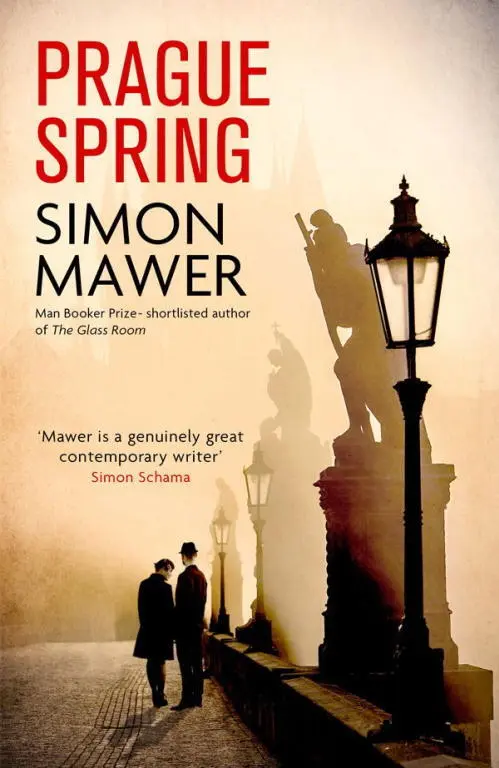
- Название:Prague Spring
- Автор:
- Издательство:Little, Brown Book Group
- Жанр:
- Год:2018
- Город:London
- ISBN:978-1-4087-1113-2
- Рейтинг книги:3 / 5. Голосов: 1
-
Избранное:Добавить в избранное
- Отзывы:
-
Ваша оценка:
Prague Spring: краткое содержание, описание и аннотация
Предлагаем к чтению аннотацию, описание, краткое содержание или предисловие (зависит от того, что написал сам автор книги «Prague Spring»). Если вы не нашли необходимую информацию о книге — напишите в комментариях, мы постараемся отыскать её.
In the summer of 1968, the year of Prague Spring with a Cold War winter, Oxford students James Borthwick and Eleanor Pike set out to hitchhike across Europe, complicating a budding friendship that could be something more. Having reached southern Germany, they decide on a whim to visit Czechoslovakia, where Alexander Dubček’s “socialism with a human face” is smiling on the world.
Meanwhile, Sam Wareham, First Secretary at the British embassy in Prague, observes developments in the country with a diplomat’s cynicism and a young man’s passion. In the company of Czech student Lenka Konečková, he finds a way into the world of Czechoslovak youth, with all its hopes and new ideas; now, nothing seems off-limits behind the Iron Curtain. But the great wheels of politics are grinding in the background; Soviet leader Leonid Brezhnev is making demands of Dubček, and the Red Army is massing on the borders.
This shrewd, engrossing, and sensual novel once again proves Simon Mawer is one of today’s most talented writers of historical spy fiction.
Prague Spring — читать онлайн бесплатно полную книгу (весь текст) целиком
Ниже представлен текст книги, разбитый по страницам. Система сохранения места последней прочитанной страницы, позволяет с удобством читать онлайн бесплатно книгу «Prague Spring», без необходимости каждый раз заново искать на чём Вы остановились. Поставьте закладку, и сможете в любой момент перейти на страницу, на которой закончили чтение.
Интервал:
Закладка:
‘Of course I’m not,’ he told the person from the consular department. ‘Isn’t it economic affairs? Exporting British pop music to the world, or something?’
Then a messenger came in from communications with a telex from London that had just come through, something about a report of troops being moved up to the East German–Czech border. Did the embassy have any confirmation of this?
He sighed. There had been reports of troop movements both inside and outside the country ever since the spring manoeuvres. Half the bloody Warsaw Pact had been sniffing round Czechoslovakia for months now, like dogs round a bitch’s arse. He passed the telex on to Eric Whittaker, along with a suggested anodyne response that mentioned neither dogs nor bitches. Then he went through whatever else there was on his desk and closed down for the day. He was taking Lenka out for dinner, to the restaurant overlooking the river at Barrandov where they had had lunch on their first date. There was a certain tension between them over the Russians and over that weekend jaunt to the castle that he’d been forced to miss. He’d make it up to her, tell her that he loved her. Maybe, if things went well, he’d even propose to her. The idea shocked him. Could you shock yourself? Apparently it was possible. Mrs Lenka Wareham. How did that sound? Of course, here she’d become Paní Lenka Warehamová or something equally hideous. But it wouldn’t be here, would it? It’d be a posting to somewhere undistinguished, as a counsellor probably; or if he got lucky, something good for the curriculum vitae, such as Washington or Paris. Moscow would be the obvious one, with his knowledge of the language, but surely they’d not post him to Moscow with a citizen of a Soviet Bloc country in tow.
Was this all nothing more than idle daydreaming brought unexpectedly out into the open when confronted by the ambassador’s enquiries? Perhaps. But the idea had brought with it a strange, physical sensation, a blend of warmth and contentment and blatant sexual arousal. Mrs Lenka Wareham.
42
A pop group on the Charles Bridge. There’s something feminine about them, something effete. Long, waved hair. Blouses with puffed sleeves. Skintight trousers. They call themselves The Moody Blues and are the soft side of the hippy craze, come across the Iron Curtain to bring some glimmer of psychedelic beat music to the benighted inhabitants of the Soviet empire. Television cameras peer at them while a dapper little man bobs around with a microphone, telling people in French where to go and what to say. No one understands. He slips into German, which everyone pretends not to understand either. Someone from Czech television translates and the technicians do more or less what is asked of them as though it was obvious from the beginning if only he’d said. The audience – a gaggle of girls in short skirts and beehive hairdos, boys in jeans and open-necked white shirts – sit along the parapet of the bridge trying not to look bored. This is television, this is exciting. They clap because someone tells them to and the anchor man explains to an imaginary audience that nous sommes sur le très très vieux pont Charles . Die schönen Karlsbrücke , he adds for an imaginary German audience. ‘Who is your spokesman?’ he asks, in English now, of the hapless musicians. He pushes a microphone in the face of the volunteer. ‘How do you depict your musical style?’
The musician looks perplexed. What to say? ‘Well, it’s still beat,’ he decides. ‘But the way it’s progressing now, it’s getting very classical.’
The anchor man translates these gnomic words into French and then German. The song they are about to sing is well known to all aficionados of such music, and the artificial audience clap once again as though having something to do has at least aroused them from their summer torpor. The members of the group begin to strum dead guitars, finger a dumb keyboard and tap a muted drum kit while a recording of their number comes out over a pair of speakers so they can pretend to sing. ‘Knights In White Satin’ is the title. James imagines Lancelot and Guinevere, in white satin both of them, just the kind of image conjured up by the fantasy worlds of Camelot and Jesus Christ Superstar .
Ellie giggles. ‘It’s night-time , you idiot, not men in suits of armour, nights in white satin sheets .’
For a moment they’re reunited in barely suppressed laughter. Lenka looks at them askance, in case their noise intrudes on the soundtrack. She has arranged their presence there, through someone she knows in TV, so she feels responsible for their behaviour. But their laughter doesn’t intrude on the soundtrack because the whole thing will be dubbed over later in the studios in Paris.
The song, vaguely mysterious, vaguely evocative, seeps into the hot afternoon air. Whatever their merits, James thinks, The Moody Blues are not the Ides of March.
43
Dinner on the terraces at Barrandov, in the humid evening. The darkness was punctuated by candlelight and laughter, as though there was not a care in the world. A jazz quartet played ‘Take Five’, the saxophone wandering off into the vagaries of improvisation.
‘One thing about Prague,’ Sam said. ‘You can always guarantee the music.’
Lenka smiled. ‘Every Czech a musician. That’s what they say.’
They talked about the weekend, his imprisonment in the flat with Egorkin and the violinist, her trek with Jitka and the others out to the hrádek . ‘It was fun. The girl, Ellie. I like her.’ She added, still with a hint of accusation in her tone: ‘Perhaps you should have been there.’
‘I’m afraid my life is like that. The unexpected happens all the time.’
‘If it’s all the time, it’s not unexpected, is it?’
One of her sharp retorts that he still could not fathom. He wondered whether and how he should pose the question. Confessions of love did not come easily to him, perhaps because love, promising so much yet threatening disaster, seemed the very antithesis of diplomacy. Feeling something akin to panic, he reached across the table to take her hand just as ‘Take Five’ came to a thoughtful end and the quartet segued into some Miles Davis. People got up to dance. Lenka too, taking Sam with her. She was strong and sinuous, drifting softly to the music, moulding her shape to his. ‘What,’ she whispered in his ear, ‘do you want?’
And so, dancing slowly on the Barrandov Terraces in the warm evening, he told her. And for a while – that dance, her whispered reply, the rest of the evening together – happiness seemed possible.
He woke from nightmare into nightmare. Lenka slept undisturbed beside him, breathing softly. For a while he lay on the borderline between the two states, between the sleeping nightmare and the waking nightmare, the dream fading from his memory to leave only a vague sense of dread and the ringing of the telephone that didn’t fade. He fumbled in the dark for his watch and read the luminous hands. One-thirty.
The phone continued to ring.
No good ever came from a telephone call in the middle of the night. He thought of his parents. He thought of Steffie. What had happened and what might have happened. There was the temptation to ignore the damn thing and return to sleep, but the ringing continued and now there was the sound of aircraft, unusual in the night. The whine of turboprops. The roar of jets.
Lenka’s voice in the darkness: ‘What is it?’
‘Planes. The phone.’
The fragmentary nature of disaster – a telephone ringing; the sounds of planes in the night sky; a sense of unreality. Surely this was a dream of some kind, a phantom created at the edge of sleep? Then came a flutter of panic at the knowledge that it wasn’t a dream, that nightmare had turned real, like a fog freezing into hard black ice. The Russian winter. The phone was still ringing and he stumbled out into the hall to pick it up. A bleak voice on the other end of the line said, ‘It’s Eric.’ There was a moment’s bleeping and whirring on the line and then Eric’s voice continued: ‘…should be here in a couple of hours,’ it was saying.
Читать дальшеИнтервал:
Закладка:
Похожие книги на «Prague Spring»
Представляем Вашему вниманию похожие книги на «Prague Spring» списком для выбора. Мы отобрали схожую по названию и смыслу литературу в надежде предоставить читателям больше вариантов отыскать новые, интересные, ещё непрочитанные произведения.






Обсуждение, отзывы о книге «Prague Spring» и просто собственные мнения читателей. Оставьте ваши комментарии, напишите, что Вы думаете о произведении, его смысле или главных героях. Укажите что конкретно понравилось, а что нет, и почему Вы так считаете.