Джанет Фитч - Chimes of a Lost Cathedral
Здесь есть возможность читать онлайн «Джанет Фитч - Chimes of a Lost Cathedral» весь текст электронной книги совершенно бесплатно (целиком полную версию без сокращений). В некоторых случаях можно слушать аудио, скачать через торрент в формате fb2 и присутствует краткое содержание. Город: New York, Год выпуска: 2019, ISBN: 2019, Издательство: Little, Brown and Company, Жанр: Историческая проза, на английском языке. Описание произведения, (предисловие) а так же отзывы посетителей доступны на портале библиотеки ЛибКат.
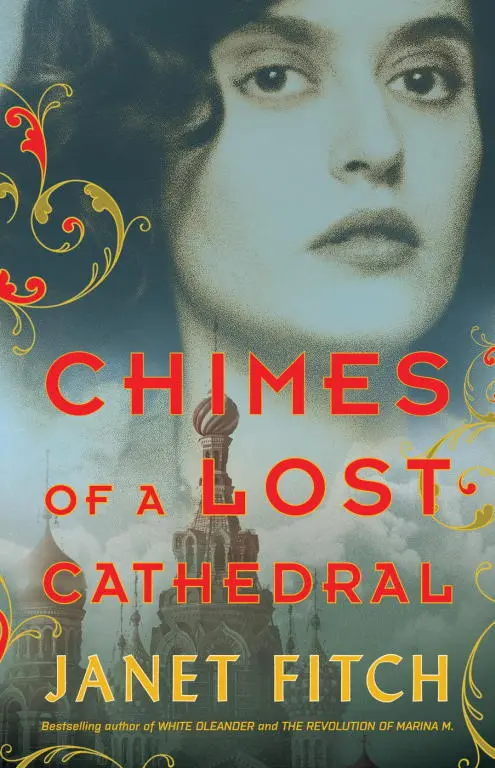
- Название:Chimes of a Lost Cathedral
- Автор:
- Издательство:Little, Brown and Company
- Жанр:
- Год:2019
- Город:New York
- ISBN:978-0-316-51006-6
- Рейтинг книги:5 / 5. Голосов: 1
-
Избранное:Добавить в избранное
- Отзывы:
-
Ваша оценка:
Chimes of a Lost Cathedral: краткое содержание, описание и аннотация
Предлагаем к чтению аннотацию, описание, краткое содержание или предисловие (зависит от того, что написал сам автор книги «Chimes of a Lost Cathedral»). Если вы не нашли необходимую информацию о книге — напишите в комментариях, мы постараемся отыскать её.
After the events of The Revolution of Marina M., the young Marina Makarova finds herself on her own amid the devastation of the Russian Civil War—pregnant and adrift in the Russian countryside, forced onto her own resourcefulness to find a place to wait out the birth of her child. She finds new strength and self-reliance to fortify her in her sojourn, and to prepare her for the hardships and dilemmas still to come.
When she finally returns to Petrograd, the city almost unrecognizable after two years of revolution, the haunted, half-emptied, starving Capital of Once Had Been, she finds the streets teeming with homeless children, victims of war. Now fully a woman, she takes on the challenge of caring for these civil war orphans, until they become the tool of tragedy from an unexpected direction.
But despite the ordeal of war and revolution, betrayal and privation and unimaginable loss, Marina at last emerges as the poet she was always meant to be.
Chimes of a Lost Cathedral finishes the epic story of Marina’s journey through some of the most dramatic events of the last century—as a woman and an artist, entering her full power, passion, and creativity just as her revolution reveals its true direction for the future.
Chimes of a Lost Cathedral — читать онлайн бесплатно полную книгу (весь текст) целиком
Ниже представлен текст книги, разбитый по страницам. Система сохранения места последней прочитанной страницы, позволяет с удобством читать онлайн бесплатно книгу «Chimes of a Lost Cathedral», без необходимости каждый раз заново искать на чём Вы остановились. Поставьте закладку, и сможете в любой момент перейти на страницу, на которой закончили чтение.
Интервал:
Закладка:
I waited on the street corner through several rounds of crude advances. “Come on, kitten, I’ll pay your ticket.” “ Milaya, you’ve been waiting for me all your life.” “How much for a quick one? We can go in that courtyard. Fifty thousand? I’ll get a scumbag—what do you say?” The inflation was prodigious. A match was two hundred fifty rubles now.
Eventually the boy emerged from the rust-colored curtain, leading a tall, ginger-haired man who didn’t look much like a fisherman—too tall, too slouchy, with a red beard, a long sharp chin and long nose. His eyes were very dark under pale brows, level and dangerous, like the barrels of two guns.
“This is her,” Makar said. To me: “This is the Wolf.”
So this was what had replaced Arkady von Princip, a lean, voracious redheaded Finn of twenty-five or so with a fresh scar through one pale eyebrow. He held his sharp chin in his hand. “The kid said you want to take a tour,” he said.
“How much?” I said.
He looked at me closely, squinting at my dress, my boots. I’d changed back into my old clothes—if I’d worn the things Kolya had bought me, the price would be double. “A million,” he said.
I was blown backward as if in a strong wind. “Where is this tour going, Africa?”
“Sestroretsk.” Just over the border.
“That’s not far enough. I could walk there and keep the million,” I said.
“So walk.” The Wolf turned to go back into the nightclub.
“You really a fisherman?” I called after him.
“Fisher of men,” he said. And laughed and stepped back toward me. “And you, you’re really a teacher?”
“In the school of many sorrows,” I said. “How about Helsinki?”
“Two million,” he said.
What a disgusting fellow. “It’s not that much farther.”
“I have no need to go to Helsinki. It’s more complicated all around.”
A million, two million—it made my head swim. Everything was so expensive now—yet, the new people had bathtubs of money—for restaurants, for nightclubs, and beaded dresses and silk stockings. How in the world could I raise that kind of money? A million. He might as well have said ten times that. “I don’t like Sestroretsk. It’s too close. Too many eyes on the border.”
“I know a customs officer,” he said. “My brother Ahti. You know who is Ahti?”
I shook my head.
“The God of Water. It’s good luck for us, Sestroretsk.”
I didn’t like it. I especially didn’t like the brother. Too many heads to get ideas. Like taking my money and dumping me right back into Russia—why not? Or worse, into the hands of the Russian border police. Or into the sea. No, I could see it as clearly as if I were Vera Borisovna. “How about Kuokkala?” The former Russian artists’ colony on the gulf a couple of miles northwest of Sestroretsk, a place I actually knew. My Uncle Vadim once rented a dacha there, next door to the artist Repin.
The Wolf considered it, rubbing his chin.
I wondered if the painter had remained after that coast was returned to Finland. Seryozha had adored that old man, as did Vera Borisovna. We went visiting as often as she would allow it. My brother in particular had been fascinated by a half-finished portrait of a young man in a black suit smoking a cigarette.
“Nothing’s going on in Kuokkala. Sestroretsk, that’s where you want to be. Catch the train for Vyborg.”
Those afternoons at Repin’s, painter of The Volga Boatmen, and the famous portrait of the barefoot Tolstoy. All of us had posed for him. Those pictures, where had they gone? Sold for grain to the Volga? My mother, knocking sweetly on his door—she had the perennial entrée of beautiful women everywhere. Seryozha watching the artist with the same concentration with which the artist studied him. Surely there were still some Russians left in Kuokkala. If I couldn’t get to Helsinki, I’d rather land on familiar terrain. Somewhere without the Wolf’s brother.
The Finn gazed at me, stroking his little beard. “I like you, Teacher. You find two more people, I’ll let you go for eight hundred thousand.”
“Each?”
“No, just you. For them it’s the regular price. But it’s a bargain. People will cross you on foot for two million, and you’d have to take the train, hide in the woods. This is a hundred percent safer.”
“I don’t know anyone else,” I said.
The Wolf sighed. Makar was back, stuffing cash into his pocket. “So when do we go?”
“Thursday,” said the Finn.
Three days to collect a million rubles. But I had an idea how I would get it.
Our brass bed was the big seller of the day. I felt I was killing swans, selling it. That bed was our love, where he’d hoped we’d spend the months and years ahead. We would never sleep in it again. Forgive me, Kolya. But I’d told him plainly. I could not be his toy. I could never put my life in his hands after that duplicity. I watched the two metalworkers break the bed into parts—footboard, headboard, frame, and springs. All around me, the empty places where our love nest had been feathered. It was so soon, but if I waited, it would be too late. Don’t hesitate, Arkady taught me. In a few months, I’d be accustomed to our lives—the comings and goings of Mrs. Shurov, waiting for visits. Perhaps I’d buy cocaine through the Wolf. Drink. Make interim arrangements. It would be the death of me.
The metalworkers didn’t want the mattress. I could sell that separately. They would cut up the brass for rings and pins, belt buckles. The iron they’d do God knows what with, the springs they’d sell individually to upholsterers.
“They’ll make four times what they paid,” said Makar, counting out the cash and handing it to me. My little assistant was proving his worth. The wad of Kerenskys was growing as thick as a Bible. A couple bought the rugs, Makar talked the price up. I sold the curtains, the pillows, the mirrors, the pink champagne glasses. The groceries went to a woman wearing the ugliest hat I’d ever seen, someone the orphan knew from a brothel near the Little Brick. Sugar and sardines, quail eggs, salt and caviar. He counted the money twice, held it up to the light. She’d wanted the wine and the brandy, the whisky and the vodka, but didn’t have enough money. “Put it away for me?” she purred to Makar. He looked at me quizzically, as if asking the adult what to do, but crossed his eyes when he did it. No.
“I have another customer,” I said.
“How much? I’ll double it.”
How much would this nonexistent customer give us for bottles of vintage wine and cognac, English whisky and vodka? “A hundred thousand,” Makar said.
“You little runt,” the woman replied, resettling her hat. “Go jump off a bridge.”
He looked to me again, shrugged. I touched my eyebrow, meaningfully. We would have been a good team, Makar and me. Who could have imagined this in the days when I told the boys the story of Shinshen, and Iskra and Maxim were still alive?
In the end we came down to eighty. “If you can be back in a half hour.”
“I’ll be right back. Don’t sell any of it, promise me.”
Where did these people come from? How had they survived the war ready to set up shop as soon as the season changed? Such strange times. Yes, perhaps it would all end well, just as Kolya hoped. But I felt the lid descending, the last door closing. Kolya had too much faith in himself, which was fine for him, but I could not make a life out of hope. Makar counted the money, smoking his dirty chinar —I’d given him a box of Egyptian ovals but he must have sold them. “Sure you want to leave?” he asked. “We could make a fortune together, and live like kings.” He handed me a pile of cash. “Here’s another hundred thousand. How much do we have altogether?”
Читать дальшеИнтервал:
Закладка:
Похожие книги на «Chimes of a Lost Cathedral»
Представляем Вашему вниманию похожие книги на «Chimes of a Lost Cathedral» списком для выбора. Мы отобрали схожую по названию и смыслу литературу в надежде предоставить читателям больше вариантов отыскать новые, интересные, ещё непрочитанные произведения.








Обсуждение, отзывы о книге «Chimes of a Lost Cathedral» и просто собственные мнения читателей. Оставьте ваши комментарии, напишите, что Вы думаете о произведении, его смысле или главных героях. Укажите что конкретно понравилось, а что нет, и почему Вы так считаете.