Арнольд Цвейг - Outside Verdun
Здесь есть возможность читать онлайн «Арнольд Цвейг - Outside Verdun» весь текст электронной книги совершенно бесплатно (целиком полную версию без сокращений). В некоторых случаях можно слушать аудио, скачать через торрент в формате fb2 и присутствует краткое содержание. Город: Glasgow, Год выпуска: 2014, ISBN: 2014, Издательство: Freight Books, Жанр: Историческая проза, prose_military, на английском языке. Описание произведения, (предисловие) а так же отзывы посетителей доступны на портале библиотеки ЛибКат.
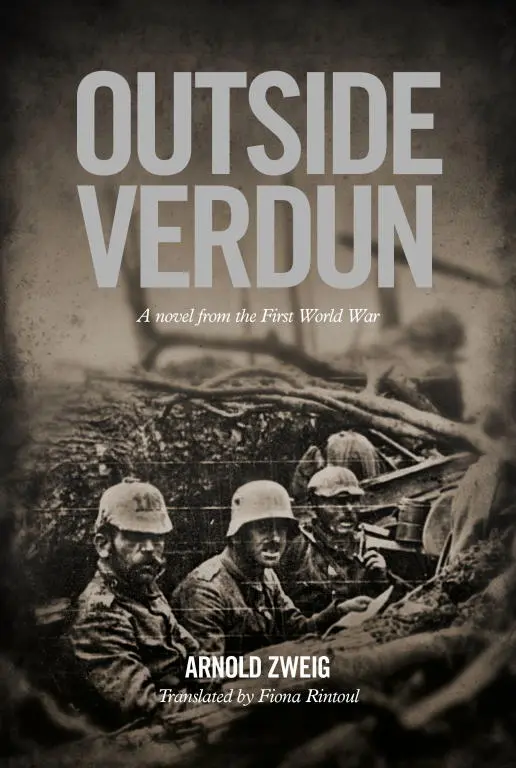
- Название:Outside Verdun
- Автор:
- Издательство:Freight Books
- Жанр:
- Год:2014
- Город:Glasgow
- ISBN:978-1-908754-52-3
- Рейтинг книги:3 / 5. Голосов: 1
-
Избранное:Добавить в избранное
- Отзывы:
-
Ваша оценка:
Outside Verdun: краткое содержание, описание и аннотация
Предлагаем к чтению аннотацию, описание, краткое содержание или предисловие (зависит от того, что написал сам автор книги «Outside Verdun»). Если вы не нашли необходимую информацию о книге — напишите в комментариях, мы постараемся отыскать её.
“The war, an operation instigated by men, still felt to him like a storm decreed by fate, an unleashing of powerful elements, unaccountable and beyond criticism.”
Arnold Zweig’s novel was first published in 1933 and is based on his own experiences in the German army during World War I. Following the unlawful killing of his younger brother by his own superiors, Lieutenant Kroysing swears revenge, using his influence to arrange for his brother’s unit, normally safely behind the lines, to be reassigned to the fortress at Douaument, in the very heart of the battle for France. Bertin, a lowly but educated Jewish sapper through whose eyes the story unfolds, is the innocent man caught in the cross-fire.
The book not only explores the heart-breaking tragedy of one individual trapped in a nightmare of industrialized warfare but also reveals the iniquities of German society in microcosm, with all its injustice, brutality, anti-Semitism, and incompetence. A brilliant translation captures all the subtleties, cadences, and detachment of Zweig’s masterful prose.
Outside Verdun — читать онлайн бесплатно полную книгу (весь текст) целиком
Ниже представлен текст книги, разбитый по страницам. Система сохранения места последней прочитанной страницы, позволяет с удобством читать онлайн бесплатно книгу «Outside Verdun», без необходимости каждый раз заново искать на чём Вы остановились. Поставьте закладку, и сможете в любой момент перейти на страницу, на которой закончили чтение.
Интервал:
Закладка:
He stood up, feeling better now. He was a man who needed clarity. He lit the shaded lamps, the candles on the piano and the night light. He drank a glass of the French liqueur he kept for visitors, then a second. It tasted good. He collected together the things he’d laid out earlier. He took his matt black service revolver, a modern pistol, from his open desk drawer and placed it on a silver platter beside the poisonous sleeping pills he’d gradually accumulated. In Germany, you could only get them with a doctor’s prescription. Citizens had more freedom in France, even when it came to death. As a Prussian officer, it was his duty to choose the weapon. If he was going to die, he should do it properly. But as an intellectual man, averse to violence and destruction, he preferred poison. As his father’s son, he had paid his father far too much regard while he was alive, silently conforming to his wishes. Should he pay him regard one last time and do as convention demanded? Or should he perform this last of all human actions as he saw fit? To ask the question was to answer it. If he had paid his father less regard, been less the well-behaved son, been less sensitive to the rough and tumble of life, had engaged with the world as vigorously as many of his boyhood friends had done, then who knew what his life might have been like and if he would now be facing the silence of eternal rest. Great was Diana of the Ephesians and Cybele the Great Mother, but great too was the consolation provided by music, the mysterious source of existence that was expressed both in the remarkable ratios of planetary orbits and in the simple metrics and proportions of harmonies, through which the unknown could be measured. Vibration and gradation were all. Physicists said everything could be reduced to movements in the unknown ether, in its force fields, which themselves could transform masses and solids into pulsating, substanceless and therefore spiritual matter. Then why not into something akin to music? Why not into music itself? Wasn’t there something in those remarkable sequences of resonant air, vibrating strings and complex interrelationships that went beyond noise and air? Didn’t we see behind the secrets of advanced mathematics when we lost ourselves in music? Physics had a great future, he sensed, though he understood little of it. The physicist Einstein, raised in Switzerland but whom he’d known in Berlin, had changed our world view, freeing it from the physical and introducing with his spiritual concepts a new way of thinking, akin to that of Husserl in Göttingen. And he loved music. Perhaps music and the solace it provided led us to an existence more real than our earthly existence of flesh and nerves, making us aware, through the physical instrument of the ear, of a wider universe, the other stars and better worlds that Shakespeare, pointing to the night sky, had described as ‘patines of bright gold’ that move ‘like an angel sings’. Be that as it may, he knew how he was going to move: while making music. He would put a sleeping draught on the piano and drink it when he felt like it. It would be a sort of deathly refreshment, and then he would pass into a world of unknown consonances and harmonies, through the portal of those he loved the most, because they were dark and ambivalent, but also modern and glorious: Brahms’ quartet in A minor.
The piano they’d put in the house for him came from Paris. It was old and some notes were a little tinny but on the whole the sound was soft and warm. He made his drink with hot water from a vacuum flask, stirring it slowly as he thought about his nephew, to whom he’d bequeathed most of his worldly goods, and about the humble library in a small university at the foot of a little visited range of hills where he’d spent some happy months, which was about to become an important seat of learning for legal history and the development of legal theory through the priceless bequest of the Mertens library. A lot of other things went through his mind too, for example that with a little more knowledge and skill he could have rigged up the stove to give off carbon monoxide, removing any need for action on his part. Next time, he smiled. Then he opened the piano score for the Brahms quartet and began to play. The music echoed softly in the quiet house and out through its rustic windows, and a passer-by occasionally looked up or stopped for a moment before the damp, icy weather drove them on.
Mertens’ fingers flew over the keys, a blissful smile lit his face and he moved his head, his whole body, in time to the rhythms of the overture. His heart filled with inexpressible joy. The man who had brought these sounds into being, before they were inked on the page, was a stout, long-haired cigar smoker with a beard and a snub nose, but an angel had clearly possessed him – for this to have sounded within him, his soul must have been lovelier than Rembrandt’s or Grünewald’s most splendid creations. It was indescribable, other-worldly, the highest joy, a revelation scribbled down for 16 strings of gut stretched on a hollow wooden frame – a dance of blessed spirits performed by 10 fingers that soon would hang rigid and numb. But for now they played. All the sweetness of a spring breeze rippling over a meadow of flowers was there in those notes, as well as the dark, putrid source from which the flowers, like the soul, sprang. This music was the world all over again, but better, flawless, free from the terrible savage urges of our animal nature, which smother everything that is light and pure. How good it felt to bring it to an end, to leave and go through the unknown portal into the unknown land on the wings of the only joy that had never let him down. He drank from his glass, to which he’d added a sweet liqueur, and began the second movement. The deep solemnity of farewell… his fingers slid lightly over the keys, his ear caught every note, his mouth was set and grave. The earth curved away from him; all the people and trees rose up from a mountaintop, but he didn’t see them. Swaddled in the swirling atmosphere, he saw himself on the edge of space, which began above his head and stretched unbroken to the planets. A musician sensed such things. Writers, too, had a sense for what was behind their backs, above their heads and beneath their feet. Had he ever heard as clearly as today? And then the master, in the midst of his wonderful art, bowed before the genius of a young Austrian named Franz Schubert, quoting one of his songs entitled ‘Numbness’: ‘I search the snow in vain/For the trace of her steps…’ Which trace of which steps did a man seek when, the numbness finally over, he softly opened that last of all doors and set upon a new path, leading to new meadows and new towns built of spiritual materials by unknown residents, of gratitude, service and kindness, of valiant solitude, genial companionship and the joy of giving – everything that was great and noble in the human soul and that might just as well, or even better, exist within a Negro savage as within the emperor Napoleon or the philosopher Nietzsche? It felt good to be tired, tired of life and death, tired of being and not being, tired of what lay above and what lay below, tired of colour and the absence of colour… The opening of the minuet required a certain effort from the player, but then a threshold was crossed and the dance of the ghost-lit sylphs was consummated. It didn’t matter if the player’s fingers obeyed him in the allegro. The meaning was clear before the notes were struck, before the opening and progression. But it seemed only natural that Maestro Brahms, pot-bellied with a cigar butt in the corner of his mouth, should come to the aid of his pupil and passionate admirer C.G. Mertens, take a seat at the piano in his black frock coat and apply his soft hands to playing his own music as it was meant to be played, while Mertens rested for a moment. Was it any different from Socrates sitting and drinking with his friends? A solemn sweetness surrounded Mertens’ heart. The spirits of the strings danced a silver, moonlit minuet, caressed by a night breeze, on a hilltop, scented by seaside pines. Foothills and coves swayed before him… ‘and their heads began to sink onto the upholstery/a young man came – I can remember…’ He walked, grave and lovely, from behind the gathered bedroom curtain supported by two slender, flute-playing women, and Maestro Brahms looked at him questioningly and said in Latin: ‘You have loved justice and hated iniquity and so…’ What does he mean? thought Mertens in alarm. I’m not dying in exile! No one could fall asleep more blissfully than I am doing in this armchair .
Читать дальшеИнтервал:
Закладка:
Похожие книги на «Outside Verdun»
Представляем Вашему вниманию похожие книги на «Outside Verdun» списком для выбора. Мы отобрали схожую по названию и смыслу литературу в надежде предоставить читателям больше вариантов отыскать новые, интересные, ещё непрочитанные произведения.








Обсуждение, отзывы о книге «Outside Verdun» и просто собственные мнения читателей. Оставьте ваши комментарии, напишите, что Вы думаете о произведении, его смысле или главных героях. Укажите что конкретно понравилось, а что нет, и почему Вы так считаете.