Арнольд Цвейг - Outside Verdun
Здесь есть возможность читать онлайн «Арнольд Цвейг - Outside Verdun» весь текст электронной книги совершенно бесплатно (целиком полную версию без сокращений). В некоторых случаях можно слушать аудио, скачать через торрент в формате fb2 и присутствует краткое содержание. Город: Glasgow, Год выпуска: 2014, ISBN: 2014, Издательство: Freight Books, Жанр: Историческая проза, prose_military, на английском языке. Описание произведения, (предисловие) а так же отзывы посетителей доступны на портале библиотеки ЛибКат.
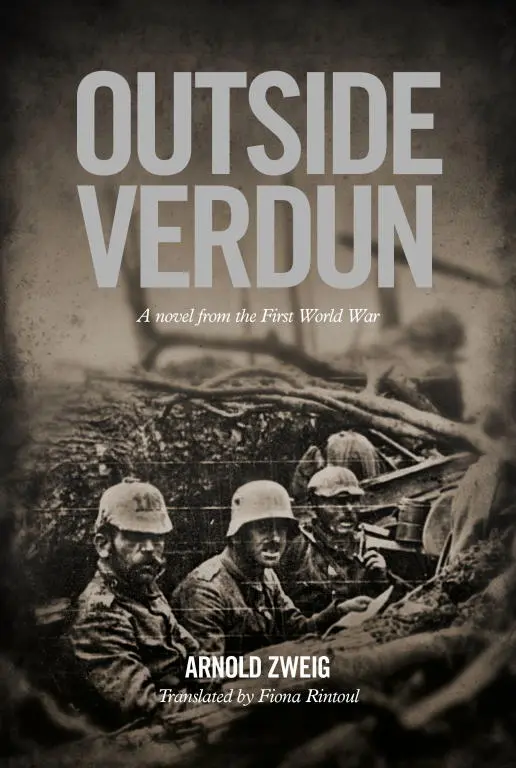
- Название:Outside Verdun
- Автор:
- Издательство:Freight Books
- Жанр:
- Год:2014
- Город:Glasgow
- ISBN:978-1-908754-52-3
- Рейтинг книги:3 / 5. Голосов: 1
-
Избранное:Добавить в избранное
- Отзывы:
-
Ваша оценка:
Outside Verdun: краткое содержание, описание и аннотация
Предлагаем к чтению аннотацию, описание, краткое содержание или предисловие (зависит от того, что написал сам автор книги «Outside Verdun»). Если вы не нашли необходимую информацию о книге — напишите в комментариях, мы постараемся отыскать её.
“The war, an operation instigated by men, still felt to him like a storm decreed by fate, an unleashing of powerful elements, unaccountable and beyond criticism.”
Arnold Zweig’s novel was first published in 1933 and is based on his own experiences in the German army during World War I. Following the unlawful killing of his younger brother by his own superiors, Lieutenant Kroysing swears revenge, using his influence to arrange for his brother’s unit, normally safely behind the lines, to be reassigned to the fortress at Douaument, in the very heart of the battle for France. Bertin, a lowly but educated Jewish sapper through whose eyes the story unfolds, is the innocent man caught in the cross-fire.
The book not only explores the heart-breaking tragedy of one individual trapped in a nightmare of industrialized warfare but also reveals the iniquities of German society in microcosm, with all its injustice, brutality, anti-Semitism, and incompetence. A brilliant translation captures all the subtleties, cadences, and detachment of Zweig’s masterful prose.
Outside Verdun — читать онлайн бесплатно полную книгу (весь текст) целиком
Ниже представлен текст книги, разбитый по страницам. Система сохранения места последней прочитанной страницы, позволяет с удобством читать онлайн бесплатно книгу «Outside Verdun», без необходимости каждый раз заново искать на чём Вы остановились. Поставьте закладку, и сможете в любой момент перейти на страницу, на которой закончили чтение.
Интервал:
Закладка:
Carl Georg Mertens’ heart felt like a soft clump hanging in his chest. He threw the blanket back and, shivering slightly, walked through his rooms, which had been put at his disposal by headquarters after expelling the owner. How long had this house been here? More than 100 years for sure. When it was new the names of Goethe, Beethoven and Hegel had shone over Germany, and Europe stood in the shadow of Napoleon I, who had at least atoned for the devastation caused by his campaigns through comprehensive political and legal reforms. Now, 100 years later, conquests brought nothing but moral disintegration, obliteration of all individual values, an ardent wearing down of the moral culture that had revived since the Thirty Years’ War. He wondered what his father would have made of this war, of its unanimous glorification by Germany’s intellectuals – a war they knew nothing about but that they were all resolved to whitewash and falsify, to distort until it fitted with their view of the world. Lawyers and theologians, philosophers and doctors, economists and history teachers, and above all poets, thinkers and writers, spread deceit among the people with every word they said and wrote in the newspapers. They rushed to confirm that which was not and disputed that which was, were naïve and ignorant, putrid with self-assurance, and didn’t make the slightest attempt to establish the facts before giving the benefit of their views.
Professor Mertens was a short-sighted man but he could see well in the dark. He went to his wardrobe and put on a warm dressing gown and slippers, then he wandered through the three rooms that until now had been his billet, opening and closing drawers. He searched his desk for a particular object, eventually found it and put it to one side, looked in the bedroom for things he might need and laid them out. There was no point in maintaining illusions in the last hours of a year when his eyes had been opened, even with regard to his dearest and most firmly held values, for example about his father. Would the venerable Gotthold Mertens, descendant of protestant pastors and Mecklenburg officials, have rejected the illusions established by the Fatherland to conceal and justify all the horrors brought by its lust to conquer? Of course not. Let’s not kid ourselves. At the outbreak of war, the great man would have rallied the young men and sent them into battle. Throughout the first year of the war, operating from a deep sense of justice, he would have championed Germany’s actions as a necessary mission. In the second year, he would have invoked his country’s destiny, called for stout hearts and endurance in the face of a holy necessity, certain that he was fulfilling his duty, dealing with reality and promoting the survival of the nation. And if his son, who now knew how things stood, had then set out what he knew, what was the best Gotthold Mertens might have done? Said nothing in public and approached his former pupil the Imperial Chancellor in private. Then he would have given up in the face of the Army Command, taken comfort from past glories and dark allusions to the spirit of European legal history, whose aim was to tame the passions, establish inalienable civil rights, provide peaceful citizens with security, improve public morals, and promote intellectual enlightenment and the cultural heritage that alone made life worth living. But he, his son, no longer believed in all these wonderful claims and illusions. A sapper lieutenant had opened his eyes. During the past half year, he’d learnt to look more closely, and his suspicions had grown. And now he knew more: the gaps had been filled in by that same sapper lieutenant and by his murdered brother in the shape of two brief reports.
When he looked back on that whole period, he realised that, oddly enough, his art books had helped to sharpen his sense of the authentic. Painters’ creations don’t lie. Their absolute devotion to what is real, their powerful desire to reveal form, in the landscape as much as in figures, had simply made him more sensitive to the embellishments, calculated lies and biased quarter truths that people made do with day after day, month after month, in politics as in the army bulletins. But he could no longer make do with that. Faced with the incredible he had begun to investigate. And once his eyes had been ripped open he couldn’t shut them again. Until he reached a point where it became blindingly clear to him that he couldn’t go on. Until his disgust with the whole business knocked him over – literally. His life did not have many roots. He had no interest in women or the usual male enjoyments and distractions. His father had both replaced such pleasures for him and devalued them. He had loved travelling, but after the destruction of this war there wouldn’t be many places a German could go without feeling ashamed. He had thought himself to be in the service of the intellect and truth but had seen them abused and defiled. Only music remained to him, and that tragic existential force was no longer enough to keep him going. Beyond the soft lit walls of the concert hall, a world of barbarism began; beneath the alluring strains of 50 violins and cellos echoed the groans of the exiled, the slain and the dispossessed, and he would never again be able to look at a conductor’s raised baton without thinking of all the compliant minds that studiously marched in time with the lies fed to the public, all those who heard the beat and followed. Followed, followed, Volk, follow, follow .
When Sergeant Kroysing’s case first came before him, he was initially surprised, then scandalised. He wasn’t deterred by its difficulties. He believed amends could be made; it would be difficult, but not impossible. For about a fortnight now, he’d known it wouldn’t be possible. The letters forwarded by the sapper lieutenant hadn’t given him the necessary leverage, and then he vanished after the fall of Douaumont. His unit provisionally reported him missing, as the fort’s garrison had been blown to bits in October. Subsequent weeks of searching ended hopefully: Lieutenant Kroysing was alive. There had been a confirmed sighting in a dugout in the Pepper ridge lines. The sapper commander had received Kroysing’s report and knew where he was. Until a fortnight previously when those German lines also fell in the fresh French attack. Since then there had been no sign of him. The last news of him had come from one of his NCOs, who had seen him disappearing into an ice-covered shell hole during a French bombardment. Lieutenant Kroysing was again missing, but this time the tone was hopeless. Hard to see how he could have reached safety in an area under continual French machine-gun fire. No, the Kroysing brothers were dead, and justice was unattainable even for an individual within his own nation. What hope was there then among nations? None. ‘None,’ said Judge Advocate Mertens under his breath in the darkening room, and he heard the strings of his piano vibrate slightly with the echo of that terrible word.
Yes, C.G. Mertens had grown ears. He no longer believed people’s claims or their denials. They did not give the complete picture. No one cares to admit that a loved one’s case is hopeless – not metaphorically but literally. And this wasn’t about a beloved person but about the prerequisite for all that one loved: the homeland, the land of one’s birth, the Fatherland, Germany.
This clean-shaven man, with his scholarly head and fine gold-rimmed spectacles, shivered. Headquarters had installed an ugly but efficient little coal stove in the black and white stone fireplace, the same sort as currently heated many a German home. Mertens pulled his armchair nearer to the reddish glow flickering through the vents in the nickel-plated door, sat down and warmed his splayed hands. He relaxed back into the low padded chair. Meaningless scraps of verse ran through his mind from poets who were still alive or whose work has been much discussed when, as a young student, he began to suck up the joys of knowledge and intellectual life: ‘…it will not be long/Till neither moon nor stars/But only black night stands above us in the sky… The crows are cawing/And flapping homewards towards the town/The snow is near at hand / Happy is he that has a home still… We listen gratefully to the rustle of the wind/Gleams of sunlight flicker through the leaves/And we look up and listen as one by one/The ripe fruits patter to the ground…’
Читать дальшеИнтервал:
Закладка:
Похожие книги на «Outside Verdun»
Представляем Вашему вниманию похожие книги на «Outside Verdun» списком для выбора. Мы отобрали схожую по названию и смыслу литературу в надежде предоставить читателям больше вариантов отыскать новые, интересные, ещё непрочитанные произведения.








Обсуждение, отзывы о книге «Outside Verdun» и просто собственные мнения читателей. Оставьте ваши комментарии, напишите, что Вы думаете о произведении, его смысле или главных героях. Укажите что конкретно понравилось, а что нет, и почему Вы так считаете.