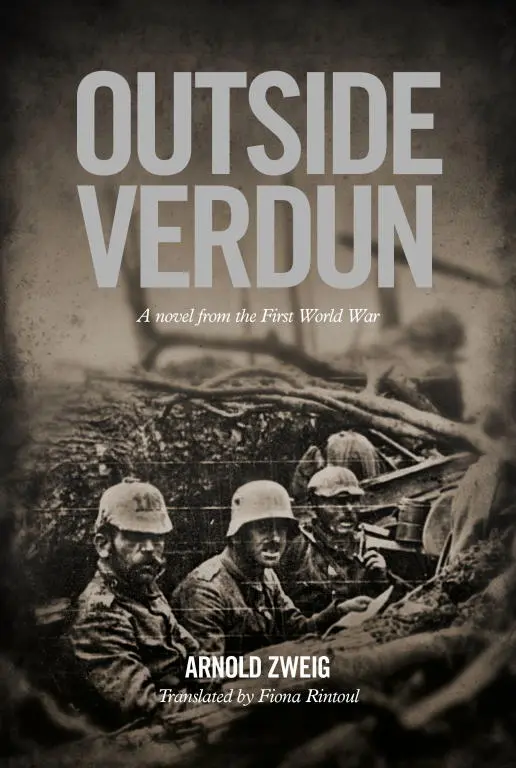
Арнольд Цвейг - Outside Verdun
Здесь есть возможность читать онлайн «Арнольд Цвейг - Outside Verdun» весь текст электронной книги совершенно бесплатно (целиком полную версию без сокращений). В некоторых случаях можно слушать аудио, скачать через торрент в формате fb2 и присутствует краткое содержание. Город: Glasgow, Год выпуска: 2014, ISBN: 2014, Издательство: Freight Books, Жанр: Историческая проза, prose_military, на английском языке. Описание произведения, (предисловие) а так же отзывы посетителей доступны на портале библиотеки ЛибКат.
- Название:Outside Verdun
- Автор:
- Издательство:Freight Books
- Жанр:
- Год:2014
- Город:Glasgow
- ISBN:978-1-908754-52-3
- Рейтинг книги:3 / 5. Голосов: 1
-
Избранное:Добавить в избранное
- Отзывы:
-
Ваша оценка:
Outside Verdun: краткое содержание, описание и аннотация
Предлагаем к чтению аннотацию, описание, краткое содержание или предисловие (зависит от того, что написал сам автор книги «Outside Verdun»). Если вы не нашли необходимую информацию о книге — напишите в комментариях, мы постараемся отыскать её.
“The war, an operation instigated by men, still felt to him like a storm decreed by fate, an unleashing of powerful elements, unaccountable and beyond criticism.”
Arnold Zweig’s novel was first published in 1933 and is based on his own experiences in the German army during World War I. Following the unlawful killing of his younger brother by his own superiors, Lieutenant Kroysing swears revenge, using his influence to arrange for his brother’s unit, normally safely behind the lines, to be reassigned to the fortress at Douaument, in the very heart of the battle for France. Bertin, a lowly but educated Jewish sapper through whose eyes the story unfolds, is the innocent man caught in the cross-fire.
The book not only explores the heart-breaking tragedy of one individual trapped in a nightmare of industrialized warfare but also reveals the iniquities of German society in microcosm, with all its injustice, brutality, anti-Semitism, and incompetence. A brilliant translation captures all the subtleties, cadences, and detachment of Zweig’s masterful prose.
Outside Verdun — читать онлайн бесплатно полную книгу (весь текст) целиком
Ниже представлен текст книги, разбитый по страницам. Система сохранения места последней прочитанной страницы, позволяет с удобством читать онлайн бесплатно книгу «Outside Verdun», без необходимости каждый раз заново искать на чём Вы остановились. Поставьте закладку, и сможете в любой момент перейти на страницу, на которой закончили чтение.
Интервал:
Закладка:
‘It’s all very sad,’ he said to Bertin, ‘but what can you do? We were obviously meant to smoke Willy the Eldest’s cigarettes.’ And he sat down on the bunk next to where Bertin was lying, pulled out the iron box inscribed on the back with ‘Fifth Army, Christmas 1916’, awarded himself a cigarette and adeptly removed the portrait of the crown prince from its embossed setting with his new pocket knife. It was easily done. ‘It looks better without it,’ he said. ‘Where all is love, Don Carlos cannot hate,’ he added. He didn’t know where the lines were from, but Bertin recognised them as Schiller’s Don Carlos . ‘Listen to the peace and goodwill outside,’ he supplied.
Outside the guns were thundering. It was Christmas night, an emotional time for the Germans, but they thought they’d best dilute such indulgent emotions with a dose of virile brutality. The German guns distributed steel Christmas presents, and the French replied in kind. Peace on Earth, sang the gospel. War on Earth, thundered reality. And so it went on as the year lurched to a close. Under beetle-brow heavens the wind blew ever colder, and weather pundits predicted frosts from the east, heavy cloud and starless nights. When Private Bertin took his evening stroll before bedtime and looked up at the sky with his myopic eyes, he could find no hope of an early peace reflected there no matter how hard he tried. In a couple of days they’d be writing 1917. The war was approaching its fourth year. He’d heard nothing further from Kroysing or about his Iron Cross from Lieutenant von Roggstroh – only depressing news from his wife and parents. There was no pleasure in living any more or in being a soldier. It was just a question of getting through, of curling up into a small, ugly ball in the hope of going unnoticed. Shoulders bent, he made his way back to the refuge of his comrades. Human warmth still came free.
CHAPTER FIVE
Professor Mertens resigns
A SNOWLESS NEW YEAR’S EVE afternoon, short and bleak, weighed on the streets of Montmédy. The French prepared for the celebrations and did their shopping furtively and without pleasure, making the bustle in the officers’ messes and soldiers’ billets seem all the more cheerful. Candles would burn once more on the Christmas trees from the Argonne, a great deal of diluted alcohol would be served and men would sit round tables singing stirring, sentimental songs. The year 1916 must be brought to a close befitting the heroic status it was sure to enjoy in the annals of the German nation.
That’s what was going through Sergeant Porisch’s mind, as he stood in his braided Litevka looking down with almost maternal concern on the gaunt, lined face of his superior. The judge advocate lay on the sofa with a blanket pulled up round his chin, and as Porisch took his leave of him with a file of papers under his arm, he said: ‘Can I help you with anything else, Judge?’
‘Yes, Porisch, you can. Please give my excuses for tonight to the officers’ mess. I’d just be in the way. And I’d be grateful if the doctor, Herr Koschmieder, would look in on me again tomorrow about noon after everyone has slept it off.’
Porisch nodded, satisfied. He almost congratulated his superior on his sensible behaviour. Instead he tapped the orange folder on the table. ‘Should I take this away with me?’
‘Leave it there, Porisch. I may have another look. Will there be much gunfire at midnight?’
Porisch blew out his cheeks. ‘The inspector general has expressly forbidden it, because it’s a waste of ammunition, but if I know the Bavarians they’ll fire a few blank cartridges. After all, it’s their custom, and you can’t change people with an order.’
Mertens closed his eyes in silent agreement, then he looked up at his subordinate, pulled his arm out from under the blanket and gave him his hand. ‘Quite right, Porisch. People don’t change or if they do it’s so slow the likes of us can’t wait that long. In any case, thank you for your help and I wish you as good a New Year as possible under the circumstances.’
Porisch thanked him, feeling almost moved, returned his good wishes and left. Afterwards, he’d maintain he could still feel Mertens’ small-boned scholarly hand in his great mitt years later.
As the door clicked shut behind Porisch, Mertens breathed a sigh of relief and his dark-ringed eyes lit up for a moment. Porisch was a decent man who meant well, but he was a human being, and Professor Mertens had had enough of that species. That particular animal’s flat, flesh-coloured face with its holes leading behind the mask to the inside gave him the creeps: the mouth cavity, the nose vents, the wedge-shaped depths from which the eyes stared – to say nothing of the ears, receivers of noise but never of understanding. It was a wretched thing when a man had so completely lost respect for his own species that he no longer saw any point in life – his own or other people’s. What was he to do then?
A new year was beginning – what a gruesome prospect. He’d seen in 1914 and 1915 in an orderly manner with his Landwehr company in northern Poland, surrounded by sparkling snow, full of hope for an early peace, believing in a vastly improved post-war Europe. The following year he’d been home on leave, and there had been much solemn debate over punch and pancakes in the quiet, candlelit home of Herr Stahr, a king’s counsel and his father’s last surviving boyhood friend. The house had already experienced death, as the youngest son had just been killed. And the composure with which the family bore their pain, the dignity they drew from their terrible loss, afforded a glimpse of the enormous obligation the heroic deaths of this generation of young men would place on those left behind. ‘So many noble dead dug into the foundations of this new Reich,’ said the tipsy, white-haired old man as the New Year bells rang out from the cathedral, the Memorial church, St Matthew’s and St Ludwig’s – all the churches of western Berlin. ‘They’ll have a job proving themselves worthy of it.’ And they drank to the freer, less prejudiced Germany they were sure would be the reward for the terrible sacrifices the nation had made. And Professor Mertens had believed it all.
He shivered and pulled his father’s long-fringed travel rug back up under his chin. The deep green hues of the soft Scottish wool merged with the sleepy cosiness of the twilit room. He no longer had beliefs or hopes. During the past year, all his illusions had been shattered; the whole beautiful sham, so wonderfully embellished by poets and so pitilessly blasted by the philosopher Schopenhauer, to reveal the agonised world underneath, was gone. If Schopenhauer himself, son of a Danzig salesman, hadn’t been such a nagging old woman, filled with unbridled hate of everything he was not, he could have been a great source of comfort. As it was, he was no use to anyone; his gifts sparkled and faded into the night like the fireworks the Bavarians lit on New Year’s Eve, and his wonderful phrases left nothing behind but emptiness and the desolate night.
Mertens sat up. His eyes, seeking the light switch, glided over the orange folder, a splash of light on the black table. His eyelids twitched, and there was an unpleasant taste in his mouth. He sank back. It was that business there that had started it all. The pathetic little case of Sergeant Kroysing had been the catalyst, a minor catalyst but enough for someone like Mertens, who perhaps already harboured concerns. But now it wasn’t about individual cases. Man’s whole dubious existence stood ready to be sentenced before the spiritual jury of a man who, guided by his father, had spent his first four decades searching for truth and justice. Things had become so bad that he couldn’t hear certain words without coughing and feeling sick, above all the German word for nation: Volk . If you said the word Volk over and over to yourself – Volk, Volk, follow, follow, follow – you ended up with nothing but herds following. You should follow, you must follow, and never mind whom. Aristotle had known that, and Plato had known it even better. People were zoon politikon , political animals: what else could that definition mean but that they were condemned forever to wretched dependency? Except that for the two Greeks and their scholars in Europe this fact of nature laid a great moral imperative upon individuals and intellectuals to improve this deplorable state of affairs, to create balance through wisdom and insight, to convert and reform humanity through moral duty and kindness, patience and self-control. Churches and intellectuals worldwide had ceaselessly tried to fulfil this duty since the renaissance of reason in the Italy of Lorenzo the Magnificent, triggering religions, reformations, revolutions – with the result that in this war the pinnacle of our development had become blindingly clear. The spirit of Europe was prancing about in uniforms, and there were only nations, peoples, Völker, standing there in the scarlet, black and white of their sacred egomanias, and civilisation served at best as a technology for killing, a means of whitewashing, as a phrase to justify the conquering zeal that had rendered the world too small for Alexander the Great. At least the Romans had paid for their conquests with a paltry 500 years of peace and a world civilisation. How would they pay? With goods and lies.
Читать дальшеИнтервал:
Закладка:
Похожие книги на «Outside Verdun»
Представляем Вашему вниманию похожие книги на «Outside Verdun» списком для выбора. Мы отобрали схожую по названию и смыслу литературу в надежде предоставить читателям больше вариантов отыскать новые, интересные, ещё непрочитанные произведения.








Обсуждение, отзывы о книге «Outside Verdun» и просто собственные мнения читателей. Оставьте ваши комментарии, напишите, что Вы думаете о произведении, его смысле или главных героях. Укажите что конкретно понравилось, а что нет, и почему Вы так считаете.