Michael Shaara - The Killer Angels
Здесь есть возможность читать онлайн «Michael Shaara - The Killer Angels» весь текст электронной книги совершенно бесплатно (целиком полную версию без сокращений). В некоторых случаях можно слушать аудио, скачать через торрент в формате fb2 и присутствует краткое содержание. Жанр: Историческая проза, на английском языке. Описание произведения, (предисловие) а так же отзывы посетителей доступны на портале библиотеки ЛибКат.
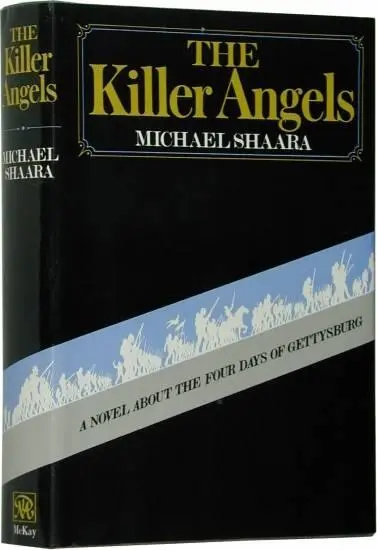
- Название:The Killer Angels
- Автор:
- Жанр:
- Год:неизвестен
- ISBN:нет данных
- Рейтинг книги:5 / 5. Голосов: 1
-
Избранное:Добавить в избранное
- Отзывы:
-
Ваша оценка:
The Killer Angels: краткое содержание, описание и аннотация
Предлагаем к чтению аннотацию, описание, краткое содержание или предисловие (зависит от того, что написал сам автор книги «The Killer Angels»). Если вы не нашли необходимую информацию о книге — напишите в комментариях, мы постараемся отыскать её.
Reading about the past is rarely so much fun as on these pages.
The Killer Angels — читать онлайн бесплатно полную книгу (весь текст) целиком
Ниже представлен текст книги, разбитый по страницам. Система сохранения места последней прочитанной страницы, позволяет с удобством читать онлайн бесплатно книгу «The Killer Angels», без необходимости каждый раз заново искать на чём Вы остановились. Поставьте закладку, и сможете в любой момент перейти на страницу, на которой закончили чтение.
Интервал:
Закладка:
”Colonel, tell your men. General McClellan has assumed command of the army.”
Chamberlain did not have to spread the word. It went down the ranks like a wind in wheat. Some of the men cheered hoarsely. One man fired a rifle, and then Tozier talked to him. For a long moment Chamberlain believed it.
McClellan was back. God bless old Lincoln. The only general of the whole mess who knew what he was doing.
But then the troops moved on and the moon went behind a cloud and Chamberlain knew that it could not be true.
But the men marched believing they were behind McClellan. He was the only general Chamberlain had ever seen who was truly loved. The Rebs loved Lee, no doubt of that.
And we loved Mac. Chamberlain thought: two things an officer must do, to lead men. This from old Ames, who never cared about love: You must care for your men’s welfare. You must show physical courage.
Well, Chamberlain thought, there’s no McClellan.
There’s only Meade, whom none of these people know, let alone like, and he’ll be cautious. So I’ve taken care, as best I can, of their welfare. Now tomorrow we’ll see about the courage.
Now there were the wounded, the stragglers. Men limped back, sat out in the fields making fires, sulked along eastward, out in the dark. Now there were rumors: a terrible defeat, someone had blundered, two hundred thousand Rebs, the Eleventh Corps had deserted. Chamberlain ordered his men to close up and keep moving and not to talk. Damn the rumors. You never knew what was true until days or weeks or even months afterwards. He called close up, close up, first order he had given since morning, and then shortly after that the order came to stop, at last.
It was almost midnight. There were clouds again and it was very dark, but Chamberlain could see a hill in front of him and masses of troops and tents ahead. The Twentieth Maine went off the road and most went to sleep without fires, some without pitching tents, for the night was warm and without a wind. Chamberlain asked a passing courier: how far to Gettysburg? and the man pointed back over his shoulder. You’re there, Colonel, you’re there.
Chamberlain lay down to rest. It was just after midnight.
He wondered if McClellan would really be back. He prayed for a leader. For his boys.
5. LONGSTREET.
He rode out of Gettysburg just after dark. His headquarters were back on the Cashtown Road, and so he rode back over the battlefield of the day. His staff recognized his mood and left him discreetly alone. He was riding slumped forward, head down, hat over his eyes. One by one they left him, moving ahead, cheering up when they were out of his company. He passed a hospital wagon, saw mounded limbs glowing whitely in the dark, a pile of legs, another of arms. It looked like masses of fat white spiders.
He stopped in the road and lighted a cigar, looking around him at the tents and the wagons, listening to the rumble and music of the army in the night. There were a few groans, dead sounds from dying earth, most of them soft and low.
There was a fire far off, a large fire in a grove of trees, men outlined against a great glare; a band was playing something discordant, unrecognizable. A dog passed him, trotted through the light of an open tent flap, paused, looked, inspected the ground, padded silently into the dark. Fragments of cloth, trees, chewed bits of paper littered the road.
Longstreet took it all in, began to move on. He passed a black mound which seemed strange in the dark: lumpy, misshapen. He rode over and saw: dead horses. He rode away from the field, toward higher ground.
Lee would attack in the morning. Clear enough. Time and place not yet set. But he will attack. Fixed and unturnable, a runaway horse. Longstreet felt a depression so profound it deadened him. Gazing back on that black hill above Gettysburg, that high lighted hill already speckled with fires among the gravestones, he smelled disaster like distant rain.
It was Longstreet’s curse to see the thing clearly. He was a brilliant man who was slow in speech and slow to move and silent-faced as stone. He had not the power to convince.
He sat on the horse, turning his mind away, willing it away as a gun barrel swivels, and then he thought of his children, powerless to stop that vision. It blossomed: a black picture.
She stood in the doorway: the boy is dead. She didn’t even say his name. She didn’t even cry.
Longstreet took a long deep breath. In the winter the fever had come to Richmond. In a week they were dead. All within a week, all three. He saw the sweet faces: moment of enormous pain. The thing had pushed him out of his mind, insane, but no one knew it. They looked at the plain blunt stubborn face and saw nothing but dull Dutch eyes, the great darkness, the silence. He had not thought God would do a thing like that. He went to church and asked and there was no answer. He got down on his knees and pleaded but there was no answer. She kept standing in the door: the boy is dead. And he could not even help her, could say nothing, could not move, could not even take her into his arms.
Nothing to give. One strength he did not have. Oh God: my boy is dead.
He had tears in his eyes. Turn away from that. He mastered it. What he had left was the army. The boys were here. He even had the father, in place of God: old Robert Lee. Rest with that, abide with that.
His aides were all gone, all but two. Goree hung back from him in the growing dark. He rode on alone, silently, Goree trailing like a hunting dog, and met one of his surgeons coming up from camp: J. S. D. Cullen, delighted, having heard of the great victory, and Longstreet succeeded in depressing him, and Cullen departed. Longstreet lectured himself: depression is contagious; keep it to yourself. He needed something to cheer him, turned to two men behind him, found there was only one, not an aide, the Englishman: Fremantle. Exactly what he needed. Longstreet drew up to wait.
The Englishman came pleasantly, slowly forward. He was the kind of breezy, cheery man who brings humor with his presence. He was wearing the same tall gray hat and the remarkable coat. He said cheerily, tapping the great hat, “Don’t mean to intrude upon your thoughts. General.”
”Not Tall,” Longstreet said.
”Really, sir, if you’d rather ride alone…”
”Good to see you,” Longstreet said.
The Englishman rode up grinning broadly through widely spaced teeth. He had entered the country by way of Mexico, riding in a wagon drawn by a tobacco-chewing man who had turned out to be, in his spare time, the local judge, Fremantle had seen many interesting things: a casual hanging, raw floods, great fires. He was continually amazed at the combination of raw earth and rough people, white columned houses and traces of English manner. He had not gotten used to the crude habit of shaking hands, which was common among these people, but he forced himself. He was enjoying himself hugely. He had not changed his clothes in some days and he looked delightfully disreputable, yet mannered and cool and light in the saddle.
Longstreet grinned again. “Did you get a chance to see anything?”
”Well as a matter of fact I did. I found rather a large tree and Lawley and I sat out in the open and there was quite a show. Lovely, oh lovely.”
”You didn’t happen to see a cavalry charge?” Stuart: not yet returned.
”Not a one,” Fremantle gloomed. “Nor a hollow square. You know, sir, we really ought to discuss that at length on some occasion. Provided this war lasts long enough, which most people seem to think it won’t. You fellows seem to do well enough without it, I must say. But still, one likes to feel a certain security in these matters, which the square gives, do you see? One likes to know, that is, where everyone is, at given moments. Ah, but then-“ he took a deep breath, tapped his chest-“there’s always tomorrow. I gather you expect a bit of an adventure tomorrow.”
Читать дальшеИнтервал:
Закладка:
Похожие книги на «The Killer Angels»
Представляем Вашему вниманию похожие книги на «The Killer Angels» списком для выбора. Мы отобрали схожую по названию и смыслу литературу в надежде предоставить читателям больше вариантов отыскать новые, интересные, ещё непрочитанные произведения.






Обсуждение, отзывы о книге «The Killer Angels» и просто собственные мнения читателей. Оставьте ваши комментарии, напишите, что Вы думаете о произведении, его смысле или главных героях. Укажите что конкретно понравилось, а что нет, и почему Вы так считаете.