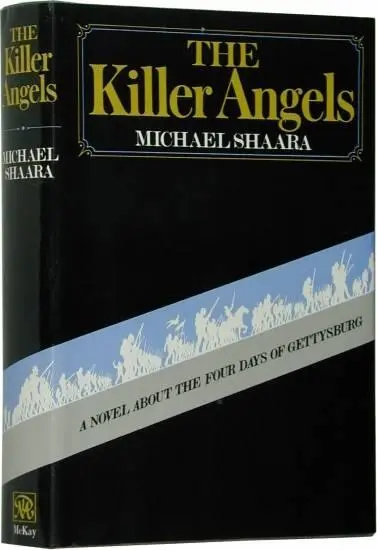
Michael Shaara - The Killer Angels
Здесь есть возможность читать онлайн «Michael Shaara - The Killer Angels» весь текст электронной книги совершенно бесплатно (целиком полную версию без сокращений). В некоторых случаях можно слушать аудио, скачать через торрент в формате fb2 и присутствует краткое содержание. Жанр: Историческая проза, на английском языке. Описание произведения, (предисловие) а так же отзывы посетителей доступны на портале библиотеки ЛибКат.
- Название:The Killer Angels
- Автор:
- Жанр:
- Год:неизвестен
- ISBN:нет данных
- Рейтинг книги:5 / 5. Голосов: 1
-
Избранное:Добавить в избранное
- Отзывы:
-
Ваша оценка:
The Killer Angels: краткое содержание, описание и аннотация
Предлагаем к чтению аннотацию, описание, краткое содержание или предисловие (зависит от того, что написал сам автор книги «The Killer Angels»). Если вы не нашли необходимую информацию о книге — напишите в комментариях, мы постараемся отыскать её.
Reading about the past is rarely so much fun as on these pages.
The Killer Angels — читать онлайн бесплатно полную книгу (весь текст) целиком
Ниже представлен текст книги, разбитый по страницам. Система сохранения места последней прочитанной страницы, позволяет с удобством читать онлайн бесплатно книгу «The Killer Angels», без необходимости каждый раз заново искать на чём Вы остановились. Поставьте закладку, и сможете в любой момент перейти на страницу, на которой закончили чтение.
Интервал:
Закладка:
He swung to Heth. “General, you may attack.”
To Pender he said the same. He gave no further directions. The generals would know what to do now. With that word it was out of his hands. It had never really been in his hands at all. And yet his was the responsibility.
He rode forward to the rise ahead, across the small creek.
Now he had a clearer view. Pender’s Division was on the move; he heard the great scream of the massed Rebel yells.
Now batteries were in position behind him, beginning to open up on the woods near the cupola. Lee ducked his head as the shot whickered over him. He did not like to stand in front of artillery. Some of the artillery was moving forward.
Rifle fire was breaking out. The wind shifted; he was enveloped in smoke. Marshall ’s face appeared, an incoherent message. Lee tried to find some place to watch the assault. Pender’s whole force was streaming forward across the fields, into the woods. Lee saw flags floating through white smoke, disembodied, like walking sticks. Shell bursts were appearing in the air, white flakes, round puffs. One blossomed near. There was Marshall again. Lee heard fragments split the air near him. He moved into a grove of trees: oak, chestnut. There was a white house nearby, a white rail fence, a dead horse lying in a black mound in the sun.
He waited in the grove, listening to the enormous sound of war. Eventually he sat, resting himself against the bole of a tree. It was dark and cool back in here out of the sun. Men were dying up ahead. He took off his hat, ran his fingers through his hair, felt his life beating in his chest. The fight went on. Lee thought for the first time that day of his son.
Rooney, wounded, lying not far from here. He closed his eyes, prayed for his boy, for all of them. He put his hand down on black dirt, was reminded: Pennsylvania. I am the invader.
Once more the Rebel yell-inhuman screaming of the onrushing dead. Another unit was going. He rose and went forward, trying to see, but no point in that. There was too much smoke. Yet it might help if he was seen. He moved up out of the grove of trees, onto the road. The road ahead was crowded with wounded. There were men lying under wagons, out of the sun, most of them semi-naked, covered with bandages, blood. He saw another dead horse, a splintered wagon; the severed forefoot of a horse lay near him in gray dust. Smoke was pouring down the road as from a great furnace. He moved forward; his staff followed him.
Here was A. P. Hill.
Hill said, white-faced, “Very hard going. Heth is down.”
Lee looked at him, waiting.
”Wounded in the head. I don’t know how serious. But the Division is moving. Pender is on the flank. But the Yankees are fighting well. I don’t recall them fighting this well before.”
Hill seemed peculiarly calm, vacant, as if he was not wholly present. He was a handsome man who had a great deal of money but was not “society” and was overly aware of it and very touchy about it.
Lee said, “Let me know General Heth’s condition as soon as possible.”
Lee sat down against a rail fence. A band came by, playing an incoherent song, fifes and bugles. The sky was overcast with blowing white smoke, the smell of hot guns, of blasted earth, the sweet smell of splintery trees. Lee was in the way, in the road; men were gathering around him, calling to him. He saw a house, an empty front porch. He moved toward that way and stared down toward the smoke.
Firing was intense. He sent couriers to Early and Rodes to advise them of his new headquarters and to ask for progress.
He had no idea of the whereabouts of Ewell, who was supposed to be in command over there and who probably knew less of what was happening than Lee did. Longstreet was right: command was too loose. But no time for that now.
A courier from Early: The enemy was falling back. Lee could hear an officer near him erupt in a high scream.
”They’re runnin’. Great God Amighty, they’re runnin’!”
Lee looked down the smoky street, saw a man helping another man along the road, saw masses of men moving vaguely through a field, saw flashes of artillery. The fire seemed to be slowing down. There were many men yelling.
A lieutenant came down the road, pointing back toward the smoke, yelling wildly that someone was hurt.
A. P. Hill said, at Lee’s elbow, “General Heth’s surgeon has examined him, sir. He says he ought to be all right, but he will be out of action for a while.”
”Where is he?”
”In a house over this way.” Hill pointed.
”You will take good care of him, of course. And, General, see to yourself. You can do no more good now. I want you to rest.”
Hill said softly, calmly, vacantly, “I’m fine. General, just fine.”
But he looked as if he were about to faint. Lee was thinking: if Longstreet were only here. How many in the Union Army? If the First Corps is here and the Eleventh, the rest must not be far behind. He heard more men yelling. In the street he saw officers waving their hats, grinning enormous grins. Victory? A rider came up, from Pender. A young man with a marvelous wide mustache said, “General Pender begs to report the enemy is falling back.” Officers threw hats in the air. Lee smiled, could not be heard. One man touched him, another patted his back. He raised his glasses and looked to the clearing smoke.
He turned to Marshall. “I’ll go forward.”
Traveler was at the rail outside. Lee mounted and rode.
Men were cheering him now, touching the horse as he went by. He tried to control his face. The wounded were everywhere. Some of them were Union boys, looking at him insensibly as he went by. A courier from Early: a rout on the left flank. The Union Eleventh Corps was running. More cheers. Lee closed his eyes once briefly. God’s will. My trust in Thee. Oh Lord, bless You and thank You.
He moved forward to the rise ahead, across a small creek.
Taylor said, “This must be Willoughby Run.” Lee halted at the crest. Now he could see; the land lay before him wreathed in smoky ridges. Half a mile away lay the town, white board buildings, dirt roads. Beyond it was a high hill that rose above a series of ridges running off to the east.
Blue troops were pouring back through the town, moving up the sides of the hill. The couriers were right: they were retreating. Victory. Lee put his glasses to his eyes, felt his hands tremble, focused, saw: Union artillery forming on the high hill, men digging. The fight was not over. Must not let those men occupy the high ground. Lee turned. To Taylor he said, “Find Hill’s chief of artillery, tell him I want fire placed on that hill. I don’t want it occupied. What word do you have from Ewell? And send General Hill to me.”
Taylor moved off. Lee was thinking: we must continue the assault. The blue troops are on the move; now we must keep them moving. But Heth is down. He looked for Pender’s courier, informed him to tell General Pender to continue the assault. But Early and Rodes were closer, on the left. If they only kept moving. The guns on the high hill were beginning to fire.
Here was Powell Hill, looking worse. He said, “The men have done all they can do. Heth’s division is exhausted.
Pender says he has had the hardest fighting of the war.”
Lee studied him, looked away, back to the hill above Gettysburg. Hill may be sick but Pender was trustworthy. If Pender had doubts…
Taylor arrived. “General Ewell is with General Early, sir.
We are in communication.”
”Good,” Lee said. “Deliver this message in person.
Tell General Ewell the Federal troops are retreating in confusion. It is only necessary to push those people to get possession of those heights. Of course, I do not know his situation, and I do not want him to engage a superior force, but I do want him to take that hill, if he thinks practicable, as soon as possible. Remind him that Longstreet is not yet up.”
Читать дальшеИнтервал:
Закладка:
Похожие книги на «The Killer Angels»
Представляем Вашему вниманию похожие книги на «The Killer Angels» списком для выбора. Мы отобрали схожую по названию и смыслу литературу в надежде предоставить читателям больше вариантов отыскать новые, интересные, ещё непрочитанные произведения.






Обсуждение, отзывы о книге «The Killer Angels» и просто собственные мнения читателей. Оставьте ваши комментарии, напишите, что Вы думаете о произведении, его смысле или главных героях. Укажите что конкретно понравилось, а что нет, и почему Вы так считаете.