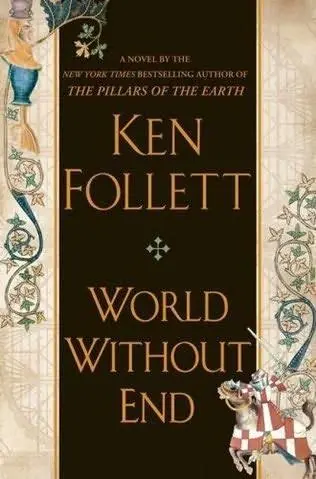
Ken Follett - World Without End
Здесь есть возможность читать онлайн «Ken Follett - World Without End» весь текст электронной книги совершенно бесплатно (целиком полную версию без сокращений). В некоторых случаях можно слушать аудио, скачать через торрент в формате fb2 и присутствует краткое содержание. Жанр: Историческая проза, на английском языке. Описание произведения, (предисловие) а так же отзывы посетителей доступны на портале библиотеки ЛибКат.
- Название:World Without End
- Автор:
- Жанр:
- Год:неизвестен
- ISBN:нет данных
- Рейтинг книги:5 / 5. Голосов: 1
-
Избранное:Добавить в избранное
- Отзывы:
-
Ваша оценка:
World Without End: краткое содержание, описание и аннотация
Предлагаем к чтению аннотацию, описание, краткое содержание или предисловие (зависит от того, что написал сам автор книги «World Without End»). Если вы не нашли необходимую информацию о книге — напишите в комментариях, мы постараемся отыскать её.
Ken Follett has 90 million readers worldwide. The Pillars of the Earth is his bestselling book of all time. Now, eighteen years after the publication of The Pillars of the Earth, Ken Follett has written the most-anticipated sequel of the year, World Without End.
In 1989 Ken Follett astonished the literary world with The Pillars of the Earth, a sweeping epic novel set in twelfth-century England centered on the building of a cathedral and many of the hundreds of lives it affected. Critics were overwhelmed-"it will hold you, fascinate you, surround you" (Chicago Tribune)-and readers everywhere hoped for a sequel.
World Without End takes place in the same town of Kingsbridge, two centuries after the townspeople finished building the exquisite Gothic cathedral that was at the heart of The Pillars of the Earth. The cathedral and the priory are again at the center of a web of love and hate, greed and pride, ambition and revenge, but this sequel stands on its own. This time the men and women of an extraordinary cast of characters find themselves at a crossroad of new ideas-about medicine, commerce, architecture, and justice. In a world where proponents of the old ways fiercely battle those with progressive minds, the intrigue and tension quickly reach a boiling point against the devastating backdrop of the greatest natural disaster ever to strike the human race-the Black Death.
Three years in the writing, and nearly eighteen years since its predecessor, World Without End breathes new life into the epic historical novel and once again shows that Ken Follett is a masterful author writing at the top of his craft.
World Without End — читать онлайн бесплатно полную книгу (весь текст) целиком
Ниже представлен текст книги, разбитый по страницам. Система сохранения места последней прочитанной страницы, позволяет с удобством читать онлайн бесплатно книгу «World Without End», без необходимости каждый раз заново искать на чём Вы остановились. Поставьте закладку, и сможете в любой момент перейти на страницу, на которой закончили чтение.
Интервал:
Закладка:
“I disagree. You haven’t heard it yet.”
“All right, what is it?”
“Sir Ralph says Wulfric is to have his father’s lands back.”
Wulfric leaped to his feet. “As a tenant?” he said. “Not just to labour on?”
“As a tenant, on the same terms as your father,” said Nate expansively, as if he were making the concession himself, rather than simply passing on a message.
Wulfric beamed with joy. “That’s wonderful!”
“Do you accept?” Nate said jovially, as if it were a mere formality.
Gwenda said: “Wulfric! Don’t accept!”
He looked at her, bewildered. As usual, he was slow to see beyond the immediate.
“Discuss the terms!” she urged him in a low voice. “Don’t be a serf like your father. Demand a free tenancy, with no feudal obligations. You’ll never be in such a strong bargaining position again. Negotiate!”
“Negotiate?” he said. He wavered briefly, then gave in to the happiness of the occasion. “This is the moment I’ve been hoping for for the last twelve years. I’m not going to negotiate.” He turned to Nate. “I accept,” he said, and held up his cup.
They all cheered.
70
The hospital was full again. The plague, which had seemed to retreat during the first three months of 1349, came back in April with redoubled virulence. On the day after Easter Sunday, Caris looked wearily at the rows of mattresses crammed together in a herringbone pattern, packed so tightly that the masked nuns had to step gingerly between them. Moving around was a little easier, however, because there were so few family members at the bedsides of the sick. Sitting with a dying relative was dangerous – you were likely to catch the plague yourself – and people had become ruthless. When the epidemic began, they had stayed with their loved ones regardless, mothers with children, husbands with wives, the middle-aged with their elderly parents, love overcoming fear. But that had changed. The most powerful of family ties had been viciously corroded by the acid of death. Nowadays the typical patient was brought in by a mother or father, a husband or wife, who then simply walked away, ignoring the piteous cries that followed them out. Only the nuns, with their face masks and their vinegar-washed hands, defied the disease.
Surprisingly, Caris was not short of help. The nunnery had enjoyed an influx of novices to replace the nuns who had died. This was partly because of Caris’s saintly reputation. But the monastery was experiencing the same kind of revival, and Thomas now had a class of novice monks to train. They were all searching for order in a world gone mad.
This time the plague had struck some leading townspeople who had previously escaped. Caris was dismayed by the death of John Constable. She had never much liked his rough-and-ready approach to justice – which was to hit troublemakers over the head with a stick and ask questions afterwards – but it was going to be more difficult to maintain order without him. Fat Betty Baxter, baker of special buns for every town festivity, shrewd questioner at parish guild meetings, was dead, her business awkwardly shared out between four squabbling daughters. And Dick Brewer had died, the last of Caris’s father’s generation, a cohort of men who knew how to make money and how to enjoy it.
Caris and Merthin had been able to slow the spread of the disease by cancelling major public gatherings. There had been no big Easter procession in the cathedral, and there would be no Fleece Fair this Whitsun. The weekly market was held outside the city walls, in Lovers’ Field, and most townspeople stayed away. Caris had wanted such measures when the plague first struck, but Godwyn and Elfric had opposed her. According to Merthin, some Italian cities had even closed their gates for a period of thirty or forty days, called a trentine or a quarantine. It was now too late to keep the disease out, but Caris still thought restrictions would save lives.
One problem she did not have was money. More and more people bequeathed their wealth to the nuns, having no surviving relatives, and many of the new novices brought with them lands, flocks, orchards and gold. The nunnery had never been so rich.
It was small consolation. For the first time in her life she felt tired – not just weary from hard work, but drained of energy, short of will power, enfeebled by adversity. The plague was worse than ever, killing two hundred people a week, and she did not know how she was going to carry on. Her muscles ached, her head hurt, and sometimes her vision seemed to blur. Where would it end, she wondered dismally. Would everyone die?
Two men staggered in through the door, both bleeding. Caris hurried forward. Before she got within touching distance she picked up the sweetly rotten smell of drink on them. They were both nearly helpless, although it was not yet dinner time. She groaned in frustration: this was all too common.
She knew the men vaguely: Barney and Lou, two strong youngsters employed in the abattoir owned by Edward Slaughterhouse. Barney had one arm hanging limp, possibly broken. Lou had a dreadful injury to his face: his nose was crushed and one eye was a ghastly pulp. Both seemed too drunk to feel pain. “It was a fight,” Barney slurred, his words only just comprehensible. “I didn’t mean it. He’s my best friend. I love him.”
Caris and Sister Nellie got the two drunks lying down on adjacent mattresses. Nellie examined Barney and said his arm was not broken but dislocated, and sent a novice to fetch Matthew Barber, the surgeon, who would try to relocate it. Caris bathed Lou’s face. There was nothing she could do to save his eye: it had burst like a soft-boiled egg.
This kind of thing made her furious. The two men were not suffering from a disease or an accidental injury: they had harmed one another while drinking to excess. After the first wave of the plague, she had managed to galvanize the townspeople into restoring law and order; but the second wave had done something terrible to people’s souls. When she called again for a return to civilized behaviour, the response had been apathetic. She did not know what to do next, and she felt so tired.
As she contemplated the two maimed men lying shoulder to shoulder on the floor, she heard a strange noise from outside. For an instant, she was transported back three years, to the battle of Crécy, and the terrifying booming sound made by King Edward’s new machines that shot stone balls into the enemy ranks. A moment later the noise came again and she realized it was a drum – several drums, in fact, being struck in no particular rhythm. Then she heard pipes and bells whose notes failed to form any kind of tune; then hoarse cries, wailing, and shouts that might have indicated triumph or agony, or both. It was not unlike the noise of battle, but without the swish of deadly arrows or the screams of maimed horses. Frowning, she went outside.
A group of forty or so people had come on to the cathedral green, dancing a mad antic jig. Some played on musical instruments, or rather sounded them, for there was no melody or harmony to the noise. Their flimsy light-coloured clothes were ripped and stained, and some were half naked, carelessly exposing the intimate parts of their bodies. All those who did not have instruments were carrying whips. A crowd of townspeople followed, staring in curiosity and amazement.
The dancers were led by Friar Murdo, fatter than ever but cavorting energetically, sweat pouring down his dirty face and dripping from his straggly beard. He led them to the great west door of the cathedral, where he turned to face them. “We have all sinned!” he roared.
His followers cried out in response, inarticulate shrieks and groans.
“We are dirt!” he said thrillingly. “We wallow in lasciviousness like pigs in filth. We yield, quivering with desire, to our fleshly lusts. We deserve the plague!”
Читать дальшеИнтервал:
Закладка:
Похожие книги на «World Without End»
Представляем Вашему вниманию похожие книги на «World Without End» списком для выбора. Мы отобрали схожую по названию и смыслу литературу в надежде предоставить читателям больше вариантов отыскать новые, интересные, ещё непрочитанные произведения.












Обсуждение, отзывы о книге «World Without End» и просто собственные мнения читателей. Оставьте ваши комментарии, напишите, что Вы думаете о произведении, его смысле или главных героях. Укажите что конкретно понравилось, а что нет, и почему Вы так считаете.