Ken Follett - World Without End
Здесь есть возможность читать онлайн «Ken Follett - World Without End» весь текст электронной книги совершенно бесплатно (целиком полную версию без сокращений). В некоторых случаях можно слушать аудио, скачать через торрент в формате fb2 и присутствует краткое содержание. Жанр: Историческая проза, на английском языке. Описание произведения, (предисловие) а так же отзывы посетителей доступны на портале библиотеки ЛибКат.
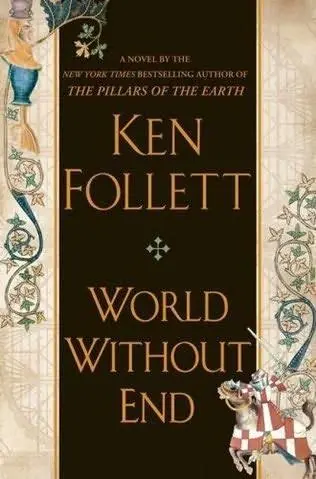
- Название:World Without End
- Автор:
- Жанр:
- Год:неизвестен
- ISBN:нет данных
- Рейтинг книги:5 / 5. Голосов: 1
-
Избранное:Добавить в избранное
- Отзывы:
-
Ваша оценка:
World Without End: краткое содержание, описание и аннотация
Предлагаем к чтению аннотацию, описание, краткое содержание или предисловие (зависит от того, что написал сам автор книги «World Without End»). Если вы не нашли необходимую информацию о книге — напишите в комментариях, мы постараемся отыскать её.
Ken Follett has 90 million readers worldwide. The Pillars of the Earth is his bestselling book of all time. Now, eighteen years after the publication of The Pillars of the Earth, Ken Follett has written the most-anticipated sequel of the year, World Without End.
In 1989 Ken Follett astonished the literary world with The Pillars of the Earth, a sweeping epic novel set in twelfth-century England centered on the building of a cathedral and many of the hundreds of lives it affected. Critics were overwhelmed-"it will hold you, fascinate you, surround you" (Chicago Tribune)-and readers everywhere hoped for a sequel.
World Without End takes place in the same town of Kingsbridge, two centuries after the townspeople finished building the exquisite Gothic cathedral that was at the heart of The Pillars of the Earth. The cathedral and the priory are again at the center of a web of love and hate, greed and pride, ambition and revenge, but this sequel stands on its own. This time the men and women of an extraordinary cast of characters find themselves at a crossroad of new ideas-about medicine, commerce, architecture, and justice. In a world where proponents of the old ways fiercely battle those with progressive minds, the intrigue and tension quickly reach a boiling point against the devastating backdrop of the greatest natural disaster ever to strike the human race-the Black Death.
Three years in the writing, and nearly eighteen years since its predecessor, World Without End breathes new life into the epic historical novel and once again shows that Ken Follett is a masterful author writing at the top of his craft.
World Without End — читать онлайн бесплатно полную книгу (весь текст) целиком
Ниже представлен текст книги, разбитый по страницам. Система сохранения места последней прочитанной страницы, позволяет с удобством читать онлайн бесплатно книгу «World Without End», без необходимости каждый раз заново искать на чём Вы остановились. Поставьте закладку, и сможете в любой момент перейти на страницу, на которой закончили чтение.
Интервал:
Закладка:
“I saw domes in Italy.”
“I can see how it would save money.”
“And the tower can be topped by a slender wooden spire, which will save money and look wonderful.”
“You’ve got this all worked out, haven’t you?”
“Not really. But it’s been at the back of my mind ever since I returned from Florence.”
“Well, it sounds good to me – good for business, good for the town.”
“And good for our eternal souls.”
“I’ll do my best to help you push it through.”
“Thank you.”
Merthin mulled over the design of the tower as he went about his more mundane work, repairing the bridge and building new houses on Leper Island. It helped turn his mind away from dreadful, obsessive visions of Caris ill with the plague. He thought a lot about the south tower at Chartres. It was a masterpiece, albeit a little old-fashioned, having been built about two hundred years ago.
What Merthin had liked about it, he recalled very clearly, was the transition from the square tower to the octagonal spire above. At the top of the tower, perched on each of the four corners, were pinnacles facing diagonally outwards. On the same level, at the midpoint of each side of the square, were dormer windows similar in shape to the pinnacles. These eight structures matched the eight sloping sides of the tower rising behind them, so that the eye hardly noticed the change of shape from square to octagon.
However, Chartres was unnecessarily chunky by the standards of the fourteenth century. Merthin’s tower would have slender columns and large window openings, to lighten the weight on the pillars below, and to reduce stress by allowing the wind to blow through.
He made his own tracing floor at his workshop on the island. He enjoyed himself planning the details, doubling and quadrupling the narrow lancets of the old cathedral to make the large windows of the new tower, updating the clusters of columns and the capitals.
He hesitated over the height. He had no way to calculate how high it had to be in order to be visible from Mudeford Crossing. That could be done only by trial and error. When he had finished the stone tower he would have to erect a temporary spire, then go to Mudeford on a clear day and determine whether it could be seen. The cathedral was built on elevated ground, and at Mudeford the road breasted a rise just before descending to the river crossing. His instinct told him that if he went a little higher than Chartres – say about four hundred feet – that would be sufficient.
The tower at Salisbury cathedral was four hundred and four feet high.
Merthin planned his to be four hundred and five.
While he was bent over the tracing floor, drawing the roof pinnacles, Bill Watkin appeared. “What do you think of this?” Merthin said to him. “Does it need a cross on top, to point to heaven? Or an angel, to watch over us?”
“Neither,” said Bill. “It’s not going to get built.”
Merthin stood up, holding a straight-edge in his left hand and a sharpened iron drawing-needle in his right. “What makes you say that?”
“I’ve had a visit from Brother Philemon. I thought I might as well let you know as soon as possible.”
“What did that snake have to say?”
“He pretended to be friendly. He wanted to give me a piece of advice for my own good. He said it wouldn’t be wise of me to support any plan for a tower designed by you.”
“Why not?”
“Because it would annoy Prior Godwyn, who was not going to approve your plans, regardless.”
Merthin could hardly be surprised. If Mark Webber had become alderman, the balance of power in the town would have changed, and Merthin might have won the commission to build the new tower. But Mark’s death meant the odds were against him. He had clung to hope, however, and now he felt the deep ache of heavy disappointment. “I suppose he’ll commission Elfric?”
“That was the implication.”
“Will he never learn?”
“When a man is proud, that counts for more than common sense.”
“Will the parish guild pay for a stumpy little tower designed by Elfric?”
“Probably. They may not get excited about it, but they’ll find the money. They are proud of their cathedral, despite everything.”
“Elfric’s incompetence almost cost them the bridge!” Merthin said indignantly.
“They know that.”
He allowed his wounded feelings to show. “If I hadn’t diagnosed the problem with the tower, it would have collapsed – and it might have brought down the entire cathedral.”
“They know that, too. But they’re not going to fight with the prior just because he’s treated you badly.”
“Of course not,” said Merthin, as if he thought that was perfectly reasonable; but he was hiding his bitterness. He had done more for Kingsbridge than Godwyn, and he was hurt that the townspeople had not put up more of a fight for him. But he also knew that most people most of the time acted in their own immediate self-interest.
“People are ungrateful,” Bill said. “I’m sorry.”
“Yes,” Merthin said. “That’s all right.” He looked at Bill, then looked away; and then he threw down his drawing implements and walked off.
During the pre-dawn service of Lauds, Caris was surprised to look down the nave and see a woman in the north aisle, on her knees, in front of a wall painting of Christ Risen. She had a candle by her side and, in its unsteady light, Caris made out the chunky body and jutting chin of Madge Webber.
Madge stayed there throughout the service, not paying any attention to the psalms, apparently deep in prayer. Perhaps she was asking God to forgive Mark’s sins and let him rest in peace – not that Mark had committed many sins, as far as Caris knew. More likely, Madge was asking Mark to send her good fortune from the spirit world. Madge was going to carry on the cloth business with the help of her two older children. It was the usual thing, when a trader died leaving a widow and a thriving enterprise. Still, no doubt she felt the need of her dead husband’s blessing on her efforts.
But this explanation did not quite satisfy Caris. There was something intense in Madge’s posture, something about her stillness that suggested great passion, as if she were begging heaven to grant her some terribly important boon.
When the service ended, and the monks and nuns began to file out, Caris broke away from the procession and walked through the vast gloom of the nave towards the candle’s glow.
Madge stood up at the sound of her footsteps. When she recognized Caris’s face, she spoke with a note of accusation. “Mark died of the plague, didn’t he?”
So that was it. “I think so,” said Caris.
“You didn’t tell me.”
“I’m not sure, and I didn’t want to frighten you – not to mention the whole town – on the basis of a guess.”
“I’ve heard it’s come to Bristol.”
So the townspeople had been talking about it. “And London,” Caris said. She had heard this from a pilgrim.
“What will happen to us all?”
Sorrow stabbed Caris like a pain in the heart. “I don’t know,” she lied.
“It spreads from one to another, I hear.”
“Many illnesses do.”
The aggression went out of Madge, and her face took on a pleading look that broke Caris’s heart. In a near-whisper she asked: “Will my children die?”
“Merthin’s wife got it,” Caris said. “She died, and so did all her family, but Merthin recovered, and Lolla didn’t catch it at all.”
“So my children will be all right?”
That was not what Caris had said. “They may be. Or some may catch it and others escape.”
That did not satisfy Madge. Like most patients, she wanted certainties, not possibilities. “What can I do to protect them?”
Читать дальшеИнтервал:
Закладка:
Похожие книги на «World Without End»
Представляем Вашему вниманию похожие книги на «World Without End» списком для выбора. Мы отобрали схожую по названию и смыслу литературу в надежде предоставить читателям больше вариантов отыскать новые, интересные, ещё непрочитанные произведения.







Обсуждение, отзывы о книге «World Without End» и просто собственные мнения читателей. Оставьте ваши комментарии, напишите, что Вы думаете о произведении, его смысле или главных героях. Укажите что конкретно понравилось, а что нет, и почему Вы так считаете.