Ken Follett - World Without End
Здесь есть возможность читать онлайн «Ken Follett - World Without End» весь текст электронной книги совершенно бесплатно (целиком полную версию без сокращений). В некоторых случаях можно слушать аудио, скачать через торрент в формате fb2 и присутствует краткое содержание. Жанр: Историческая проза, на английском языке. Описание произведения, (предисловие) а так же отзывы посетителей доступны на портале библиотеки ЛибКат.
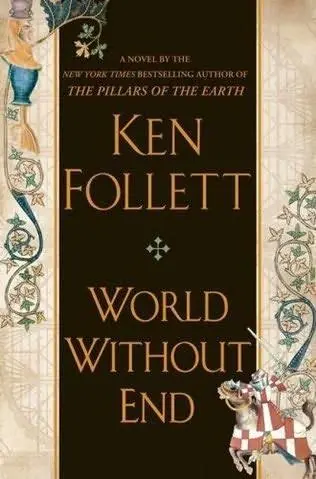
- Название:World Without End
- Автор:
- Жанр:
- Год:неизвестен
- ISBN:нет данных
- Рейтинг книги:5 / 5. Голосов: 1
-
Избранное:Добавить в избранное
- Отзывы:
-
Ваша оценка:
World Without End: краткое содержание, описание и аннотация
Предлагаем к чтению аннотацию, описание, краткое содержание или предисловие (зависит от того, что написал сам автор книги «World Without End»). Если вы не нашли необходимую информацию о книге — напишите в комментариях, мы постараемся отыскать её.
Ken Follett has 90 million readers worldwide. The Pillars of the Earth is his bestselling book of all time. Now, eighteen years after the publication of The Pillars of the Earth, Ken Follett has written the most-anticipated sequel of the year, World Without End.
In 1989 Ken Follett astonished the literary world with The Pillars of the Earth, a sweeping epic novel set in twelfth-century England centered on the building of a cathedral and many of the hundreds of lives it affected. Critics were overwhelmed-"it will hold you, fascinate you, surround you" (Chicago Tribune)-and readers everywhere hoped for a sequel.
World Without End takes place in the same town of Kingsbridge, two centuries after the townspeople finished building the exquisite Gothic cathedral that was at the heart of The Pillars of the Earth. The cathedral and the priory are again at the center of a web of love and hate, greed and pride, ambition and revenge, but this sequel stands on its own. This time the men and women of an extraordinary cast of characters find themselves at a crossroad of new ideas-about medicine, commerce, architecture, and justice. In a world where proponents of the old ways fiercely battle those with progressive minds, the intrigue and tension quickly reach a boiling point against the devastating backdrop of the greatest natural disaster ever to strike the human race-the Black Death.
Three years in the writing, and nearly eighteen years since its predecessor, World Without End breathes new life into the epic historical novel and once again shows that Ken Follett is a masterful author writing at the top of his craft.
World Without End — читать онлайн бесплатно полную книгу (весь текст) целиком
Ниже представлен текст книги, разбитый по страницам. Система сохранения места последней прочитанной страницы, позволяет с удобством читать онлайн бесплатно книгу «World Without End», без необходимости каждый раз заново искать на чём Вы остановились. Поставьте закладку, и сможете в любой момент перейти на страницу, на которой закончили чтение.
Интервал:
Закладка:
They rode away from the army into territory that had not yet suffered from the arrival of thousands of men, where there were sheep in the pastures and crops ripening in the fields. They came to a village from which the estuary could be seen in the far distance. They kicked their horses into a canter along the grassy track that led into the village. The one-room and two-room hovels of the serfs reminded Ralph of Wigleigh. As he expected, the peasants fled in all directions, the women carrying babies and children, most of the men holding an axe or a sickle.
Ralph and his companions had played out this drama twenty or thirty times in the past few weeks. They were specialists in gathering intelligence. Usually, the army’s leaders wanted to know where local people had hidden their stocks. When they heard the English were coming, the sly peasants drove their cattle and sheep into woods, stashed sacks of flour in holes in the ground, and hid bales of hay in the bell tower of the church. They knew they would probably starve to death if they revealed where their food was, but they always told sooner or later. On other occasions the army needed directions, perhaps to an important town, a strategic bridge, a fortified abbey. The peasants would usually answer such inquiries unhesitatingly, but it was necessary to make sure they were not lying, for the shrewder among them might try to deceive the invading army, knowing the soldiers were not able to return to Punish them.
As Ralph and his men chased the fleeing peasants across gardens and fields, they ignored the men and concentrated on the women and children. Ralph knew that if he captured them, their husbands and fathers would come back.
He caught up with a girl of about thirteen. He rode alongside her for a few seconds, watching her terrified expression. She was dark-haired and dark-skinned, with plain, homely features, young but with a rounded woman’s body – the type he liked. She reminded him of Gwenda. In slightly different circumstances he would have enjoyed her sexually, as he had several similar girls in the last few weeks.
But today he had other priorities. He turned Griff to cut her off. She tried to dodge him, tripped over her own feet and fell flat in a vegetable patch. Ralph leaped off his horse and grabbed her as she got up. She screamed and scratched his face, so he punched her in the stomach to quiet her, then he grabbed her long hair. Walking his horse, he began to drag her back to the village. She stumbled and fell, but he just kept going, dragging her along by the hair; and she struggled to her feet, crying in pain. After that, she did not fall again.
They gathered in the little wooden church. The eight English soldiers had captured four women, four children and two babies in arms. They made them sit on the floor in front of the altar. A few moments later a man ran in, babbling in the local French, begging and pleading. Four others followed.
Ralph was pleased.
He stood at the altar, which was only a wooden table painted white. “Quiet!” he shouted. He waved his sword. They fell silent. He pointed at a young man. “You,” he said. “What are you?”
“A leather worker, lord. Please don’t harm my wife and child, they’ve done you no wrong.”
He pointed to another man. “You?”
The girl he had captured gasped, and Ralph concluded that they were related; father and daughter, he guessed.
“Just a poor cowherd, lord.”
“A cowherd?” That was good. “And how often do you take cattle across the river?”
“Once or twice a year, lord, when I go to market.”
“And where is the ford?”
He hesitated. “Ford? There is no ford. We have to cross the bridge at Abbeville.”
“Are you sure?”
“Yes, lord.”
He looked around. “All of you – is this the truth?”
They nodded.
Ralph considered. They were scared – terrified – but they could still be lying. “If I fetch the priest, and he brings a Bible, will you all swear on your immortal souls that there is no ford across the estuary?”
“Yes, lord.”
But that would take too long. Ralph looked at the girl he had captured. “Come here.”
She took a step back.
The cowherd fell to his knees. “Please, lord, don’t harm an innocent child, she is only thirteen-”
Alan Fernhill picked up the girl as if she were a sack of onions and threw her to Ralph, who caught her and held her. “You’re lying to me, all of you. There is a ford, I’m sure there is. I just need to know exactly where it is.”
“All right,” said the cowherd. “I’ll tell you, but leave the child alone.”
“Where is the ford?”
“It’s a mile downstream from Abbeville.”
“What’s the name of the village?”
The cowherd was thrown by the question for a moment, then he said: “There is no village, but you can see an inn on the far side.”
He was lying. He had never travelled, so he did not realize that there was always a village by a ford.
Ralph took the girl’s hand and placed it on the altar. He drew his knife. With a swift movement, he cut off one of her fingers. His heavy blade easily split her small bones. The girl screamed in agony, and her blood spurted red over the white paint of the altar. All the peasants cried out with horror. The cowherd took an angry step forward, but was stopped by the point of Alan Fernhill’s sword.
Ralph kept hold of the girl with one hand, and held up the severed finger on the point of his knife.
“You are the devil himself,” the cowherd said, shaking with shock.
“No, I’m not.” Ralph had heard that accusation before, but it still stung him. “I’m saving the lives of thousands of men,” he said. “And if I have to. I’ll cut off the rest of her fingers, one by one.”
“No, no!”
“Then tell me where the ford really is.” He brandished the knife.
The cowherd shouted: “The Blanchetaque, it’s called the Blanchetaque, please leave her alone!”
“The Blanchetaque?” said Ralph. He was pretending scepticism, but in fact this was promising. It was an unfamiliar word, but it sounded as if it might mean a white platform, and it was not the kind of thing that a terrified man would invent on the spur of the moment.
“Yes, lord, they call it that because of the white stones on the river bottom that enable you to cross the mud.” He was panic-stricken, tears streaming down his face, so he was almost certainly telling the truth, Ralph thought with satisfaction. The cowherd babbled on: “People say the stones were put there in olden times, by the Romans, please leave my little girl alone.”
“Where is it?”
“Ten miles downstream from Abbeville.”
“Not a mile?”
“I’m telling the truth this time, lord, as I hope to be saved!”
“And the name of the village?”
“Saigneville.”
“Is the ford always passable, or only at low tide?”
“Only at low tide, lord, especially with livestock or a cart.”
“But you know the tides.”
“Yes.”
“Now, I have only one more question for you, but it is a very important one. If I even suspect you may be lying to me, I will cut off her whole hand.” The girl screamed. Ralph said: “You know I mean it, don’t you?”
“Yes, lord, I’ll tell you anything!”
“When is low tide tomorrow?”
A look of panic came over the cowherd. “Ah – ah – let me work it out!” The man was so wrought up he could barely think.
The leather worker said: “I’ll tell you. My brother crossed yesterday, so I know. Low tide tomorrow will be in the middle of the morning, two hours before noon.”
“Yes!” said the cowherd. “That’s right! I was just trying to calculate. Mid-morning, or a little after. Then again in the evening.”
Читать дальшеИнтервал:
Закладка:
Похожие книги на «World Without End»
Представляем Вашему вниманию похожие книги на «World Without End» списком для выбора. Мы отобрали схожую по названию и смыслу литературу в надежде предоставить читателям больше вариантов отыскать новые, интересные, ещё непрочитанные произведения.


Обсуждение, отзывы о книге «World Without End» и просто собственные мнения читателей. Оставьте ваши комментарии, напишите, что Вы думаете о произведении, его смысле или главных героях. Укажите что конкретно понравилось, а что нет, и почему Вы так считаете.