Ken Follett - World Without End
Здесь есть возможность читать онлайн «Ken Follett - World Without End» весь текст электронной книги совершенно бесплатно (целиком полную версию без сокращений). В некоторых случаях можно слушать аудио, скачать через торрент в формате fb2 и присутствует краткое содержание. Жанр: Историческая проза, на английском языке. Описание произведения, (предисловие) а так же отзывы посетителей доступны на портале библиотеки ЛибКат.
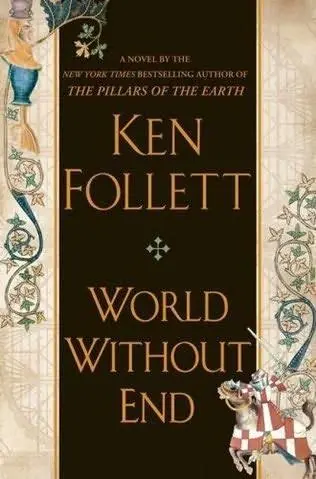
- Название:World Without End
- Автор:
- Жанр:
- Год:неизвестен
- ISBN:нет данных
- Рейтинг книги:5 / 5. Голосов: 1
-
Избранное:Добавить в избранное
- Отзывы:
-
Ваша оценка:
World Without End: краткое содержание, описание и аннотация
Предлагаем к чтению аннотацию, описание, краткое содержание или предисловие (зависит от того, что написал сам автор книги «World Without End»). Если вы не нашли необходимую информацию о книге — напишите в комментариях, мы постараемся отыскать её.
Ken Follett has 90 million readers worldwide. The Pillars of the Earth is his bestselling book of all time. Now, eighteen years after the publication of The Pillars of the Earth, Ken Follett has written the most-anticipated sequel of the year, World Without End.
In 1989 Ken Follett astonished the literary world with The Pillars of the Earth, a sweeping epic novel set in twelfth-century England centered on the building of a cathedral and many of the hundreds of lives it affected. Critics were overwhelmed-"it will hold you, fascinate you, surround you" (Chicago Tribune)-and readers everywhere hoped for a sequel.
World Without End takes place in the same town of Kingsbridge, two centuries after the townspeople finished building the exquisite Gothic cathedral that was at the heart of The Pillars of the Earth. The cathedral and the priory are again at the center of a web of love and hate, greed and pride, ambition and revenge, but this sequel stands on its own. This time the men and women of an extraordinary cast of characters find themselves at a crossroad of new ideas-about medicine, commerce, architecture, and justice. In a world where proponents of the old ways fiercely battle those with progressive minds, the intrigue and tension quickly reach a boiling point against the devastating backdrop of the greatest natural disaster ever to strike the human race-the Black Death.
Three years in the writing, and nearly eighteen years since its predecessor, World Without End breathes new life into the epic historical novel and once again shows that Ken Follett is a masterful author writing at the top of his craft.
World Without End — читать онлайн бесплатно полную книгу (весь текст) целиком
Ниже представлен текст книги, разбитый по страницам. Система сохранения места последней прочитанной страницы, позволяет с удобством читать онлайн бесплатно книгу «World Without End», без необходимости каждый раз заново искать на чём Вы остановились. Поставьте закладку, и сможете в любой момент перейти на страницу, на которой закончили чтение.
Интервал:
Закладка:
47
By Tuesday 22 August the English army was on the run.
Ralph Fitzgerald was not sure how it had happened. They had stormed across Normandy from west to east, looting and burning, and no one had been able to withstand them. Ralph had been in his element. On the march, a soldier could take anything he saw – food, jewellery, women – and kill any man who stood in his way. It was how life ought to be lived.
The king was a man after Ralph’s own heart. Edward III loved to fight. When he was not at war he spent most of his time organizing elaborate tournaments, costly mock battles with armies of knights in specially designed uniforms. On the campaign, he was always ready to lead a sortie or raiding party, hazarding his life, never pausing to balance risks against benefits like a Kingsbridge merchant. The older knights and earls commented on his brutality, and had protested about incidents such as the systematic rape of the women of Caen, but Edward did not care. When he had heard that some of the Caen citizens had thrown stones at soldiers who were ransacking their homes, he had ordered that everyone in the town should be killed, and only relented after vigorous protests by Sir Godfrey de Harcourt and others.
Things had started to go wrong when they came to the river Seine. At Rouen they had found the bridge destroyed, and the town – on the far side of the water – heavily fortified. King Philippe VI of France was there in person, with a mighty army.
The English marched upstream, looking for a place to cross, but they found that Philippe had been there before them, and one bridge after another was either strongly defended or in ruins. They went as far as Poissy, only twenty miles from Paris, and Ralph thought they would surely attack the capital – but older men shook their heads sagely and said it was impossible. Paris was a city of fifty thousand men, and they must by now have heard the news from Caen, so they would be prepared to fight to the death, knowing they could expect no mercy.
If the king did not intend to attack Paris, Ralph asked, what was his plan? No one knew, and Ralph suspected that Edward had no plan other than to wreak havoc.
The town of Poissy had been evacuated, and the English engineers were able to rebuild its bridge – fighting off a French attack at the same time – so at last the army crossed the river.
By then it was clear that Philippe had assembled an army larger by far than the English, and Edward decided on a dash to the north, with the aim of joining up with an Anglo-Flemish force invading from the north-east.
Philippe gave chase.
Today the English were encamped south of another great river, the Somme, and the French were playing the same trick as they had at the Seine. Sorties and reconnaissance parties reported that every bridge had been destroyed, every riverside town heavily fortified. Even more ominously, an English detachment had seen, on the far bank, the flag of Philippe’s most famous and frightening ally, John, the blind king of Bohemia.
Edward had started out with fifteen thousand men in total. In six weeks of campaigning many of those had fallen, and others had deserted, to find their way home with their saddlebags full of gold. He had about ten thousand left, Ralph calculated. Reports of spies suggested that in Amiens, a few miles upstream, Philippe now had sixty thousand foot soldiers and twelve thousand mounted knights, an overwhelming advantage in numbers. Ralph was more worried than he had been since he first set foot in Normandy. The English were in trouble.
Next day they marched downstream to Abbeville, location of the last bridge before the Somme widened into an estuary; but the burgesses of the town had spent money, over the years, strengthening the walls, and the English could see it was impregnable. So cocksure were the citizens that they sent out a large force of knights to attack the vanguard of the English army, and there was a fierce skirmish before the locals withdrew back inside their walled town.
When Philippe’s army left Amiens, and started advancing from the south, Edward found himself trapped in the point of a triangle: on his right the estuary, on his left the sea, and behind him the French army, baying for the blood of the barbaric invaders.
That afternoon, Earl Roland came to see Ralph.
Ralph had been fighting in Roland’s retinue for seven years. The earl no longer regarded him as an untried boy. Roland still gave the impression that he did not much like Ralph, but he certainly respected him, and would always use him to shore up a weak point in the line, lead a sally or organize a raid. Ralph had lost three fingers from his left hand, and had walked with a limp when tired ever since a Frenchman’s pikestaff had cracked his shinbone outside Nantes in 1342. Nevertheless, the king had not yet knighted Ralph, an omission which caused Ralph bitter resentment. Por all the loot he had garnered – most of it held for safekeeping by a London goldsmith – Ralph was unfulfilled. He knew that his father would be equally dissatisfied. Like Gerald, Ralph fought for honour, not money; but in all this time he had not climbed a single step up the staircase of nobility.
When Roland appeared, Ralph was sitting in a field of ripening wheat that had been trampled to shreds by the army. He was with Alan Fernhill and half a dozen comrades, eating a gloomy dinner, pea soup with onions: food was running out, and there was no meat left. Ralph felt as they did, tired from constant marching, dispirited by repeated encounters with broken bridges and well-defended towns, and scared of what would happen when the French army caught up with them.
Roland was now an old man, his hair and beard grey, but he still walked erect and spoke with authority. He had learned to keep his expression stonily impassive, so that people hardly noticed that the right side of his face was paralysed. He said: “The estuary of the Somme is tidal. At low tide, the water may be shallow in places. But the bottom is thick mud, making it impassable.”
“So we can’t cross,” said Ralph. But he knew Roland had not come just to give him bad news, and his spirits lifted optimistically.
“There may be a ford – a point where the bottom is firmer,” Roland went on. “If there is, the French will know.”
“You want me to find out.”
“As quick as you like. There are some prisoners in the next field.”
Ralph shook his head. “Soldiers might have come from anywhere in France, or even other countries. It’s the local people who will have the information.”
“I don’t care who you interrogate. Just come to the king’s tent with the answer by nightfall.” Roland walked away.
Ralph drained his bowl and leaped to his feet, glad to have something aggressive to do. “Saddle up, lads,” he said.
He still had Griff. Miraculously, his favourite horse had survived seven years of war. Griff was somewhat smaller than a warhorse, but had more spirit than the oversized destriers most knights preferred. He was now experienced in battle, and his iron-shod hooves gave Ralph an extra weapon in the melee. Ralph was more fond of him than of most of his human comrades. In fact the only living creature to whom he felt closer was his brother, Merthin, whom he had not seen for seven years – and might never see again, for Merthin had gone to Florence.
They headed north-east, towards the estuary. Every peasant living within half a day’s walk would know of the ford if there was one, Ralph calculated. They would use it constantly, crossing the river to buy and sell livestock, to attend the weddings and funerals of relatives, to go to markets and fairs and religious festivals. They would be reluctant to give information to the invading English, of course – but he knew how to solve that problem.
Читать дальшеИнтервал:
Закладка:
Похожие книги на «World Without End»
Представляем Вашему вниманию похожие книги на «World Without End» списком для выбора. Мы отобрали схожую по названию и смыслу литературу в надежде предоставить читателям больше вариантов отыскать новые, интересные, ещё непрочитанные произведения.








Обсуждение, отзывы о книге «World Without End» и просто собственные мнения читателей. Оставьте ваши комментарии, напишите, что Вы думаете о произведении, его смысле или главных героях. Укажите что конкретно понравилось, а что нет, и почему Вы так считаете.