Ken Follett - World Without End
Здесь есть возможность читать онлайн «Ken Follett - World Without End» весь текст электронной книги совершенно бесплатно (целиком полную версию без сокращений). В некоторых случаях можно слушать аудио, скачать через торрент в формате fb2 и присутствует краткое содержание. Жанр: Историческая проза, на английском языке. Описание произведения, (предисловие) а так же отзывы посетителей доступны на портале библиотеки ЛибКат.
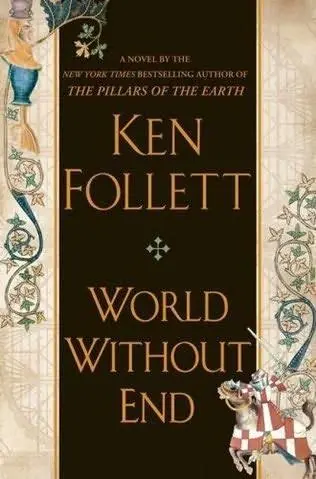
- Название:World Without End
- Автор:
- Жанр:
- Год:неизвестен
- ISBN:нет данных
- Рейтинг книги:5 / 5. Голосов: 1
-
Избранное:Добавить в избранное
- Отзывы:
-
Ваша оценка:
World Without End: краткое содержание, описание и аннотация
Предлагаем к чтению аннотацию, описание, краткое содержание или предисловие (зависит от того, что написал сам автор книги «World Without End»). Если вы не нашли необходимую информацию о книге — напишите в комментариях, мы постараемся отыскать её.
Ken Follett has 90 million readers worldwide. The Pillars of the Earth is his bestselling book of all time. Now, eighteen years after the publication of The Pillars of the Earth, Ken Follett has written the most-anticipated sequel of the year, World Without End.
In 1989 Ken Follett astonished the literary world with The Pillars of the Earth, a sweeping epic novel set in twelfth-century England centered on the building of a cathedral and many of the hundreds of lives it affected. Critics were overwhelmed-"it will hold you, fascinate you, surround you" (Chicago Tribune)-and readers everywhere hoped for a sequel.
World Without End takes place in the same town of Kingsbridge, two centuries after the townspeople finished building the exquisite Gothic cathedral that was at the heart of The Pillars of the Earth. The cathedral and the priory are again at the center of a web of love and hate, greed and pride, ambition and revenge, but this sequel stands on its own. This time the men and women of an extraordinary cast of characters find themselves at a crossroad of new ideas-about medicine, commerce, architecture, and justice. In a world where proponents of the old ways fiercely battle those with progressive minds, the intrigue and tension quickly reach a boiling point against the devastating backdrop of the greatest natural disaster ever to strike the human race-the Black Death.
Three years in the writing, and nearly eighteen years since its predecessor, World Without End breathes new life into the epic historical novel and once again shows that Ken Follett is a masterful author writing at the top of his craft.
World Without End — читать онлайн бесплатно полную книгу (весь текст) целиком
Ниже представлен текст книги, разбитый по страницам. Система сохранения места последней прочитанной страницы, позволяет с удобством читать онлайн бесплатно книгу «World Without End», без необходимости каждый раз заново искать на чём Вы остановились. Поставьте закладку, и сможете в любой момент перейти на страницу, на которой закончили чтение.
Интервал:
Закладка:
They had never patched up their quarrel. She had not told him about her abortion, so he did not know whether her pregnancy had terminated spontaneously or otherwise. Neither of them had ever referred to it. On two occasions since then he had come to talk to her, solemnly, and had begged her to make a fresh start with him. Both times, she had told him that she would never love another man, but she was not going to spend her life as someone’s wife and someone else’s mother. “How will you spend your life, then?” he had asked, and she had replied simply that she did not know.
Merthin was not as impish as he used to be. His hair and beard were neatly trimmed – he was now a regular customer of Matthew Barber. He was dressed in a russet tunic, like the masons, but he wore a yellow cape trimmed with fur, a sign of his status as a master, and a cap with a feather in it, which made him look a bit taller.
Elfric, whose enmity continued, had objected to Merthin dressing like a master, on the grounds that he was not a member of any guild. Merthin’s reply was that he was a master, and the solution to the problem was for him to be admitted to a guild. And there the matter remained, unresolved.
Merthin was still only twenty-one, and Guillaume looked at him and said: “He’s young!”
Caris said defensively: “He’s been the best builder in town since he was about seventeen.”
Merthin said a few more words to Thomas then came over. “The abutments of a bridge need to be heavy, with deep foundations,” he said, explaining the massive bulwark of stone he was constructing.
Guillaume said: “Why is that, young man?”
Merthin was used to being condescended to, and he took it lightly. With a small smile, he said: “Let me show you. Stand with your feet as far apart as you can, like this.” Merthin demonstrated, and Guillaume – after a moment’s hesitation – imitated him. “Your feet feel as if they might slide farther apart, don’t they?”
“Yes.”
“And the ends of a bridge tend to spread, like your feet. This puts a strain on the bridge, just as you’re now feeling the tension in your groin.” Merthin stood upright and placed his own booted foot firmly up against Guillaume’s soft leather shoe. “Now your foot can’t move, and the strain on your groin has eased, hasn’t it?”
“Yes.”
“The abutment has the same effect as my foot, in bracing your foot and relieving the strain.”
“Very interesting,” Guillaume said thoughtfully as he straightened up, and Caris knew he was telling himself not to underestimate Merthin.
“Let me show you around,” Merthin said.
The island had changed completely in the last six months. All signs of the old leper colony had gone. Much of the rocky land was now taken up with stores: neat piles of stone, barrels of lime, stacks of timber and coils of rope. The place was still infested with rabbits, but they were now competing for space with the builders. There was a smithy, where a blacksmith was repairing old tools and forging new ones; several masons’ lodges; and Merthin’s new house, small but carefully built and beautifully proportioned. Carpenters, stone carvers and mortar makers were labouring to keep the men on the scaffolding supplied with materials.
“There seem to be more people at work than usual,” Caris murmured in Merthin’s ear.
He grinned. “I’ve put as many as possible in highly visible positions,” he replied quietly. “I want every visitor to notice how fast we’re working to build the new bridge. I want them to believe the fair will be back to normal next year.”
At the west end of the island, away from the twin bridges, were storage yards and warehouses on plots of land Merthin had rented to Kingsbridge merchants. Although his rents were lower than what tenants would have to pay within the city walls, Merthin was already earning a good deal more than the token sum he paid every year for the lease.
He was also seeing a lot of Elizabeth Clerk. Caris thought she was a cold bitch, but she was the only other woman in town with the brains to challenge Merthin. She had a small box of books she had inherited from her father, the bishop, and Merthin spent evenings at her house, reading. Whether anything else went on, Caris did not know.
When the tour was over, Edmund took Guillaume back across the water, but Caris stayed behind to talk to Merthin. “Good customer?” he asked as they watched the raft being poled away.
“We’ve just sold him two sacks of cheap wool for less than we paid.” A sack was 364 pounds’ weight of wool, washed clean and dried. This year, the cheap wool was selling for thirty-six shillings a sack, the good quality for about double that.
“Why?”
“When prices are falling, it’s better to have cash than wool.”
“But surely you anticipated a poor fair.”
“We didn’t expect it to be this bad.”
“I’m surprised. In the past, your father has always had a supernatural ability to foresee trends.”
Caris hesitated. “It’s the combination of slack demand and the lack of a bridge.” In truth, she was surprised too. She had watched her father buy fleeces in the same quantity as usual, despite the poor prospects, and had wondered why he did not play safe by reducing his purchases.
“I suppose you’ll try to sell your surplus at the Shiring Fair,” Merthin said.
“It’s what Earl Roland wants everyone to do. The trouble is, we’re not regulars there. The locals will cream off the best of the business. It’s what happens in Kingsbridge: my father and two or three others strike large deals with the biggest buyers, leaving smaller operators and outsiders to scrabble for the leftovers. I’m sure the Shiring merchants do the same. We might sell a few sacks there, but there’s no real chance we can get rid of it all.”
“What will you do?”
“That’s why I’ve come to talk to you. We may have to stop work on the bridge.”
He stared at her. “No,” he said quietly.
“I’m very sorry, but my father doesn’t have the money. He’s put it all into fleeces that he can’t sell.”
Merthin looked as if he had been slapped. After a moment he said: “We have to find another way!”
Her heart went out to him, but she could think of nothing hopeful to say. “My father pledged seventy pounds to the bridge. He’s paid out half already. The rest, I’m afraid, is in woolsacks at his warehouse.”
“He can’t be completely penniless.”
“Very nearly. And the same applies to several other citizens who promised money for the bridge.”
“I could slow down,” Merthin said desperately. “Lay off some craftsmen, and run down the stocks of materials.”
“Then you wouldn’t have a bridge ready by next year’s fair, and we’d be in worse trouble.”
“Better than giving up altogether.”
“Yes, it would be,” she said. “But don’t do anything yet. When the Fleece Fair is over, we’ll think again. I just wanted you to know the situation.”
Merthin still looked pale. “I appreciate it.”
The raft came back, and Jimmie waited to take her to the shore. As she walked on board, she said casually: “And how is Elizabeth Clerk?”
Merthin pretended to be a little surprised by the question. “She’s fine, I think,” he said.
“You seem to be seeing a lot of her.”
“Not especially. We’ve always been friends.”
“Yes, of course,” Caris said, though it was not really true. Merthin had completely ignored Elizabeth for most of last year, when he and Caris were spending so much time together. But it would have been undignified to contradict him, so she said no more.
She waved goodbye and Jimmie pushed the raft off. Merthin was trying to give the impression that his relationship with Elizabeth was not a romance. Perhaps that was true. Or perhaps he was embarrassed to admit to Caris that he was in love with someone else. She could not tell. One thing she felt sure of: it was a romance on Elizabeth’s side. Caris could tell, just by the way Elizabeth looked at him. Elizabeth might be an ice maiden, but she was hot for Merthin.
Читать дальшеИнтервал:
Закладка:
Похожие книги на «World Without End»
Представляем Вашему вниманию похожие книги на «World Without End» списком для выбора. Мы отобрали схожую по названию и смыслу литературу в надежде предоставить читателям больше вариантов отыскать новые, интересные, ещё непрочитанные произведения.









Обсуждение, отзывы о книге «World Without End» и просто собственные мнения читателей. Оставьте ваши комментарии, напишите, что Вы думаете о произведении, его смысле или главных героях. Укажите что конкретно понравилось, а что нет, и почему Вы так считаете.