Philippa Gregory - Virgin Earth
Здесь есть возможность читать онлайн «Philippa Gregory - Virgin Earth» — ознакомительный отрывок электронной книги совершенно бесплатно, а после прочтения отрывка купить полную версию. В некоторых случаях можно слушать аудио, скачать через торрент в формате fb2 и присутствует краткое содержание. Жанр: Историческая проза, на английском языке. Описание произведения, (предисловие) а так же отзывы посетителей доступны на портале библиотеки ЛибКат.
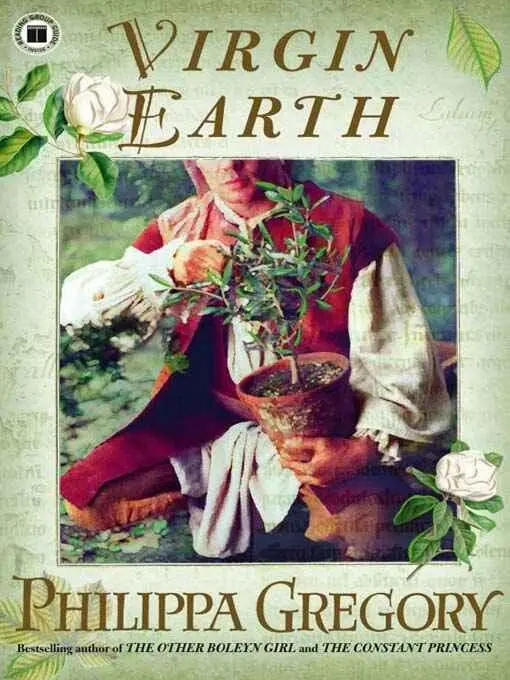
- Название:Virgin Earth
- Автор:
- Жанр:
- Год:неизвестен
- ISBN:нет данных
- Рейтинг книги:4 / 5. Голосов: 1
-
Избранное:Добавить в избранное
- Отзывы:
-
Ваша оценка:
Virgin Earth: краткое содержание, описание и аннотация
Предлагаем к чтению аннотацию, описание, краткое содержание или предисловие (зависит от того, что написал сам автор книги «Virgin Earth»). Если вы не нашли необходимую информацию о книге — напишите в комментариях, мы постараемся отыскать её.
Virgin Earth — читать онлайн ознакомительный отрывок
Ниже представлен текст книги, разбитый по страницам. Система сохранения места последней прочитанной страницы, позволяет с удобством читать онлайн бесплатно книгу «Virgin Earth», без необходимости каждый раз заново искать на чём Вы остановились. Поставьте закладку, и сможете в любой момент перейти на страницу, на которой закончили чтение.
Интервал:
Закладка:
There were common plants by the wayside but the constant plowing and replowing of the land for tobacco had uprooted anything of any size. John thought it incredible that the woods where Suckahanna had run when she was a little girl should now be as tame and as enclosed as the riverside at Surrey.
He passed a gang of slaves working on the road, filling in the potholes with chippings of stone, and they pointed him on: on and then turn right after the next grand house, for the savages’ village. The overseer rode up as John left them, tipped his hat to John, confirmed the directions and then went past him to the men. John heard a yelp of pain at a casual blow, and trudged onward without turning his head.
He turned right as they had advised and found that the track led him through a marsh of foul water. This was land that no one had wanted, far from the road and from the river, and needing to be drained and cleansed, a project which might take years and never be done. There were rotting trees sunk deep into the marsh and, in their shelter, water-loving plants just coming into bud. John hesitated to step off the single-track causeway and risk a wetting but promised himself that he would stop and collect them on his way back.
He turned another corner and saw a little wooden house, built like his own Virginian shack had been. On either side of it a tall wooden fence ran as if to enclose a huge field. The little hut was a gatehouse, the only way into the enclosed acres. On the porch lounging in the sun were two men in remnants of what had once been good jackets, chewing tobacco and spitting into a brass bowl placed conveniently between them. They watched him as he walked up and John felt self-conscious and needlessly guilty as they stared at him, walking along the deserted road toward the village that no one ever visited.
“Good day,” John said.
One man got to his feet and nodded a greeting.
“I have come to seek a servant of mine,” John said, succumbing to the prejudice of the place. “I have been a long time in England. I wondered if she was here.”
“Might be,” the man said unhelpfully. “We’ve got a hundred and sixty-two of ’em here.”
“And where will I find the others?” John asked, looking around, thinking there must be another village nearby.
“That’s all there is,” the man said. “D’you have a pass?”
John handed over Sir Josiah’s letter. “I mean, where are the other Powhatan? The rest of them?”
The man could hardly read; he only looked at the paper and at the seal on the bottom. “That’s all there is left,” he said simply.
John hesitated at the enormity of what the man was saying. “There is surely another village elsewhere in the colony with more people?” he asked. “There were thousands of them when I was last here, thousands.”
The man shook his head. “This a hundred and sixty-two is all that is left of the Powhatan,” he said. “Unless they start having babies again. But they don’t show any disposition at the moment.”
The other man sniggered. “Most unwillin’.”
“Can I go in?” John asked.
“I’ll take you,” the soldier said.
He lit the fuse on his musket and held the gun across his chest, the fuse between his two fingers, the end of it aglow. Then he led the way into the enclosed village.
John walked through the gate, and then stopped and blinked. It was like the village he had known, but in miniature; the long houses were too few and built too small. There was a dancing circle but it was compressed against one of the blank encircling wooden walls. There was the central street leading up to the house of the werowance but it could be walked in forty strides. There was no sweat lodge that he could see. All around the houses, planted with the meticulous care of the Powhatan women, were the food crops, cramped up against the houses. John recognized at once the growing stalks of the Indian corn and the amaracock planted between them, and the little shelter built to overlook the field where the children would wait for their mothers to finish their work.
“Can I talk to them alone?” John asked the soldier.
“They don’t speak English,” he said. “You’d better just look for your girl. I can line them up for you. They understand ‘Muster.’”
“No, no,” John said. “I can speak Powhatan. Let me speak with them.”
The soldier hesitated. “Shout if you need help then,” he said and went back to his seat.
The women working in the field did not raise their eyes at this exchange, they did not take more than a glance at John. But John knew that they would have seen every detail of him, and that if Suckahanna or Attone or any of his people were alive in this cage then they would know within minutes that he had come.
He walked up to the little confined field and spoke in Powhatan.
“Sister,” he said. “I was the husband of Suckahanna and the friend of Attone. They called me the Eagle when they took me into the People.”
She did not break off her work, her hands still moved in the earth, setting the little plants, dropping in seeds. She did not look up at him, she might as well have been deaf.
“I have come to find Suckahanna, or Attone, or any of my people,” John said. “Or news of them.”
She nodded at that; but did not pause in the steady, sweeping movement of her hands.
“Did you know them?” John asked. “Suckahanna, Attone, any of them? She had a little boy-”
The woman turned her head and called a single word, the name Popanow, the child of winter, and a young girl came forward.
“I knew Suckahanna,” she said simply. “You must be the Eagle. I would not have known you, they spoke of a hunter and you are too fat and old.”
John concealed the hurt to his vanity and looked at the girl. “I don’t remember you.”
“I was born in the village of the bad water,” she said. “You were long gone.”
“Suckahanna?”
She paused. “Why d’you want to know, white man?”
John hesitated. “I am a white man, I know,” he said humbly. “But once I was a Powhatan. Suckahanna was my wife and Attone was my friend. Tell me, Popanow, what became of my wife and my friend and my people? I was not with them because they sent me away. I have come back to learn what became of them. Tell me, Popanow.”
She nodded. “It was like this. The soldiers were hunting us down, every month they came a little closer. It was like a hunting trip for them, they came out in spring. Winter we were left alone to starve and freeze but spring and summer they came out and destroyed our fields when they could find them, and broke down the fish weirs, and tracked us with their dogs.”
John flinched at the matter-of-fact solidity of her description. “Attone wanted to lead us upriver and north, away from the white men. We thought that another People might take us in, or if they would not then we could fight the white men and die in the fighting rather than be picked off one at a time. Others thought that the white men would grow weary of the sport of hunting us and start to hunt for food. They would leave us alone after a while. I think Suckahanna was with Attone. She said we should go.
“We started to move out in the winter. We had not enough stores of food, and it was not safe to light fires. A slave saw us.” She was suddenly alight with anger, animated with resentment. “A black slave who thought more of his master than anything else – the white man’s dog, the white man’s fool – he ran and told his master, who brought out some other planters and they hunted us through the snow and we were easy to track in the deep snow, and slow-moving with old people and babies to carry.”
John nodded. “I remember. I was with them when they went to the marshland.”
Читать дальшеИнтервал:
Закладка:
Похожие книги на «Virgin Earth»
Представляем Вашему вниманию похожие книги на «Virgin Earth» списком для выбора. Мы отобрали схожую по названию и смыслу литературу в надежде предоставить читателям больше вариантов отыскать новые, интересные, ещё непрочитанные произведения.
Обсуждение, отзывы о книге «Virgin Earth» и просто собственные мнения читателей. Оставьте ваши комментарии, напишите, что Вы думаете о произведении, его смысле или главных героях. Укажите что конкретно понравилось, а что нет, и почему Вы так считаете.