Philippa Gregory - Earthly Joys
Здесь есть возможность читать онлайн «Philippa Gregory - Earthly Joys» — ознакомительный отрывок электронной книги совершенно бесплатно, а после прочтения отрывка купить полную версию. В некоторых случаях можно слушать аудио, скачать через торрент в формате fb2 и присутствует краткое содержание. Жанр: Историческая проза, на английском языке. Описание произведения, (предисловие) а так же отзывы посетителей доступны на портале библиотеки ЛибКат.
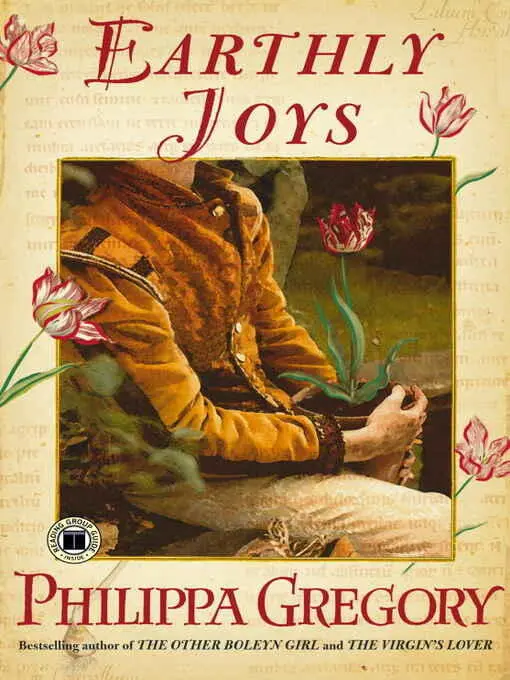
- Название:Earthly Joys
- Автор:
- Жанр:
- Год:неизвестен
- ISBN:нет данных
- Рейтинг книги:3 / 5. Голосов: 1
-
Избранное:Добавить в избранное
- Отзывы:
-
Ваша оценка:
Earthly Joys: краткое содержание, описание и аннотация
Предлагаем к чтению аннотацию, описание, краткое содержание или предисловие (зависит от того, что написал сам автор книги «Earthly Joys»). Если вы не нашли необходимую информацию о книге — напишите в комментариях, мы постараемся отыскать её.
Earthly Joys — читать онлайн ознакомительный отрывок
Ниже представлен текст книги, разбитый по страницам. Система сохранения места последней прочитанной страницы, позволяет с удобством читать онлайн бесплатно книгу «Earthly Joys», без необходимости каждый раз заново искать на чём Вы остановились. Поставьте закладку, и сможете в любой момент перейти на страницу, на которой закончили чтение.
Интервал:
Закладка:
It was a good Baptist wedding and John, watching the priest about his business, serving his God and his congregation in the sight of them both, remembered the church at Meopham and his own wedding, which had been conducted the same way, and wished that Archbishop Laud had left things as they were, and not put honest men like him and Josiah Hurte on either side of a new divide.
Josiah Hurte gave them a good wedding dinner as he had promised and both sets of parents, the apprentice boys and half a dozen friends saw the young couple into their wedding chamber and put them to bed.
John, in the bed chamber overlooking the street with Elizabeth sitting in the four-poster bed behind him, was reminded of his own wedding night. “D’you remember, Lizzie?” he asked Elizabeth. “What a misery it was?”
She nodded. “I’m glad it has been quieter for our John. And I don’t think anyone would dare make a game of Jane; she is a strong-minded young woman.”
“You won’t mind her coming into your house?”
Elizabeth shook her head. “She’s a pleasant girl, and I will enjoy having someone to talk to during the day when you and J are both out.” She turned back the cover on the bed. “Come to bed, husband; we have done a good day’s work today.”
Still he lingered at the window, looking down at the cobbled London street, empty except for a scavenging cat, silent except for the occasional call of the night watchman. “You have been a good wife to me, Elizabeth. I am sorry if I have ever grieved you.”
“And you have been a good husband to me.” She hesitated. The other love and the vow of love till death was still between them, even on this day. “Shall you call to see the duke to see if he needs any service before we go back to New Hall?”
“He’s hunting at Richmond,” John answered. “And I may not go to him until he sends for me.”
“When will he send for you again?”
“I don’t know.”
She slipped from the bed and stood beside him, her hand on his shoulder. The draughts from the window were icy but John was not aware of them.
“Did you part on bad terms?” she asked. “Is that why he never sends for you now? And why you are waiting and waiting for him and why you look so pained when someone mentions his name?”
“We parted on no terms at all,” John said heavily. “He dismissed me. There are no terms between us but those of a master and his man; it was I who forgot my place and he did right to remind me. You would have thought I would have known, wouldn’t you, Elizabeth?” He shot her a brief unhappy smile. “Trained with Cecil. You would have thought that of all the men in England I would have known that you can be close to a great man, you can be in his confidence. But he is always the great man and you are always his servant.”
“You forgot that?” she asked gently.
“I was reminded quick enough,” John said quietly. The dismissal on the quayside when Buckingham had turned from him to his wife and the courtiers was still as sharply painful as when it had happened. “But he was in the right and I in the wrong. I thought I would stay with him but he did not need me. And still he does not need me now. He is busy with the king, with his wife, with his mistresses. He will not send for me until he needs an honest man, and he has no need of an honest man at court. Indeed, there is no room for an honest man at court.”
“I am sure he will send for you soon,” she said. It was the only comfort she could think of.
He nodded. “Soon he will need a dog,” he said bitterly. “And then he will remember me.”
John was wrong; the duke did not need a dog. Spring came to New Hall but not the duke. The earth warmed and John had the grass courts scythed and seedlings planted out from the nursery beds. He ordered that the roses have their spring pruning and that the buds be pinched off the fruit trees. He set charcoal burners in the hollow wall of the fruit garden to speed the fruit for his lordship to eat when he came… but still he did not come.
The tulips that John had bought with such joy when he and his lord had been adventurers together in Europe, gambling with the crown jewels of England, flowered in their pots and Buckingham did not even see them. As soon as the precious blooms were over John set the pots outside in the dappled shade of his own garden so that he could water them daily and watch the leaves flop and droop, and pray that deep inside the soil the bulbs were growing plump and strong.
“When will we lift them?” J asked him, eyeing the dispiriting sight of the limp leaves.
“In autumn,” John said shortly. “And then we will know if we have made my lord a fortune, or if we have lost him one.”
“But either way he missed seeing the bloom,” J pointed out.
“He missed it,” John agreed. “And I missed showing it to him.”
Everyone in the town of Chelmsford, in the village of Chorley, in the kitchens at New Hall, and even the shepherds in the lambing pens spoke of nothing but the king and Parliament and the quarrel between them, the king and his wife and the quarrel between them, the quarrel between the king and the French, between the king and the Spanish, between the king and the Roman Catholics and between the king and the Puritans. Inside the enclosing walls of the duke’s park they did not dare say it, but in the ale houses of Chelmsford they had a joke which went: “Who rules the kingdom? The king! Who rules the king? The duke! Who rules the duke? The Devil!”
It would have been bad enough if it had stopped there, but the joke spread from the ale-house men to the women, who were more apt to see the work of the Devil in the gross injustice of life and took the jest too literally. From them it spread to the preachers, who knew that the Devil did his work daily, and that the richest pickings for him were around the king who could not rule his wife, nor his court, nor Parliament, nor protect his country.
They said that the duke was the most hated man in England. One of the garden lads, employed to scare crows off Tradescant’s new West Indian scarlet runner beans, boasted to another that they served a man worse-hated than the Pope. Everything was blamed on the duke: the plague which was again taking hundreds of men and women already weakened by a hungry winter, the wetness of the spring which would spoil the crops in the ground and, over and over again, the corruption of a king who surely would otherwise live in peace with his wife and strive to govern with Parliament.
The king was so desperate for money that he had called Parliament but the members, newly up from the country and determined to take a stand, had sworn that the king should have no money for any new wars without his signature on a Petition of Right. He must accept that there would be no taxes without their consent – no more illegal demands, no more royal charges – and that men who refused the whim of the king should not be sent to prison without a judge hearing their case. The king, bankrupt on his throne, was driven to assent, a grudging assent which he resisted to the last moment and regretted as soon as he had put his hand to the new contract.
Jane, on the settle at John’s fireside with her husband on a stool at her feet leaning his head against her knees, read the family her father’s letter.
“The king’s consent to the Petition of Right is seen as the start of a new era. It is hailed as a new Magna Carta which will defend the rights of innocent people against the wickedness of those who should be their betters and their guides. They are ringing the bells while I write this to celebrate the king’s agreement with Parliament at last. I wish I could say that His Majesty welcomes it as does everyone else, but he insists that it is nothing new, that there are no new freedoms, and therefore, that he is not curbed. The older men of my congregation remember that when Parliament came against Queen Elizabeth she thanked them kindly, and when she was forced to do as they wanted, she smiled as if it was her heart’s desire.
Читать дальшеИнтервал:
Закладка:
Похожие книги на «Earthly Joys»
Представляем Вашему вниманию похожие книги на «Earthly Joys» списком для выбора. Мы отобрали схожую по названию и смыслу литературу в надежде предоставить читателям больше вариантов отыскать новые, интересные, ещё непрочитанные произведения.
Обсуждение, отзывы о книге «Earthly Joys» и просто собственные мнения читателей. Оставьте ваши комментарии, напишите, что Вы думаете о произведении, его смысле или главных героях. Укажите что конкретно понравилось, а что нет, и почему Вы так считаете.