Philippa Gregory - Earthly Joys
Здесь есть возможность читать онлайн «Philippa Gregory - Earthly Joys» — ознакомительный отрывок электронной книги совершенно бесплатно, а после прочтения отрывка купить полную версию. В некоторых случаях можно слушать аудио, скачать через торрент в формате fb2 и присутствует краткое содержание. Жанр: Историческая проза, на английском языке. Описание произведения, (предисловие) а так же отзывы посетителей доступны на портале библиотеки ЛибКат.
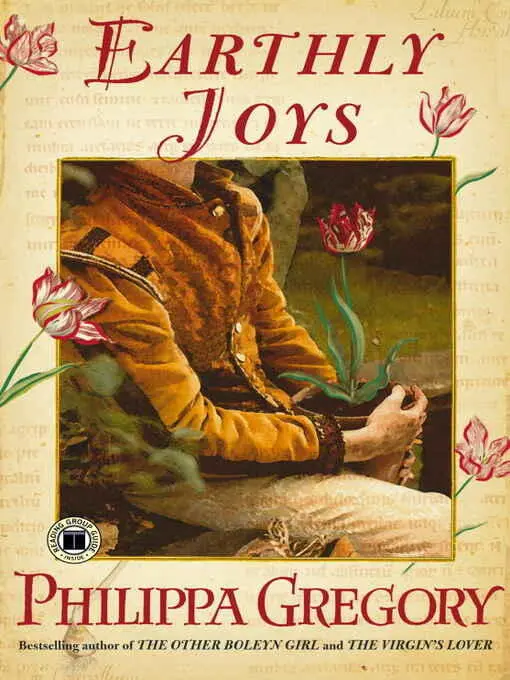
- Название:Earthly Joys
- Автор:
- Жанр:
- Год:неизвестен
- ISBN:нет данных
- Рейтинг книги:3 / 5. Голосов: 1
-
Избранное:Добавить в избранное
- Отзывы:
-
Ваша оценка:
Earthly Joys: краткое содержание, описание и аннотация
Предлагаем к чтению аннотацию, описание, краткое содержание или предисловие (зависит от того, что написал сам автор книги «Earthly Joys»). Если вы не нашли необходимую информацию о книге — напишите в комментариях, мы постараемся отыскать её.
Earthly Joys — читать онлайн ознакомительный отрывок
Ниже представлен текст книги, разбитый по страницам. Система сохранения места последней прочитанной страницы, позволяет с удобством читать онлайн бесплатно книгу «Earthly Joys», без необходимости каждый раз заново искать на чём Вы остановились. Поставьте закладку, и сможете в любой момент перейти на страницу, на которой закончили чтение.
Интервал:
Закладка:
She frowned at the sound of blasphemy. “He was only a man.”
“I know, and I loved him as a man. I loved him because he was a man and more mortal and frail than many others. He would lean on me when his back pained him-” Tradescant broke off. “I liked him leaning on me,” he said, conscious that he could not explain the mixture of elation and pity that he felt all at once when the greatest man in England after the king would confide his pain and take help.
Elizabeth pressed her lips together on hasty words and kept her jealousy to herself. She put her hand on her husband’s shoulder and reminded herself that the lord he had loved was dead and buried and a good wife should show some sympathy. “You sound as if you have lost a brother, not a lord.”
He nodded. “A lord is like a brother, like a father, even like a wife. I think of his needs all the time, I guard his interests. And I cannot be happy here without him.”
Elizabeth did not want to understand. “But you have me, and Baby J.”
John gave her a sad little smile. “And I will never love another woman or another child more than I love the two of you… but a man’s love for his lord is another thing. It comes from the head as well as the heart. Loving a woman keeps you at home; it is a private pleasure. Loving a great lord takes you into the wider world; it is a matter of pride.”
“You make it sound as if we are not enough,” she said resentfully.
He shook his head, despairing of ever making her understand. “No, no, Elizabeth. It doesn’t matter. You are enough.”
She was not convinced. “Will you seek another lord? Another master?”
The expression that passed swiftly across his face was deeper than mourning; it was desolation. “I will never see his like again.”
That silenced her for a moment, as she saw the depth of his loss.
“But what about us?” she asked. “I don’t want to lose this house, John, and J is happy here. We have put down roots here just as the plants in the garden have done. You said you would plant the chestnut here this spring and that we would sit under its branches when we are an old married couple.”
He nodded. “I know. I’m forsworn. That’s what I promised you. But I can’t bear it here without him, Elizabeth. I have tried and I cannot. Can you release me from my promise that we should stay here, and let us make another home? Back in Kent?”
“Kent? What d’you mean? Where?”
“Lord Wootton wants a gardener at Canterbury and asked me if I would go. He has the secret of growing melons which I should be glad to learn; his gardener has always teased me that only Lord Wootton in all of England can grow melons.”
Elizabeth tutted with irritation. “Forget the melons for a moment if you please. What about a house? What about your wages?”
“He’ll pay me well,” John said. “Sixty pounds where my lord paid me fifty. And we will have a house, the head gardener’s house. J can go to the King’s School in Canterbury. That’ll be a fine thing for him.”
“Canterbury,” Elizabeth said thoughtfully. “I’ve never lived in a market town. There’d be much society.”
“We could start there at once. He asked me on the death of my lord and I said I would tell him within the quarter.”
“And will you not love Lord Wootton as you loved the earl?” Elizabeth asked, thinking it would be an advantage.
John shook his head. “There will never be another lord for me like that one.”
“Let’s go, then,” she said with her typical sudden decisiveness. “And we can plant the chestnut sapling in Canterbury instead of Hatfield.”
November 1612
John was working in Lord Wootton’s garden, hands among cold clods of earth, when he heard the bell tolling. On and on it went, a funeral bell. Then he heard the rumble of cannon fire. He stood up, brushed the mud on his breeches, and reached for his coat where it was hooked over his spade.
“Something’s happened,” he said shortly to the garden lad who was working beside him.
“Shall I run into town and bring you the news?” the boy asked eagerly.
“No,” John said firmly. “You shall stay and work here while I run into town and find out the news. And if you are not here when I get back it will be the worst for you.”
“Yes, Mr. Tradescant,” the boy said sulkily.
The bell was ever more insistent.
“What does it mean?”
“I’ll find out,” John said and strode out of the garden toward the cathedral.
People were gathered in gossiping circles all the way down the road but John went on until he reached the cathedral steps and saw a face he recognized – the headmaster of the school.
“Doctor Phillips,” he exclaimed. “What are they ringing for?”
The man turned at the sound of his name and John saw, with a shock, that the man’s face was wet with tears.
“Good God! What is it? It’s not an invasion? Not Spain?”
“It’s Prince Henry,” the man said simply. “Our blessed prince. We have lost him.”
For a moment John could not take in the words. “Prince Henry?”
“Dead.”
John shook his head. “But he’s so strong, he’s always so well-”
“Dead of fever.”
John’s hand went to his forehead to cross himself, in the old superstitious forbidden sign. He caught his hand back and said instead, “Poor boy, God save us, poor boy.”
“I forgot, you would have seen him often.”
“Not often,” John said, his habitual caution asserting itself.
“He was a blessed prince, was he not? Handsome and learned and godly?”
John thought of Prince Henry’s handsome tyrannical disposition, of his casual cruelty to his dark little brother, of his easy love of his sister Elizabeth, of his royal confidence, some would say arrogance. “He was a boy born to rule,” John said cleverly.
“God save Prince Charles,” Doctor Phillips said stoutly.
John realized that the little eleven-year-old lame boy who ran after his brother and could never get nor keep his father’s attention would now be the next king – if he lived.
“God save him indeed,” he repeated.
“And if we lose him,” Doctor Phillips said in an undertone, “then it’s another woman on the throne, the Princess Elizabeth, and God knows what danger that would bring us now.”
“God save him,” John repeated. “God save Prince Charles.”
“And what is he like?” Doctor Phillips asked. “Prince Charles? What sort of a king will he make?”
John thought of the tongue-tied boy who had to be taught to walk straight, who struggled so hard to keep up with the older two, who knew himself never to be beloved like them, never to be handsome like them. He wondered how a child who knew himself to be second best and a poor second at that would be when he was a man and was first in the land. Would he take the people’s love and let it warm him, fill the emptiness in that ugly little boy’s heart? Or would he be forever mistrustful, forever doubting, always wanting to seem braver, stronger, more handsome than he was?
“He’ll be a fine king,” he said, thinking that his master would not be there to teach this king, and how the boy would learn the Tudor guile and the Tudor charm with only his father to advise him and the court filled with men picked for their looks and their bawdiness and not for their skills. “God will guide him,” Tradescant said hopefully, thinking that no one else would.
September 1616
The new cottage at Canterbury was little bigger than their first home at Meopham but Elizabeth did not complain, as the front door opened to a proper city street and the finishing of the house was elegant. They cooked and ate and lived in the large ground-floor room and Elizabeth and John slept in a curtained four-poster bed in the room next door. J, now a boy of eight years old, went up the shallow stairs to a pallet bed in the attic. During the day John went and gardened for Lord Wootton, and J went to Dame School where, for a penny a week, he was taught to read and write and to figure sums. They both came home for their dinner at four o’clock on the darkening autumn afternoons, John with a spade over his shoulder, J with his schoolbook clutched under his arm.
Читать дальшеИнтервал:
Закладка:
Похожие книги на «Earthly Joys»
Представляем Вашему вниманию похожие книги на «Earthly Joys» списком для выбора. Мы отобрали схожую по названию и смыслу литературу в надежде предоставить читателям больше вариантов отыскать новые, интересные, ещё непрочитанные произведения.
Обсуждение, отзывы о книге «Earthly Joys» и просто собственные мнения читателей. Оставьте ваши комментарии, напишите, что Вы думаете о произведении, его смысле или главных героях. Укажите что конкретно понравилось, а что нет, и почему Вы так считаете.