Philippa Gregory - Earthly Joys
Здесь есть возможность читать онлайн «Philippa Gregory - Earthly Joys» — ознакомительный отрывок электронной книги совершенно бесплатно, а после прочтения отрывка купить полную версию. В некоторых случаях можно слушать аудио, скачать через торрент в формате fb2 и присутствует краткое содержание. Жанр: Историческая проза, на английском языке. Описание произведения, (предисловие) а так же отзывы посетителей доступны на портале библиотеки ЛибКат.
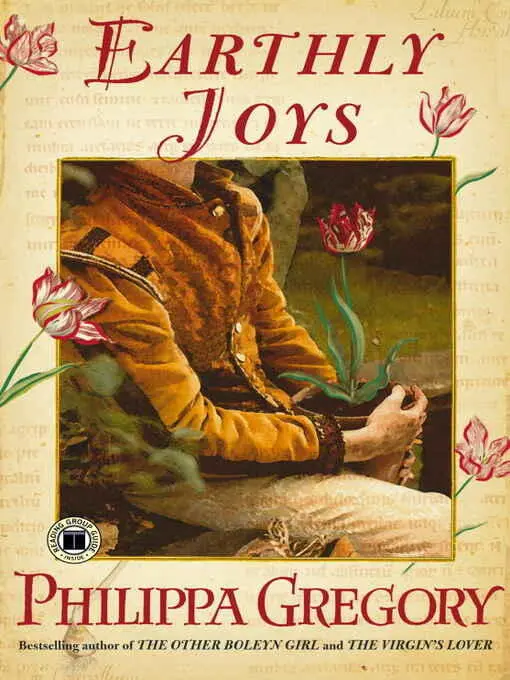
- Название:Earthly Joys
- Автор:
- Жанр:
- Год:неизвестен
- ISBN:нет данных
- Рейтинг книги:3 / 5. Голосов: 1
-
Избранное:Добавить в избранное
- Отзывы:
-
Ваша оценка:
Earthly Joys: краткое содержание, описание и аннотация
Предлагаем к чтению аннотацию, описание, краткое содержание или предисловие (зависит от того, что написал сам автор книги «Earthly Joys»). Если вы не нашли необходимую информацию о книге — напишите в комментариях, мы постараемся отыскать её.
Earthly Joys — читать онлайн ознакомительный отрывок
Ниже представлен текст книги, разбитый по страницам. Система сохранения места последней прочитанной страницы, позволяет с удобством читать онлайн бесплатно книгу «Earthly Joys», без необходимости каждый раз заново искать на чём Вы остановились. Поставьте закладку, и сможете в любой момент перейти на страницу, на которой закончили чтение.
Интервал:
Закладка:
She watched him, frowning slightly. “You would not want to go so far, surely?”
John put his arm around her waist to reassure her, but could not bring himself to lie. “We are a nation of travelers,” he said. “The finest of the lords, my lord’s friends, are all men who seek their fortunes over the seas, who see the seas as their highway. My lord himself invests in every other voyage out of London. We are too great a nation with too many people to be kept to the one island.”
Elizabeth was a woman from a village that counted the men who were lost to the sea, and tried to keep them on the land. “You don’t think of leaving England?”
“Oh, no,” John said. “But I don’t fear to travel.”
“I don’t know how you can bear to leave us for so long!” she complained. “And Baby J will be so changed by the time you come back.”
John nodded. “You must note down every new thing he says so that you can remember to tell me when I return,” he said. “And let him plant those cuttings I brought for him. They are his lordship’s favorite pinks, and they smell very sweet. They should grow well here. Let him dig the hole himself and set them in; I showed him how to do it this afternoon.”
“I know.” Elizabeth had watched from the window as her husband and her quick dark-eyed dark-haired son had kneeled side by side by the little plot of earth and dug together, John straining to understand the rapid babble of baby talk, Baby J looking up into his father’s face and repeating the sound until between guesswork and faith they could understand each other.
“Dig!” Baby J insisted, thrusting a little trowel into the earth.
“Dig,” his father agreed. “And now we put these little fellows into their beds.”
“Dig!” Baby J insisted again.
“Not here!” John said warningly. “They need to rest quiet here so that they can grow and make pretty flowers for Mama!”
“Dig! J want dig!”
“Not dig!” John replied, descending rapidly to equal stubbornness.
“Dig!”
“No!”
“Dig!”
“No! Elizabeth! Come and take your son out of this! He is going to destroy these before they even know they’ve been transplanted!”
She had come from the house and swept Baby J up, and taken him down to the end of the garden to pet Daddy’s horse.
“I don’t know that he will make a gardener,” she warned. “You should not count on it.”
“He understands the importance of deep digging,” John said firmly. “Everything else will follow.”
August 1610
John set sail in September, and experienced a rough and frightening crossing after waiting for four dull days off Gravesend for a southerly wind. He landed in Flushing and hired a large flat-bottomed canal boat so that he could stop at every farm and enquire what they had to sell, all the way down the canal to Delft. To his relief the canal boatman spoke English even though his accent was as strong as any Cornishman’s. The boat was drawn by an amiable sleepy horse which wandered along the tow path and grazed on the lush banks during John’s frequent halts. He found farmers of flowers whose whole trade consisted of nothing but the famous tulips, and whose whole fortune rested on being able to produce and then reproduce the new colors of blooms. There were farms like John had never seen before. Row upon row of floppy-leaved stalks were tended by women wearing huge wooden clogs against the rich sandy soil, and big white hats against the sun, working their way down the rows with an implement like a wooden spoon, gently lifting the smooth round bulbs from the ground and laying them softly down, and the cart coming along behind to gather them all up.
John watched them. Each set of leaves which had grown from one bulb now had a cluster of three, perhaps even four, bulbs at the end of their white stems. Most of them even carried fat buds at the head where the petals had been and when the women spotted them, and they never missed one however long he watched, they cut them off and popped them in their apron pockets. Where one valuable bulb had been set in the ground and flowered there were now four, and maybe three dozen seeds as well. A man could quadruple his investment in one year for no more labor than keeping the field free of weeds and digging up his capital in the autumn.
“Profitable business,” John remarked enviously under his breath, thinking of the price he paid for tulips in England.
At every canalside market town he had the boatman tie up and wait for him on board, sometimes for hours, sometimes for days, as he wandered around the market gardens and picked out a well-shaped tree, a sack of common bulbs, a purse full of seeds. Wherever he could, he bought in bulk, haunted by the thought of the rich green commonland and meadows around Hatfield waiting for forests and plantations and mazes and orchards. Wherever he could find someone who could speak English and had the appearance of an honorable man, he made a contract with him to send on more plants to England as they matured.
“A great planting scheme,” one of the Dutch farmers commented.
John smiled but his forehead was creased with worry. “The greatest,” he said.
Despite his rooted belief that Englishmen were the best of the world, and England undeniably the best country, John could not help but be impressed with the labor these people had put into their land. Each canal bank was maintained as smartly as each town doorstep. They took a pleasure and a pride in things being just so. And their rewards were towns which exuded wealth and a land which was interlaced with an efficient transport system that put the potholed roads of England to shame.
The dykes that held back the shifting sands and the high waves of the North Sea were a wonder to John, who had seen the feckless neglect of the marshes and waterlogged estuaries of the Fens and East Anglia. He had not thought it was possible to do anything with land soured by salt, but he saw the Dutch farmers had learned the way of it and were making use of land that an Englishman would call waste ground and abandon as hopeless. John thought of the harbors and inlets and boggy places all around the coast, even in land-hungry Kent and Essex, and how in England they were left to lie fallow, steeped in salt, whereas in Holland they were banked off from the sea and growing green.
He could not help but admire their labor and their skill, and he could not help but envy the Dutch prosperity. There was no hunger in the Holland Provinces, and basic fare was rich and good. They ate cheese on buttered bread, a double helping of richness and fat, and did not think twice about it. Their cows grazed knee-deep in lush wet pastureland and gave abundant milk. They were a people who saw themselves as divinely rewarded for their struggle against the papist Spanish, and John, idling down the narrow canals, looking left and right for plants and flowers tucked away in the moist grasses, had to agree that the Protestant God was a generous one to this, His favored people.
When they reached The Hague, Tradescant sent the loaded barge back with instructions to ship all the plants directly to England. He stood on the stone wharf and watched the swaying heads of trees glide slowly away. Some of the cherry trees were bearing fruit and he saw, with irritation, that once they were beyond hailing distance the bargee picked a handful and ate them, spitting the stones carelessly into the glassy water of the canal.
In Flanders he bought vines, and watched them pruned of their yellow leaves and thick black grapes in preparation for their journey. He ordered their roots to be wrapped in damp sacking and plunged into old wine casks for their voyage home. He sent a message ahead of them, in the careful script which Elizabeth had taught him, so that a gardener from Hatfield would meet them with a cart on the dockside, to take them back and heel them in the same day, without fail, making sure to water them religiously at dawn every day until Tradescant came home.
Читать дальшеИнтервал:
Закладка:
Похожие книги на «Earthly Joys»
Представляем Вашему вниманию похожие книги на «Earthly Joys» списком для выбора. Мы отобрали схожую по названию и смыслу литературу в надежде предоставить читателям больше вариантов отыскать новые, интересные, ещё непрочитанные произведения.

Обсуждение, отзывы о книге «Earthly Joys» и просто собственные мнения читателей. Оставьте ваши комментарии, напишите, что Вы думаете о произведении, его смысле или главных героях. Укажите что конкретно понравилось, а что нет, и почему Вы так считаете.