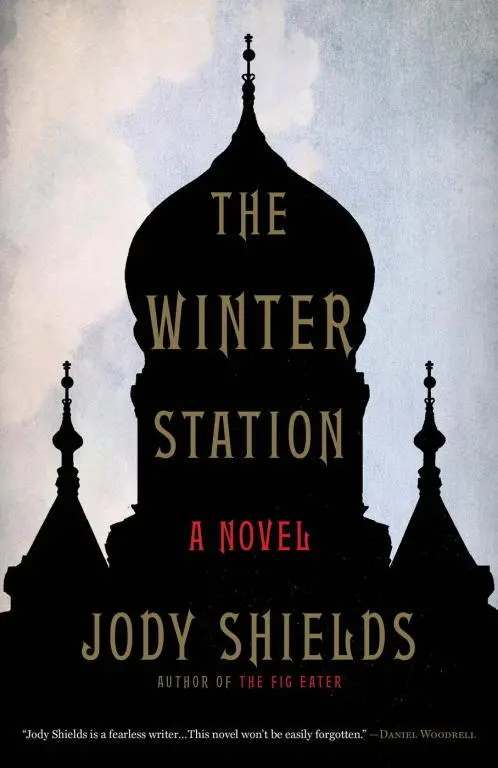
Jody Shields - The Winter Station
Здесь есть возможность читать онлайн «Jody Shields - The Winter Station» весь текст электронной книги совершенно бесплатно (целиком полную версию без сокращений). В некоторых случаях можно слушать аудио, скачать через торрент в формате fb2 и присутствует краткое содержание. Город: New York, Год выпуска: 2018, ISBN: 2018, Издательство: Little, Brown and Company, Жанр: Историческая проза, thriller_medical, на английском языке. Описание произведения, (предисловие) а так же отзывы посетителей доступны на портале библиотеки ЛибКат.
- Название:The Winter Station
- Автор:
- Издательство:Little, Brown and Company
- Жанр:
- Год:2018
- Город:New York
- ISBN:978-0-316-38532-9
- Рейтинг книги:5 / 5. Голосов: 1
-
Избранное:Добавить в избранное
- Отзывы:
-
Ваша оценка:
The Winter Station: краткое содержание, описание и аннотация
Предлагаем к чтению аннотацию, описание, краткое содержание или предисловие (зависит от того, что написал сам автор книги «The Winter Station»). Если вы не нашли необходимую информацию о книге — напишите в комментариях, мы постараемся отыскать её.
1910: people are mysteriously dying at an alarming rate in the Russian-ruled city of Kharbin, a major railway outpost in Northern China. Strangely, some of the dead bodies vanish before they can be identified.
During a dangerously cold winter in a city gripped by fear, the Baron, a wealthy Russian aristocrat and the city’s medical commissioner, is determined to stop this mysterious plague. Battling local customs, an occupying army, and a brutal epidemic with no name, the Baron is torn between duty and compassion, between Western medical science and respect for Chinese tradition. His allies include a French doctor, a black marketeer, and a charismatic Chinese dwarf. His greatest refuge is the intimacy he shares with his young Chinese wife—but she has secrets of her own.
Based on a true story that has been lost to history, set during the last days of imperial Russia, THE WINTER STATION is a richly textured and brilliant novel about mortality, fear and love.
The Winter Station — читать онлайн бесплатно полную книгу (весь текст) целиком
Ниже представлен текст книги, разбитый по страницам. Система сохранения места последней прочитанной страницы, позволяет с удобством читать онлайн бесплатно книгу «The Winter Station», без необходимости каждый раз заново искать на чём Вы остановились. Поставьте закладку, и сможете в любой момент перейти на страницу, на которой закончили чтение.
Интервал:
Закладка:
“I’ve told you everything I can remember.” She frowned, struggling to describe the encounter. “The fortune-teller was tired. Many people were waiting. It was a small crowded room.” Uneasy, she twisted her fingers together.
“Nothing else?”
“No.”
“Was Chang pleased with his future?”
“Yes. He gave me a gift. See.” Chang had brought a colorful printed paper titled “The Chart of Disappearing Cold” with nine rows of nine circles to mark eighty-one days from the winter solstice until spring. A count to carry them through the bitter season.
“Very pretty. What did the fortune-teller say to Chang?”
“‘There is no escape from the unchangeableness of change.’ Xuanxue is the dark law of mysterious things.”
That was no comfort. He carried the words like a closed book to bed. His body slowly eased into a familiar position and in the moment before sleep, Li Ju slipped in beside him and found his cold hand under the quilt. Her fingertips playfully pressed the inside of his wrist, pretending to read his mo . She wasn’t trained but had memorized the twenty-four descriptions in the ancient lexicon for him. The loving connection of mo was part of their intimate play. He hoped this didn’t mock or betray the tradition that he regarded as profound. To her, the mo was poetry, direction, joy. What he desired. A touch and an incantation, mysterious and strange, linked to pleasure.
She communicated her desire to him in the language of the mo . Sometimes she instructed him to be rough with her, like “rain-soaked sand.” At other times, she desired “a smooth succession of rolling pearls.” He was certain their imaginations never matched but arousal was mutual.
When she was younger and he first took her to bed, he was uncertain, afraid that something in her education or background would make her reject his tenderness. He exposed his nakedness to her only gradually, wearing a loose robe, understanding that his large hairy body with loose fatty flesh was totally foreign to her. The mo was their game, a coaxing seduction.
“Sand over water,” she whispered in his ear.
A line of ink on paper was irreversible. Skin was more forgiving. Skin changed with the touch of a finger. He dedicated his calligraphy to his wife. Her body was the paper; the brush traced a pattern of intimacy. Pressing memory into a line with the ink. If he had explained this to her, she would have smiled, made a gesture of dismissal.
Xiansheng, his teacher, didn’t recognize this tribute, his secret state of mind. The Baron felt himself a deceiver. But his teacher had once stated that the cao shu, the delicate, lively grass-style calligraphy, could be successfully learned only against a background of quietly rippling water or by witnessing snakes as they writhed and fought.
The Russo-Chinese Bank was a palatial building with chandeliers and marble floors. The serenity of the main room was interrupted by an echoing click-click-click, steady as the noise of insects, as each clerk at a desk worked with an abacus. Overhead, ceiling fans delicately vibrated in the hot air radiating up from the blue-and-white porcelain stoves in the corners. The Baron stamped snow from his boots on the threshold mat and noticed Andreev across the room, finishing a transaction with a clerk. The Baron handed a chit to the teller behind the window and was issued a stack of rubles and a few heavy silver pesos. He decided to wait for Andreev on the upholstered settee and savor the pleasure of a warm room.
Andreev bundled up his papers, bowed to the clerk, and greeted the Baron. “A cold day for business. My shoulders ache from walking outside in this frigid temperature. Like a clenched fist.” He shrugged his shoulders, stretched his arms, and nestled into the plush cushions next to the Baron.
“December weather.” The Baron had just started relaxing in the heat.
“I don’t need reminding. You’ve probably already started preparing for the Great Lent.”
“Not yet.” The Baron wondered if Andreev should be invited to dinner before the fast started. Was he hinting at this? He peered at the man’s face but sensed he was already distracted.
“I heard the gold is stored upstairs.” Andreev glanced up at the open gallery circling the dome of the building.
“Gold?”
“Prince Kugusev persuaded the Upper Amur River Gold Mining Company to deposit their ingots here. See the guard?” His eyes followed the dim figure of a man pacing with a rifle on the open gallery above them. “The guard marched around the gallery until the prince complained his boots were too noisy. Maybe the soldier is barefoot now.” Andreev’s face wrinkled into a grin.
“All quiet today. But how do you have information about this gold?”
“Talk drifts downriver.”
“Seems very innocent.”
“I recently supplied two men who went north as far as Manchouli in Manchuria. They hunted birds, strange fierce animals. I saw the skins they brought back. I introduced Alexiovich, the Russian hunter, to his Jesuit guide. Alexiovich came back with a collection of dead animals, swore he’d never return.”
“Jesuits were the first explorers allowed in Manchuria by the Imperial Throne, over two hundred years ago.”
“Manchuria is barely settled but it has dangers that make Kharbin seem like a cradle. Hutzul bandits swoop in on horseback, kill entire villages. The Russian said they’d walked into a village where everyone had died of a sickness.”
The Baron’s attention flared like a match. “A sickness?”
Andreev was startled by the Baron’s interest. “All I know is they found one man who was still alive. Blood everywhere. They thought it was a Hutzul massacre. The Jesuit priest was too late to save his soul.”
“What was this sickness?”
“I don’t know.”
“Where can I find this Russian, Alexiovich?”
Uneasy with the Baron’s insistence, Andreev put on a false smile, attempted to take back his words. “He told me very little. What I heard, I’ve mostly forgotten.”
“But you must know how to contact him, since you delivered supplies for his expedition.”
“My men made the delivery to him. I don’t drive goods around Kharbin.”
Their exchange became jagged, stressful, as both men recognized it had decayed into evasion and falsehood. The superior man is master of his demeanor. The Baron relaxed his mouth. “I see. You might recollect the information later.”
“Yes. I might.”
“And the Jesuit priest, Alexiovich’s guide? Who is he? Where is he?”
“Lost in Manchuria. Never returned.”
There was some reason for Andreev to withhold information about the Russian hunter and his guide. Alexiovich was probably a prominent businessman or official who could afford a lengthy expedition. Andreev might know about a scandal, potential blackmail that involved this man. Alexiovich. A common name. A hare’s chase. But he couldn’t afford to dismiss Andreev for keeping this secret. Friends, anyone, could die within a day. A lapse of judgment could be forgiven. Even an insult could be forgotten.
Andreev returned his attention to the Baron. “There’s something you should see. Follow me.”
Outside the bank, the wind caught them and they doubled back on Konnaya Street. Andreev turned into a narrow alley and grabbed the Baron’s arm.
“There. See,” Andreev hissed softly, pointing at two shadowy figures standing so still they seemed embedded in the courtyard wall. One of them had something draped over his arm, perhaps a cloth or net, and they both held stout sticks.
“Don’t move,” Andreev whispered.
One of the silent figures stepped cautiously forward, then stopped. Another step and a pause. Then he leaped forward and smashed his stick into the ground several times.
Читать дальшеИнтервал:
Закладка:
Похожие книги на «The Winter Station»
Представляем Вашему вниманию похожие книги на «The Winter Station» списком для выбора. Мы отобрали схожую по названию и смыслу литературу в надежде предоставить читателям больше вариантов отыскать новые, интересные, ещё непрочитанные произведения.










Обсуждение, отзывы о книге «The Winter Station» и просто собственные мнения читателей. Оставьте ваши комментарии, напишите, что Вы думаете о произведении, его смысле или главных героях. Укажите что конкретно понравилось, а что нет, и почему Вы так считаете.