Peter Vansittart - Secret Protocols
Здесь есть возможность читать онлайн «Peter Vansittart - Secret Protocols» весь текст электронной книги совершенно бесплатно (целиком полную версию без сокращений). В некоторых случаях можно слушать аудио, скачать через торрент в формате fb2 и присутствует краткое содержание. Город: London, Год выпуска: 2014, ISBN: 2014, Издательство: Peter Owen Publishers, Жанр: Историческая проза, на английском языке. Описание произведения, (предисловие) а так же отзывы посетителей доступны на портале библиотеки ЛибКат.
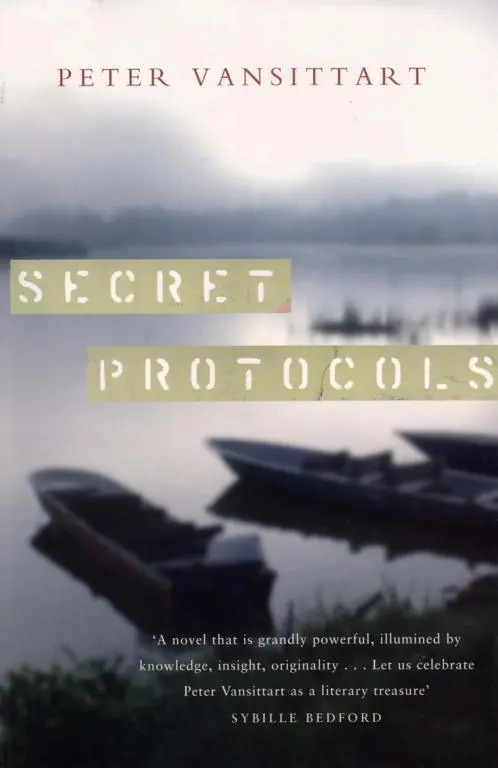
- Название:Secret Protocols
- Автор:
- Издательство:Peter Owen Publishers
- Жанр:
- Год:2014
- Город:London
- ISBN:0-7206-1264-0
- Рейтинг книги:3 / 5. Голосов: 1
-
Избранное:Добавить в избранное
- Отзывы:
-
Ваша оценка:
Secret Protocols: краткое содержание, описание и аннотация
Предлагаем к чтению аннотацию, описание, краткое содержание или предисловие (зависит от того, что написал сам автор книги «Secret Protocols»). Если вы не нашли необходимую информацию о книге — напишите в комментариях, мы постараемся отыскать её.
Erich’s odyssey begins when his Estonian childhood is ended by the outbreak of the Second World War. He arrives in Paris, where in 1945 his life seems full of promise. But a love affair drives him to England to work for the Estonian government-in-exile.
His imagined island of monarchs, Churchill and ‘gentlemen’ evaporates into one of scornful youth, insular adults and an underground of spies, political crooks and fanatics. Sojourns in Europe further underline that war and corruption are not extinct and that, in his own life, the most profound shocks are those of friendship and love. Beneath the drift towards a united Europe Erich realizes that treaties do not always end war, that solemn rites cannot guarantee love and that the inevitable can fail to happen.
Secret Protocols — читать онлайн бесплатно полную книгу (весь текст) целиком
Ниже представлен текст книги, разбитый по страницам. Система сохранения места последней прочитанной страницы, позволяет с удобством читать онлайн бесплатно книгу «Secret Protocols», без необходимости каждый раз заново искать на чём Вы остановились. Поставьте закладку, и сможете в любой момент перейти на страницу, на которой закончили чтение.
Интервал:
Закладка:
I was content to allow her the lead. She had the energies of purpose, exploring half-worlds, provisional frontiers, disguised truths, the exciting lumber in the attic. Myths were ladders into the abyss, charts of the immemorial skull, passwords to history. She had foothold in academic journals. From her, I learnt of our predecessors here: Ligurians, Phocaeans, Greeks, Celts, Saracens. A Spanish coiffure glimpsed in Nice related to a Native American head-dress; a swastika adorned a Phocaean fragment. She researched secret societies, and I could inform her of the Westphalian Vehingerichte tribunals with their camouflaged names and mandatory death sentences; of runes that fascinated Himmler; of the white raven turning black at Ragnarok; of Margarita-Who-Grieves, Sky Child, the Bandit in the Fur Coat, figures transfiguring the Great Northern Night. I supplied notes of Estonian children, clad as animals, celebrating the driving of cattle from winter shelters to summer pasture. Then of Riv Blas, Estonian Robin Hood and of the Son of the Earth, the buffoon who, each Maytide, ridicules pastors, High Folk, Tsars, even God, himself born of an oak.
‘Erich, you, too, are a creature of trees and of midnight sun. Tough roots and unusual dreams.’
Without naming him, I added the Herr General’s account of medieval pastors rebuking isolated steadings for, on Thursdays, honouring Thor and transforming elderly Christians to pigs, especially those once redheaded and those ‘lame as a smith’.
Thus, my indolence was kept within limits, as together we repeopled the landscape. Each November, ageing cottagers trudged into the hills with gifts of bread, fruits, poor-quality wine. For whom? None would say. Fragments exhumed near Valice were linked by academics to a fertility hero annually dismembered by a Lord of the Cup. The Grail, itself sought by credulous SS commissioners, had been for centuries reputed buried on the coast. A dry well, beneath local Venusberg , had gained connection with Mary Magdalene whose body a Count of Provence had disinterred from beneath Saint-Saveur Cathedral, its face showing the white dot where Christ had kissed her. Libération , 1944, had hysterically acclaimed a golden-haired tart as the Magdalene, precursor of the Second Coming, though her hair was a wig and the Second Coming mostly a crop of babies from the American saviours.
Warm southern air and colour, scented, sometimes sickly, Revolutionary Terror, the victims of Sainte Guillotine, and of Maquis reprisals, easily coalesced into confused, banked-down beliefs in the Great Mother demanding blood of the faithless.
All this delighted Nadja, who held a Swedish doctorate for work on Mystery elements in Christianity, her thesis introduced by a text from an apocryphal gospel, Let the Living Arise and Live Anew.
We explored the round Saracenic citadel founded on blocks of a temple to Thracian Dionysus where orgiastic revellers had wrecked a town. Periodically, similar outbreaks, like cattle stampede, enflamed the coast, brief, motiveless. Centuries ago, a pretender had masqueraded as long-dead Nero, luring thousands by a name and dramatic bearing.
On a crag near us were remains of a circular tower, at sundown resembling smashed tanks. Legends persisted of Templar head worship, long surviving in badlands in the hills.
Nadja’s notebooks filled rapidly, completing her like a flower. She was consultant to the local musée , much at home with broken Ligurian vases, intricate arabesques, the spiralled snakes and leaves on Bronze Age cauldrons, fragments of Phoenicia, primitive yet futuristic, like the swastika.
She corresponded with Mr Robert Graves, distrusting him yet anxious for his approval. His replies were punctilious, terse with agreement or contradiction, always useful, lately about naked girls quarrelling over an apple, which he insisted denoted a sacred kingship ritual. She disagreed, but his respect was essential for her self-confidence. ‘I have,’ she told me, ‘the self-doubts of your far-North hanging gods.’
We had, several years back, agreed to investigate la Terre Gaste, where megalithic stones allegedly roamed between dusk and cock-crow, though we had yet to do so. The prospect hovered before us, sombre, not altogether inviting, Jules muttering that interference boded no good. There were whispers even in pimpish casinos and violet-air nightclubs, about the Wild Hunt, bearded muleteers with clubs and ancient rifles pillaging remote hamlets. In la Terre Gaste, dancers said to imitate birds and curse the dead were described in travel brochures by those who had not seen them, though, much photographed in the adjoining Department, as a gypsy-like clan who, like Irish peasants, refused to utter children’s names out of doors between dusk and dawn. Such folk, Nadja reflected, had sailors’ dislike of washing, which imperilled the fortune inherent in skin. A reminder of Estonian labourers retaining hair and nails of the dead, so that, deprived of vital spirit, they would be unable to prey on the living.
In such environment, I could trace my life as quest for a pot of marvels, endangered by periodic breaking of taboo .
Less so inclined, Nadja was more concerned with calculating the age of a cromlech, climbing to inspect a pentacle carved on a corbel always in shadow, discovering an alchemical sign on a font, also Sinatra , in Gothic capitals, on a choir stall.
She often preferred exploring alone, sometimes disappearing for several days, ‘foraging’, usually informing me of failure to find a manuscript, tomb, tradition. Half-joking, she said that failure was a precaution against the evil eye of the universe, jealousy of heaven.
Nevertheless, we shared many pleasures, seeing an old man crossing himself at sight of a cart, reading a court case in which a lawyer, M. Lessore, confessed his conviction that the poisoning of children was caused by their mother offending a hunchback, a Mother Stick. In local lore, Christ had changed a baker’s daughter to an owl for his selling short weight. Hearing this, we were more respectful of our own garden owl, though we had always been mindful that the bird presaged death, and, should we convert to Judaism, blindness. For Celts – her laugh was deep, almost mannish – the owl was the sinister Night Hag.
Serious about her work, Nadja was often humorous, amusing me with revelations of the goddess Ishtar, male in the morning, female in the afternoon. At night? The jury was still out. Not so regarding the tiresome owl, for, later that morning, not boastful but pleased as if over a present, she discovered that the bird was harbinger of crime, evil and disloyal children. ‘So we’re safe! Rightly so!’
For us, no child had come, and, while we would have greeted it as a new friend, we did not lament its absence. Whether we would have been conscientious parents was disputable, occasionally disputed. We might too closely resemble our neighbour Ray Phelps, who, when his son was born, enquired if he would be staying long.
Over coffee or kumquats she could be dreamy, jokey, almost childlike, then revert to stern inspection of file, card index, tome. She often seemed the elder, in the extremes affected by Ishtar, though we were much of an age. She did not affect youthfulness, relying on clear skin, firm bones, long walks, rock climbing, at the mirror shrugging, as if at a caustic witticism deployed too often. Without her customary slight make-up, her face had emphatic lines in chin, cheeks, bone, with a subtle hint of Asia around mouth and in strong black eyes guarded by heavy lids, often less open than they appeared and divided by a proud, somewhat predatory nose. They contemplated, appraised, rejected or darted into the humour that had first attracted me. Not overpowering but insidious.
Читать дальшеИнтервал:
Закладка:
Похожие книги на «Secret Protocols»
Представляем Вашему вниманию похожие книги на «Secret Protocols» списком для выбора. Мы отобрали схожую по названию и смыслу литературу в надежде предоставить читателям больше вариантов отыскать новые, интересные, ещё непрочитанные произведения.










Обсуждение, отзывы о книге «Secret Protocols» и просто собственные мнения читателей. Оставьте ваши комментарии, напишите, что Вы думаете о произведении, его смысле или главных героях. Укажите что конкретно понравилось, а что нет, и почему Вы так считаете.