Jasper Kent - Thirteen Years Later
Здесь есть возможность читать онлайн «Jasper Kent - Thirteen Years Later» весь текст электронной книги совершенно бесплатно (целиком полную версию без сокращений). В некоторых случаях можно слушать аудио, скачать через торрент в формате fb2 и присутствует краткое содержание. Жанр: Историческая проза, Ужасы и Мистика, на английском языке. Описание произведения, (предисловие) а так же отзывы посетителей доступны на портале библиотеки ЛибКат.
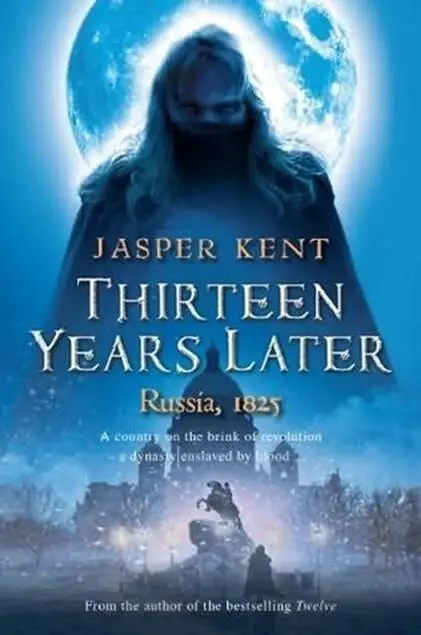
- Название:Thirteen Years Later
- Автор:
- Жанр:
- Год:неизвестен
- ISBN:нет данных
- Рейтинг книги:5 / 5. Голосов: 1
-
Избранное:Добавить в избранное
- Отзывы:
-
Ваша оценка:
Thirteen Years Later: краткое содержание, описание и аннотация
Предлагаем к чтению аннотацию, описание, краткое содержание или предисловие (зависит от того, что написал сам автор книги «Thirteen Years Later»). Если вы не нашли необходимую информацию о книге — напишите в комментариях, мы постараемся отыскать её.
Thirteen Years Later — читать онлайн бесплатно полную книгу (весь текст) целиком
Ниже представлен текст книги, разбитый по страницам. Система сохранения места последней прочитанной страницы, позволяет с удобством читать онлайн бесплатно книгу «Thirteen Years Later», без необходимости каждый раз заново искать на чём Вы остановились. Поставьте закладку, и сможете в любой момент перейти на страницу, на которой закончили чтение.
Интервал:
Закладка:
As might be expected from a man of science, Wylie showed a keen interest in what Iuda had been trying to discover, if not in his methods. When Aleksei mentioned Raisa Styepanovna and her absent reflection, Wylie began to describe one of the experiments from the notebook.
‘As you said,’ he explained to Aleksei, ‘it seems very selective in terms of what can be seen and what cannot. Why can’t you see their clothes, for example? And in the end you’re right, an intelligent selection is being made – the interesting question is, by whom?’
‘How do you mean?’
‘Well, Cain’s thought is – was – that it’s the mind of the viewer that blocks out the image of the vampire. So you do actually see the creature, in terms of the light falling into your eyes, but your brain blots it out. For what reason, he couldn’t tell. The point is, the viewer’s brain isn’t going to be so stupid as to just remove the vampire and leave its clothes standing there empty, or indeed the chain stretching out in the case you described. The brain is trying to protect the viewer in some way, so it presents a coherent picture of the scene – sans vampire.’
‘But how could he test that?’ asked Aleksei.
‘Well, first he thought he’d do it by having people who didn’t know that the creature they were seeing was a vampire look at one in a mirror. If they didn’t know it was a vampire, then why should the brain block it out?’
‘And the result?’
‘Didn’t make any odds. If the viewer was a human or a vampire, informed or uninformed, they still saw nothing.’
‘Concept disproved then,’ said Aleksei.
‘Well, Cain was a bit more meticulous than that. It could be that the information that they’re looking at a vampire is communicated to them by some means other than their prior knowledge.’
‘Smell perhaps?’
‘A possibility, though Cain didn’t get that far. What he did do was sheer, unadulterated genius.’ To Aleksei’s distaste, Wylie didn’t even attempt to hide the admiration in his voice. ‘He got hold of a children’s toy, a diable-en-boîte – a jack-in-the-box we call it in English. You know the sort of thing – you wind it up and then, after a random period of time, a little man pops out and scares the children. The point is though, it’s random. Even if you know it’s going to pop out, you can’t predict when.’
‘I know what you mean,’ confirmed Aleksei.
‘So,’ continued Wylie, ‘he puts the box on a shelf and then lets the viewer – himself in the early experiments, but others later – look at the scene through a mirror. Then the vampire, your lady Raisa Styepanovna, I suppose, walks in and stands in front of the diable-en-boîte. The viewer then describes what they see – of course they don’t see the vampire, they just see the shelf behind with the box on it. Finally Raisa walks away to reveal whether the devil has popped out of the box.’
‘So?’
‘Well, if the viewer had no idea that box was a diable-en-boîte, then universally they never saw it pop open. They looked in the mirror and just saw a box on a shelf. When the vampire walked away, they were surprised when the box suddenly appeared open – most believed it had popped open at that instant. On the other hand, those who did know the box might potentially pop open did sometimes see it do so. But they were wrong just about 50 per cent of the time. Some saw it open when it didn’t, some didn’t when it did. Some got it right. And it doesn’t matter if the viewer is a human or another vampire.’
‘I still don’t see what that proves,’ said Aleksei.
‘It proves Cain’s theory. The viewer couldn’t see the box at all, because the vampire was in the way. So their mind had to re-create the scene behind the vampire from what it remembered before she came in. Thus, if they didn’t know the box could pop open, it just stayed closed the whole time. If they did know, then they subconsciously made a guess as to when it opened, and persuaded themselves that that was what they had seen. And of course, half the time, the guess was wrong.’
Aleksei tried to get his head round the idea. Occasionally he thought he had grasped it, but then it eluded him. ‘I’ll have to think about that a little,’ he confessed. For now, despite that three-word Latin motto, he would take Dr Wylie’s word for it. He had seen Raisa Styepanovna, and her beautiful dress, and the iron ring around her throat and the chain stretching back from it in the mirror, but he had convinced himself he hadn’t.
‘The book!’ he exclaimed, suddenly remembering. Wylie turned and looked at him. ‘When I went back,’ Aleksei continued, ‘when I looked in the mirror, her book was on the table. But when I looked at her, she was reading it.’
‘So your mind,’ explained Wylie, ‘didn’t make the book invisible, or leave it dangling in mid-air, but put it in the sensible place – on the table.’
‘Cain was a very clever man.’ Aleksei had to catch himself – he’d almost said ‘Iuda’.
‘He was about to move on to experiments with silver salts, but then the book ends.’
‘Silver?’
‘Lapis lunaris, that sort of thing,’ said Wylie, as if Aleksei would understand such things beyond recognizing the name. ‘They react to light. I’m not sure what he was planning. The big question in my view is how does the viewer know they’re looking at a vampire even if they haven’t been told? Your idea of smell is an interesting one. And why does it only happen in mirrors? Why aren’t vampires just invisible all the time?’
‘You’re not thinking of picking up where Cain left off, are you?’ asked Aleksei grimly.
‘It might be tempting,’ mused Wylie, ‘but I suspect I might have you to answer to if I did. And I wouldn’t want to end up like him.’ He nodded back the way they had come as he spoke.
Aleksei glanced over his shoulder, and then ahead of them to where the sun, though not yet setting, was low in the west. It would no longer be shining through that hole in the rocks and giving Iuda his cosy shell of protection. And without that protection, there would be nothing to stop the entire horde of voordalaki from having their first decent meal in years. He wished he could have been there to see it.
‘“Princess, I know the fault not thine
That Giray loves thee, oh! then hear
A suppliant wretch, nor spurn her prayer!
Throughout the harem none but thou
Could rival beauties such as mine
Nor make him violate his vow;
Yet, Princess! in thy bosom cold
The heart to mine left thus forlorn,
The love I feel cannot be told,
For passion, Princess, was I born.
Yield me, Giray then; with these tresses
Oft have his wandering fingers played,
My lips still glow with his caresses,
Snatched as he sighed, and swore, and prayed,
Oaths broken now so often plighted!
Hearts mingled once now disunited!”’
Aleksei recognized the words as soon as he heard them. It was Pushkin – The Fountain at Bakhchisaray, published just the previous year. It was apt in more ways than one. The first was the most obvious; that even as he heard the words, Aleksei was sitting in a courtyard, enjoying the fading warmth of the autumn twilight, sipping at a local vodka of which he planned to take home with him at least a bottle and listening to the trickle of the very Fountain of Tears that had inspired Pushkin when he had visited the town.
But more than that, the subject of the poem itself could not help but suggest comparisons to Aleksei’s own life. Zarema, the former favourite of the Khan Giray, had crept into the bedchamber of his new love, the captured Polish princess Maria. Zarema was begging Maria to reject Giray, in the hope that once his love for this new beauty had proved to be a passing fancy, he would return once again to Zarema.
Читать дальшеИнтервал:
Закладка:
Похожие книги на «Thirteen Years Later»
Представляем Вашему вниманию похожие книги на «Thirteen Years Later» списком для выбора. Мы отобрали схожую по названию и смыслу литературу в надежде предоставить читателям больше вариантов отыскать новые, интересные, ещё непрочитанные произведения.







Обсуждение, отзывы о книге «Thirteen Years Later» и просто собственные мнения читателей. Оставьте ваши комментарии, напишите, что Вы думаете о произведении, его смысле или главных героях. Укажите что конкретно понравилось, а что нет, и почему Вы так считаете.