Mary Russell - Doc
Здесь есть возможность читать онлайн «Mary Russell - Doc» весь текст электронной книги совершенно бесплатно (целиком полную версию без сокращений). В некоторых случаях можно слушать аудио, скачать через торрент в формате fb2 и присутствует краткое содержание. Год выпуска: 2011, ISBN: 2011, Издательство: RANDOM HOUSE, Жанр: Историческая проза, на английском языке. Описание произведения, (предисловие) а так же отзывы посетителей доступны на портале библиотеки ЛибКат.
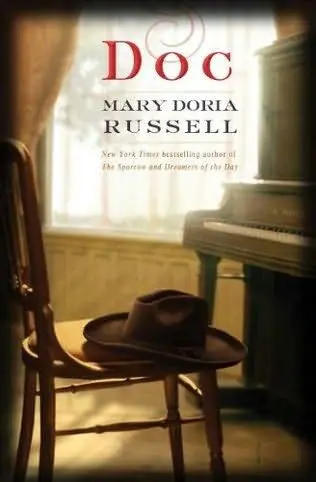
- Название:Doc
- Автор:
- Издательство:RANDOM HOUSE
- Жанр:
- Год:2011
- ISBN:978-0-679-60439-6
- Рейтинг книги:3 / 5. Голосов: 1
-
Избранное:Добавить в избранное
- Отзывы:
-
Ваша оценка:
Doc: краткое содержание, описание и аннотация
Предлагаем к чтению аннотацию, описание, краткое содержание или предисловие (зависит от того, что написал сам автор книги «Doc»). Если вы не нашли необходимую информацию о книге — напишите в комментариях, мы постараемся отыскать её.
Beautifully educated, born to the life of a Southern gentleman, Dr. John Henry Holliday is given an awful choice at the age of twenty-two: die within months in Atlanta or leave everyone and everything he loves in the hope that the dry air and sunshine of the West will restore him to health. Young, scared, lonely, and sick, he arrives on the rawest edge of the Texas frontier just as an economic crash wrecks the dreams of a nation. Soon, with few alternatives open to him, Doc Holliday is gambling professionally; he is also living with Mária Katarina Harony, a high-strung Hungarian whore with dazzling turquoise eyes, who can quote Latin classics right back at him. Kate makes it her business to find Doc the high-stakes poker games that will support them both in high style. It is Kate who insists that the couple travel to Dodge City, because 'that's where the money is.'
And that is where the unlikely friendship of Doc Holliday and Wyatt Earp really begins — before Wyatt Earp is the prototype of the square-jawed, fearless lawman; before Doc Holliday is the quintessential frontier gambler; before the gunfight at the O.K. Corral links their names forever in American frontier mythology — when neither man wanted fame or deserved notoriety.
Authentic, moving, and witty, Mary Doria Russell's fifth novel redefines these two towering figures of the American West and brings to life an extraordinary cast of historical characters, including Holliday's unforgettable companion, Kate. First and last, however, Doc is John Henry Holliday's story, written with compassion, humor, and respect by one of our greatest contemporary storytellers.
Doc — читать онлайн бесплатно полную книгу (весь текст) целиком
Ниже представлен текст книги, разбитый по страницам. Система сохранения места последней прочитанной страницы, позволяет с удобством читать онлайн бесплатно книгу «Doc», без необходимости каждый раз заново искать на чём Вы остановились. Поставьте закладку, и сможете в любой момент перейти на страницу, на которой закончили чтение.
Интервал:
Закладка:
He’d have begun with the Fantasie Impromptu to show off for the children and because he’d been thinking of Chopin since Father von Angensperg’s visit. Next, for the grown-ups, a shift in mood and tempo: the B-flat Minor Nocturne, with its slow, watery, tidal movement, like dawn on the Georgia coast. To keep the boys interested, he’d follow with the Polonaise in F-sharp Minor, which began with a bang but floated toward a lovely quiet conclusion that always seemed to lead him—lost by then, no longer aware of anything but the music—into the Waltz in A Minor, graceful and willowy and almost unbearably sad …
Moved and amazed, Belle and her mother would have exchanged glances, each slightly shaken by how sure she was. For the first time in months and months, they’d have been united in a shared conviction. Yes. Yes, this is the one . This soft-spoken, refined gentleman, with his shy, crooked smile and sly, dry humor, who was so good with children.
In her bed that night, Belle—already girlishly in love—would have remembered every word Dr. Holliday had said and imagined all that remained unspoken. Over the next few weeks, she’d become increasingly aware of how much he yearned for a home, a family, quiet companionship, and gentle affection. That deepening understanding would have placed the two of them on a more equal footing, despite the differences in their backgrounds and their ages.
When they were alone after Doc paid a call, Bob and Alice Wright would’ve talked about the younger couple. In doing so, they’d have rediscovered a little of the intimacy that had been missing for so long, for no matter what their adolescent daughter thought, there was indeed a time when they were in love, and each silently regretted the accumulation of resentment and grievance that had come between them. Bob’s visits to Bessie Earp’s establishment would have become less frequent. Dinner invitations to Captain Grier might well have ceased.
When the time came, Bob and Alice would have given their blessing to Belle and her young man wholeheartedly. The wedding would certainly have been the most splendid in Dodge City’s short history, with local guests from both sides of Front Street and a few Kansas congressmen in attendance as well, along with relatives from Missouri and Georgia.
A year or so later, at the advanced age of seventeen, Belle would have made Bob and Alice grandparents at long last. But while there is every reason to imagine that Dr. and Mrs. John Holliday would have enjoyed a few genuinely good years together, their happiness could not have lasted long, for Belle had lived all her short days amid soldiers, buffalo hunters, railroad laborers, drovers, hookers, and drunks, among whom consumption was as ordinary as venereal disease and as untreatable as measles, whooping cough, and typhoid. Her enviable alabaster skin and delicate, slender beauty at fifteen were in fact the earliest signs of the tuberculosis that would carry her off at twenty-one. Had she and John Henry married, Dodge Citians would have shaken their heads and spoken sadly about the double tragedy when—two years after Belle’s passing—Doc Holliday was laid to rest beside his wife in Prairie Grove Cemetery, not far from Johnnie Sanders’ grave.
The couple’s small orphaned children would remember their handsome young parents only vaguely. A generation later, John Henry Holliday and Isabelle Wright Holliday would exist only as entries in an obscure genealogy: an unremarkable Kansas dentist and the wife who had—like many women of their time—preceded her husband in death.
So. There you are. Nothing could have changed the commonplace calamity that would end those two lives—together or apart—no matter what they did or didn’t do in 1878. The Fates had seen to that.
On the whole, however, things might have turned out better if James Earp hadn’t intervened in something that was none of his affair. He meant no harm, of course. Helpful people never do. James and Bessie were happy; it was natural for him to think that Doc and Kate could be happy, too.
This much is sure. If Kate hadn’t gone back to Doc Holliday on the afternoon of June 10, 1878, you never would have heard of him. You wouldn’t know the names of Wyatt Earp or any of his brothers. The Clantons and McLaurys would be utterly forgotten, and Tombstone would be nothing more than an Arizona ghost town with an ironic name.
Too late now.
Unaware of the road he did not take, John Henry Holliday had instead returned to his hotel room after office hours that day, undressed to his linen, piled up a few pillows, and lay down, moving carefully so as not to upset his chest. Not quite ready for sleep, he leafed through a new dental supply catalog and was pleased to note that the barber chair he’d bought was far less expensive than the new Morrison Dentist’s Model with the reclining mechanism. Turning the page, he saw an advertisement for a motor-driven dental drill that his cousin Robert had recently recommended and was startled by its price.
Bless his heart, he thought. Robert must be doing well.
John Henry himself was still using a foot-pedal model, but it occurred to him then that if he hired little Wilfred Eberhardt to work the drive, it would provide the boy with a small income and save his own energy for the skilled labor.
He laid the catalog aside and, for a time, simply appreciated the quiet in his room. He was alone but not lonely. Kate’s absence was a relief, he decided, not a deprivation. He was, he believed, no longer prone to the paralyzing bouts of homesickness that used to overwhelm him, when the yearning for all he had lost was so powerful that his only defense was to hold himself still until the sorrow washed through him and left him empty again.
The heat was building under the roof of the hotel, but the air was dry and not so hard on him as the murderous swelter of a Southern summer. He closed his eyes and listened to the strangely lulling concert that Dodge in daylight produced. The brassy bellow of cattle, the timpani of hooves. A cello section of bees buzzing in the hotel eaves. The steady percussion of hammers: carpenters shingling the roof of a little house going up on a brand-new street extending north from Front.
Tap tap tap BANG! Tap tap tap BANG …
… The rolling thunder of artillery, the pop and crackle of small-arms fire. Wilson’s voice: “A’lanna’s burnin’, Mr. John! They’re in Jonesboro—” And Chainey’s: “They’ll come here next, Mr. John!” But Mamma is too sick to move, and he has to stand them off, and he can hear the harsh Yankee voices, the crude, vile language—how can they speak so with ladies near? He is firing and firing—all by himself now. Who’ll load the guns if Wilson and Chainey have run off? There’s no one else to save her, and the bullets are gone. “Use a rock, son,” Robert yells, but there aren’t any rocks and—
“ Ce n’est qu’un rêve. Je suis ici, mon amour . It’s only a dream. Wake up, Doc. Je suis ici. Je ne vais pas te quitter .”
Kate was there, her arm over him, her small, soft, living body stretched along his back, her voice low and sure.
“It’s just that goddam dream again. Wake up, Doc. Wake up.”
She was glad she’d arrived at their hotel room in time, pleased to help him as he fought his way out of the nightmare, happy to cradle him during those first awful moments when eviscerating grief seemed briefly fresh.
“It’s over now,” she told him again and again. “I’m here, Doc. I won’t leave you.”
She had forgotten by then that she had not left him, that she had been thrown out. She had no memory of being told not to come back. She knew how to calm him after the dream, how to steady him while he coughed until his throat was raw and his chest burned. She knew how much bourbon was enough to help him catch his breath, and she knew how to make him forget, for a time, his mother’s illness and his own.
Читать дальшеИнтервал:
Закладка:
Похожие книги на «Doc»
Представляем Вашему вниманию похожие книги на «Doc» списком для выбора. Мы отобрали схожую по названию и смыслу литературу в надежде предоставить читателям больше вариантов отыскать новые, интересные, ещё непрочитанные произведения.







Обсуждение, отзывы о книге «Doc» и просто собственные мнения читателей. Оставьте ваши комментарии, напишите, что Вы думаете о произведении, его смысле или главных героях. Укажите что конкретно понравилось, а что нет, и почему Вы так считаете.