Mary Russell - Doc
Здесь есть возможность читать онлайн «Mary Russell - Doc» весь текст электронной книги совершенно бесплатно (целиком полную версию без сокращений). В некоторых случаях можно слушать аудио, скачать через торрент в формате fb2 и присутствует краткое содержание. Год выпуска: 2011, ISBN: 2011, Издательство: RANDOM HOUSE, Жанр: Историческая проза, на английском языке. Описание произведения, (предисловие) а так же отзывы посетителей доступны на портале библиотеки ЛибКат.
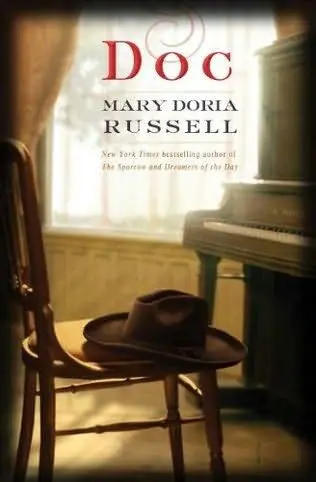
- Название:Doc
- Автор:
- Издательство:RANDOM HOUSE
- Жанр:
- Год:2011
- ISBN:978-0-679-60439-6
- Рейтинг книги:3 / 5. Голосов: 1
-
Избранное:Добавить в избранное
- Отзывы:
-
Ваша оценка:
Doc: краткое содержание, описание и аннотация
Предлагаем к чтению аннотацию, описание, краткое содержание или предисловие (зависит от того, что написал сам автор книги «Doc»). Если вы не нашли необходимую информацию о книге — напишите в комментариях, мы постараемся отыскать её.
Beautifully educated, born to the life of a Southern gentleman, Dr. John Henry Holliday is given an awful choice at the age of twenty-two: die within months in Atlanta or leave everyone and everything he loves in the hope that the dry air and sunshine of the West will restore him to health. Young, scared, lonely, and sick, he arrives on the rawest edge of the Texas frontier just as an economic crash wrecks the dreams of a nation. Soon, with few alternatives open to him, Doc Holliday is gambling professionally; he is also living with Mária Katarina Harony, a high-strung Hungarian whore with dazzling turquoise eyes, who can quote Latin classics right back at him. Kate makes it her business to find Doc the high-stakes poker games that will support them both in high style. It is Kate who insists that the couple travel to Dodge City, because 'that's where the money is.'
And that is where the unlikely friendship of Doc Holliday and Wyatt Earp really begins — before Wyatt Earp is the prototype of the square-jawed, fearless lawman; before Doc Holliday is the quintessential frontier gambler; before the gunfight at the O.K. Corral links their names forever in American frontier mythology — when neither man wanted fame or deserved notoriety.
Authentic, moving, and witty, Mary Doria Russell's fifth novel redefines these two towering figures of the American West and brings to life an extraordinary cast of historical characters, including Holliday's unforgettable companion, Kate. First and last, however, Doc is John Henry Holliday's story, written with compassion, humor, and respect by one of our greatest contemporary storytellers.
Doc — читать онлайн бесплатно полную книгу (весь текст) целиком
Ниже представлен текст книги, разбитый по страницам. Система сохранения места последней прочитанной страницы, позволяет с удобством читать онлайн бесплатно книгу «Doc», без необходимости каждый раз заново искать на чём Вы остановились. Поставьте закладку, и сможете в любой момент перейти на страницу, на которой закончили чтение.
Интервал:
Закладка:
A year after that, James would have even more to reproach himself with, for the aftermath was his fault, too. He would piece everything together during those awful hours after Morg’s funeral, listening to his mother weep.
Virgil newly crippled, worse off than James himself.
Poor young Morgan, cold in his grave.
Wyatt and Doc, fugitives from the law, wanted for killing the bastards who murdered Morg.
All of it, James would think, numb and silent. All of it is my fault.
The irony is that Big Nose Kate had a reputation for meddling and for bossing other people around, but if James Earp hadn’t stuck his big nose into something that was none of his business back in Dodge, Kate would have done all right for herself. She was attractive, resourceful, and ruthless, and she did indeed make her own way all her long life, beholden to no one to the end of her days.
And Doc? Well, none of them could have known it, but absent James Earp’s well-intentioned interference in his life, Dr. John Henry Holliday would have dropped by Bob Wright’s store to pick up his mail on the afternoon of June 10, 1878, and Miss Isabelle Wright would have been waiting for him, behind the counter.
“Dr. Holliday, we are having dinner next Sunday at two,” Belle would have said. “I wonder … would you care to join us?”
That was the fork in the road.
That was when everything might have changed.
Decisions—genuine, deliberate decisions—were never John Henry Holliday’s strong suit. In youth, he’d sought the advice and consent of his large family. In manhood, poor health and a poor economy had dictated his plans, such as they were.
Things happened. He reacted. Sometimes he took a rebellious pride in the cold-blooded courage of certain unconsidered deeds; just as often, he repented of his rashness afterward. There is, for example, nothing quite like lying in a widening pool of your own blood to make you reconsider the wisdom of challenging bad-tempered men with easy access to firearms.
For all his private discipline and the countless hours of practice he devoted to the mastery of useful skills, John Henry had been borne along by ad hoc- ery and happenstance since leaving Atlanta. If questioned, he might even have admitted that part of Kate’s allure was her fearless decisiveness, which left no room for doubt or second-guessing.
“We should go to Dodge,” she said. “That’s where the money is.”
So. Here he was. In Dodge.
Standing in Wright’s General Outfitting on June 10, with a letter from Martha Anne, a copy of Harper’s Weekly , and an intriguingly large envelope from the St. Francis Mission piled on the counter before him, John Henry would not have accepted Isabelle Wright’s invitation immediately, for he would have known that it was extended under a serious misapprehension.
Belle was a Yankee girl. That clouded her judgment in matters of character. Yankees were customarily rude to their inferiors, a fact John Henry found shocking and bewildering while he lived in Philadelphia. In the North, he discovered, courtesy was considered a barometer of genuine esteem; for any decently brought-up Southerner, good manners were simply habitual. Belle Wright undoubtedly believed that his courtesy to Johnnie Sanders and China Joe stemmed from an admirable democratic conviction that they were every bit as good as he was. In reality, he thought himself no better than they: a significant distinction. It was not a surfeit of brotherly love that informed John Henry Holliday’s egalitarianism. It was an acute awareness of the depths of disgrace into which he himself had fallen.
And in any case, it was one thing for a man like himself to befriend Johnnie Sanders; it was altogether another for a young white girl to do so. Indeed, he felt more rather than less respect for Bob Wright, knowing that the man was keeping a close watch on his daughter.
Whatever Miss Isabelle Wright thought, Dr. John Henry Holliday was not oblivious to her interest in him. He had grown up in the company of genteel Southern women schooled from the cradle in the art of flattery and concealment; Belle, by comparison, could be read like an illustrated children’s story. And yet … She was clear-eyed enough to see Johnnie Sanders for what he was. Perhaps she was not entirely wrong about John Henry’s own character. At the very least, she was offering him an opportunity to live up to a lady’s illusions.
Upon reflection, he’d have realized that he wanted to try.
Yes, she was young. And, yes, he suspected that she had learned all her manners by reading Miss Austen’s books, but she had spirit, and living in Dodge as Belle did, she was familiar with the life to which John Henry and his lungs seemed to be adapting.
Martha Anne, by contrast, seemed less and less worldly as time went by, her letters increasingly concerned with the godly and the incorporeal …
Decide, he would have told himself, standing in Bob Wright’s store while Belle gazed at him with level brown eyes, waiting for his response. Spunk up, and make your move.
Besides, it’s only dinner.
“Why, Miss Isabelle, what a charmin’ idea,” he’d have said. “You are very kind to extend the invitation. It will be my pleasure.”
The following Sunday, from the moment he arrived, John Henry would have felt at home. Mrs. Wright’s parlor, with its velvet draperies and little nests of mahogany tables and gilt mirrors and cabinets for curios and porcelain figurines, was very like that of his Aunt Mary Anne’s back in Jonesboro before the war. Even more evocative: Alice Wright’s household, like his Aunt Permelia’s, was densely populated by a lively gang of children, homemade and fostered, mixed thoroughly and well.
Before they sat down to dinner, John Henry would have teased Belle’s brothers and sisters, and drawn out the Eberhardt girls. He’d have treated young Wilfred like an old friend, inquiring after that tooth, which had indeed come out on Friday. And though the dentist’s dinner conversation would have captivated Alice and impressed Bob, John Henry’s eyes would have found Belle’s when they shared a small, skeptical reaction to her father’s Aw, shucks, I’m just a country boy act, or enjoyed a smiling amusement at how easily little boys’ laughter can be provoked.
After their meal, there would have been music, for Mrs. Wright had ordered in a fine new rosewood piano from St. Louis that spring. Belle would certainly have noticed how frequently Dr. Holliday’s glance fell upon the instrument. “None of us can play,” she’d have confided quietly. “I suspect Mother bought it to annoy Mrs. Hoover.”
“Why not just hang a sign in the parlor?” John Henry would have whispered. “It could say, ‘Dodge is not as savage as it seems.’ ”
“More economical,” Belle would have agreed, straight-faced. “And we wouldn’t have to dust it.”
Seeing the young people standing side by side at the piano, Mrs. Wright would have asked, “Dr. Holliday, do you play?” And John Henry would have turned to reply, “Yes, ma’am. Yes, ma’am, I do.”
“Nice to know somebody can,” Bob would have muttered—the first crack in his carapace of resolute pleasantness, for he suspected that Alice had bought that damn thing to annoy him, not Margaret Hoover. “Sit down! Sit down!” he’d have cried heartily. “Give us a tune then, Doc.”
It wouldn’t have taken much persuasion. He hadn’t played in nearly a year, but he often found his hands resting on a table, silently fingering the piece that was running through his mind, and that constituted a sort of mental practice. Settling himself at the keyboard, he’d have checked the tuning—and made the boys shout with envy and admiration—by ripping though the dazzling arpeggio that introduced the Emperor . That was flashy but a good warm-up, and if he crunched a few notes, no one in that room would have noticed.
Читать дальшеИнтервал:
Закладка:
Похожие книги на «Doc»
Представляем Вашему вниманию похожие книги на «Doc» списком для выбора. Мы отобрали схожую по названию и смыслу литературу в надежде предоставить читателям больше вариантов отыскать новые, интересные, ещё непрочитанные произведения.





Обсуждение, отзывы о книге «Doc» и просто собственные мнения читателей. Оставьте ваши комментарии, напишите, что Вы думаете о произведении, его смысле или главных героях. Укажите что конкретно понравилось, а что нет, и почему Вы так считаете.