Mary Russell - Doc
Здесь есть возможность читать онлайн «Mary Russell - Doc» весь текст электронной книги совершенно бесплатно (целиком полную версию без сокращений). В некоторых случаях можно слушать аудио, скачать через торрент в формате fb2 и присутствует краткое содержание. Год выпуска: 2011, ISBN: 2011, Издательство: RANDOM HOUSE, Жанр: Историческая проза, на английском языке. Описание произведения, (предисловие) а так же отзывы посетителей доступны на портале библиотеки ЛибКат.
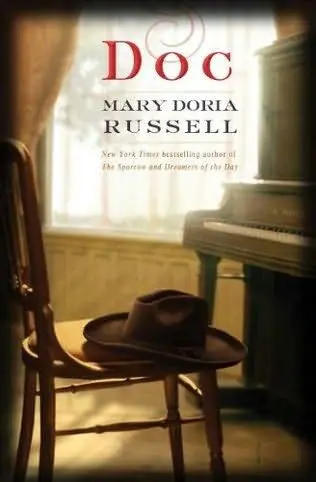
- Название:Doc
- Автор:
- Издательство:RANDOM HOUSE
- Жанр:
- Год:2011
- ISBN:978-0-679-60439-6
- Рейтинг книги:3 / 5. Голосов: 1
-
Избранное:Добавить в избранное
- Отзывы:
-
Ваша оценка:
Doc: краткое содержание, описание и аннотация
Предлагаем к чтению аннотацию, описание, краткое содержание или предисловие (зависит от того, что написал сам автор книги «Doc»). Если вы не нашли необходимую информацию о книге — напишите в комментариях, мы постараемся отыскать её.
Beautifully educated, born to the life of a Southern gentleman, Dr. John Henry Holliday is given an awful choice at the age of twenty-two: die within months in Atlanta or leave everyone and everything he loves in the hope that the dry air and sunshine of the West will restore him to health. Young, scared, lonely, and sick, he arrives on the rawest edge of the Texas frontier just as an economic crash wrecks the dreams of a nation. Soon, with few alternatives open to him, Doc Holliday is gambling professionally; he is also living with Mária Katarina Harony, a high-strung Hungarian whore with dazzling turquoise eyes, who can quote Latin classics right back at him. Kate makes it her business to find Doc the high-stakes poker games that will support them both in high style. It is Kate who insists that the couple travel to Dodge City, because 'that's where the money is.'
And that is where the unlikely friendship of Doc Holliday and Wyatt Earp really begins — before Wyatt Earp is the prototype of the square-jawed, fearless lawman; before Doc Holliday is the quintessential frontier gambler; before the gunfight at the O.K. Corral links their names forever in American frontier mythology — when neither man wanted fame or deserved notoriety.
Authentic, moving, and witty, Mary Doria Russell's fifth novel redefines these two towering figures of the American West and brings to life an extraordinary cast of historical characters, including Holliday's unforgettable companion, Kate. First and last, however, Doc is John Henry Holliday's story, written with compassion, humor, and respect by one of our greatest contemporary storytellers.
Doc — читать онлайн бесплатно полную книгу (весь текст) целиком
Ниже представлен текст книги, разбитый по страницам. Система сохранения места последней прочитанной страницы, позволяет с удобством читать онлайн бесплатно книгу «Doc», без необходимости каждый раз заново искать на чём Вы остановились. Поставьте закладку, и сможете в любой момент перейти на страницу, на которой закончили чтение.
Интервал:
Закладка:
“Bartender!” Kate called, holding up a fan of cash and tossing it into the air. “Doc says the drinks are on him!”
The tension broke and there was a cheer as Kate sailed like royalty through the crowd. She stopped at the bar before she left, dropping five dollars on the polished walnut.
“Bourbon. A bottle,” she ordered. “The good stuff, too, not that piss you sell cowboys.”
There was one last stop, this time at the piano. It was foolish, but Doc had insisted. Kate pulled a gold piece from the carpetbag and offered it. When the startled player reached for the coin, she whipped it away, holding it just beyond his grasp. “Doc says bring somebody in from St. Louis and get this goddam piano tuned. Savvy?”
The piano player nodded. He’ll be gone on the morning train, she thought, but she handed him Doc’s money.
She found Doc out behind Dodge House. To anyone else, he would have looked a picture of nonchalance, leaning against the clapboards.
“Bravo,” she said when she was close. “They won’t forget that, Doc!”
He was rolling a cigarette in the starlight, or trying to. Kate took the makings from him and tapped the tobacco into line.
“We tripled the stake,” she told him, “and the story’ll be all over town by morning. You wait and see. Nobody’s gonna bother you from now on.”
She licked the edge of the paper cylinder, lit the cigarette for him, placed it between his lips. There was the usual little choking cough on the first puff. Nothing to worry about. It was the cheap tobacco they’d been reduced to lately. She’d stop by George Hoover’s shop tomorrow. If he didn’t have any decent North Carolina leaf in stock, she’d order some, special. They had plenty of cash now.
“Let’s go to the Comique,” she suggested in French, pronouncing the theater’s name properly, not the way the locals did. Commie-Q, they called it. Ignorant louts. “We can catch Eddie Foy’s last show.”
He shook his head and went on smoking. For a time, they stood together silently, listening to the night sounds. Clanging pianos. Accordions and fiddles. Inebriated shouts of laughter. The hollow clatter of horns in a cattle pen south of the tracks.
Kate took the cigarette back, pulled the last long drag on it, and flicked the butt into the dirt.
Doc was a tall man. She liked that about him. She liked the feel of stretching up to put her hand on the back of his neck, bringing his face toward hers—pulling him down to her level. She kissed him on the mouth, then stood on tiptoe to bring her lips closer to his ear.
“Come to my bed,” she said in English, the language of the brothels. “I can make you forget all those bastards.”
And that little bitch back home, she thought.
“Come to my bed,” she said, voice low and harsh and foreign, “and I will fuck you blind.”
Later, after, he lay beside her, hands linked behind his head. He’d hardly said a word since they left the Green Front, but Kate was used to that. When Doc wasn’t talking a streak, he dummied up entirely.
She got out of bed and poured them each another drink. “Which reminds me!” she said. “He won’t give the girls his empties.”
Doc looked at her, blank.
“George Hoover?” she reminded him. “Cheap sonofabitch makes the bar girls buy the empty whiskey bottles for their tea. And they hate his wife—reformed hooker.”
“Grier?” Doc asked.
“Nobody knows.” Kate smiled. “But trust me: I’ll find out.”
Second Hand
Bad Beat
The former prince and present priest Alexander Anton Josef Maria Graf von Angensperg had been warned about Johnnie Sanders. “Don’t get your hopes up,” Father John Schoenmakers told him. “These children will break your heart.”
Twenty years on the Osage reservation had taught Father Schoenmakers to temper his expectations. So many obstacles had hindered the spiritual and educational progress of the Indians. The scarcity of Jesuit missionaries and the miserable conditions under which they worked. The violence and dislocation of “Bleeding Kansas,” and of the civil war that followed. The American government’s policy of deliberate neglect. The rapacity and corruption of Indian agents. The fear and intransigence of the Indians themselves.
“The work of bringing the Osage from barbarism to civilization and thence to Christianity is a labor not of years but of centuries,” the stolid Dutch priest told Alexander von Angensperg when the Austrian arrived at St. Francis School in 1872. “Mere decades are too brief a time to yield significant effects.”
The younger priest did not argue with Father Schoenmakers, but neither did he accept what his superior said. Alexander von Angensperg was a man in his prime. Energetic and fit, his hair still cropped cavalry short, his bearing still military, he was an aristocrat accustomed to achievement, eager to serve Christ among the red Indians and prepared to charge through enemy lines when necessary. Father Schoenmakers was not the enemy, of course, but Alexander believed it was important to resist the older man’s weary pessimism. To do this work, it was imperative to keep a high heart and even to believe in miracles.
In that spirit, Alexander had allowed himself to imagine a glowing future for Johnnie Sanders. Finishing his secondary education with the Jesuits in St. Louis. Going on to university. Conversion to the True Faith. Perhaps, one day, even a call to the priesthood, for it was plain to Alexander that the young man would have made a good Jesuit. John Sanders is a natural teacher , Alexander wrote to the Missouri Provincial, outlining the boy’s potential and inquiring about the possibility of a scholarship. He is at home on the borderlands between races, languages, and religions .
The letter was posted just a day before Johnnie disappeared, last autumn.
They did that, Indian children. They disappeared. You had to be on guard all the time. Father Schoenmakers was usually able to detect the signs. “Keep a close eye on Paul Little Dog,” he’d say at breakfast. Or “Joseph Two Birds is going to turn rabbit soon.”
Sometimes, they’d find the runaway before he made it off the mission grounds. Sometimes, they would never see him again. They might hear that a boy had gone back to his tribe; a few days or months or years later, they’d learn that he had been shot dead by a frightened settler west of Wichita, or that he was killed in a skirmish with the cavalry, or that he’d died of alcoholism on the edges of Kansas City. Once boys left St. Francis, their chances of survival fell like stones dropped from a high tower.
Some Indian parents understood that grim fact. They insisted that the runaway return to the mission school, often with a younger brother in tow. Small, skinny children would arrive all but destitute of clothing, and what little they wore was fit only to be burned. The boys themselves had to be dosed for ringworm, bathed with yellow soap, their heads shaved and their bodies rinsed in kerosene to kill their fleas and lice. When that ordeal was over, they were shown how to put on the school uniform and escorted—stumbling in their unfamiliar shoes—to the classroom. Scrubbed, shorn, and shod, they sat on wooden benches, wary as deer. If they spoke English at all, it was a poor and ungrammatical pidgin. Most seemed almost mute.
When Alexander von Angensperg walked into the classroom his own first day, he was nearly as overwhelmed as the newest boy at St. Francis. All the children were dark-haired, dark-eyed, dark-skinned, and they seemed to him as indistinguishable as the dark little chokecherries that grew on bushes near the school. On any given day there might be fifty students in his class, though their numbers were often thinned by illness, for scarlet fever, colds, whooping cough, mumps, and chicken pox spread easily in the close quarters of the dormitories. Each had been given a short, plain Christian name—easy to spell and write, but not memorable, not individual. Daniel, Thomas, Paul, Joseph. Matthew, Mark, Luke, John.
Читать дальшеИнтервал:
Закладка:
Похожие книги на «Doc»
Представляем Вашему вниманию похожие книги на «Doc» списком для выбора. Мы отобрали схожую по названию и смыслу литературу в надежде предоставить читателям больше вариантов отыскать новые, интересные, ещё непрочитанные произведения.









Обсуждение, отзывы о книге «Doc» и просто собственные мнения читателей. Оставьте ваши комментарии, напишите, что Вы думаете о произведении, его смысле или главных героях. Укажите что конкретно понравилось, а что нет, и почему Вы так считаете.