Mary Russell - Doc
Здесь есть возможность читать онлайн «Mary Russell - Doc» весь текст электронной книги совершенно бесплатно (целиком полную версию без сокращений). В некоторых случаях можно слушать аудио, скачать через торрент в формате fb2 и присутствует краткое содержание. Год выпуска: 2011, ISBN: 2011, Издательство: RANDOM HOUSE, Жанр: Историческая проза, на английском языке. Описание произведения, (предисловие) а так же отзывы посетителей доступны на портале библиотеки ЛибКат.
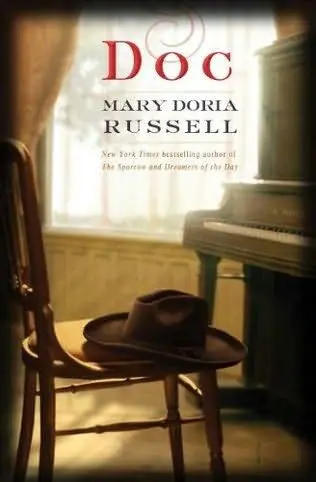
- Название:Doc
- Автор:
- Издательство:RANDOM HOUSE
- Жанр:
- Год:2011
- ISBN:978-0-679-60439-6
- Рейтинг книги:3 / 5. Голосов: 1
-
Избранное:Добавить в избранное
- Отзывы:
-
Ваша оценка:
Doc: краткое содержание, описание и аннотация
Предлагаем к чтению аннотацию, описание, краткое содержание или предисловие (зависит от того, что написал сам автор книги «Doc»). Если вы не нашли необходимую информацию о книге — напишите в комментариях, мы постараемся отыскать её.
Beautifully educated, born to the life of a Southern gentleman, Dr. John Henry Holliday is given an awful choice at the age of twenty-two: die within months in Atlanta or leave everyone and everything he loves in the hope that the dry air and sunshine of the West will restore him to health. Young, scared, lonely, and sick, he arrives on the rawest edge of the Texas frontier just as an economic crash wrecks the dreams of a nation. Soon, with few alternatives open to him, Doc Holliday is gambling professionally; he is also living with Mária Katarina Harony, a high-strung Hungarian whore with dazzling turquoise eyes, who can quote Latin classics right back at him. Kate makes it her business to find Doc the high-stakes poker games that will support them both in high style. It is Kate who insists that the couple travel to Dodge City, because 'that's where the money is.'
And that is where the unlikely friendship of Doc Holliday and Wyatt Earp really begins — before Wyatt Earp is the prototype of the square-jawed, fearless lawman; before Doc Holliday is the quintessential frontier gambler; before the gunfight at the O.K. Corral links their names forever in American frontier mythology — when neither man wanted fame or deserved notoriety.
Authentic, moving, and witty, Mary Doria Russell's fifth novel redefines these two towering figures of the American West and brings to life an extraordinary cast of historical characters, including Holliday's unforgettable companion, Kate. First and last, however, Doc is John Henry Holliday's story, written with compassion, humor, and respect by one of our greatest contemporary storytellers.
Doc — читать онлайн бесплатно полную книгу (весь текст) целиком
Ниже представлен текст книги, разбитый по страницам. Система сохранения места последней прочитанной страницы, позволяет с удобством читать онлайн бесплатно книгу «Doc», без необходимости каждый раз заново искать на чём Вы остановились. Поставьте закладку, и сможете в любой момент перейти на страницу, на которой закончили чтение.
Интервал:
Закладка:
“You want to stop for a drink?” she asked. “Warm up a little?”
“I’m not cold.”
Stage fright, she thought, but he had agreed with her strategy. Drive the stake into Cyclops’ eye early. Word would get around. Her Greek was better than Doc’s, but she knew he’d recognize the quote. “ Enter fearlessly ,” she recited. “ However foreign a man may be, in every crisis it is the high face that will carry him through .”
“Brazen it out,” he translated.
“Words to live by,” she told him.
“Easy for Athena to say.”
Front Street was alive with young men. Sauntering, staggering. Laughing, puking. Shouting in fierce strife or striking lewd whispered bargains with girls in bright dresses. They were giddy with liberty, these boys, free to do anything they could think of and pay for, unwatched by stern elders, unseen by sweethearts back home, unjudged by God, who had surely forsaken this small, bright hellhole in the immense, inhuman darkness that was west Kansas.
“You see, Doc? Dodge is where the money is,” Kate reminded him as they passed saloon after saloon, each filled with tables where months of wages and a year of profits were at hazard. And the season had barely started! “Stick with me,” she told him, squeezing his arm and dancing a little with her own excitement. “I’ll make us rich.”
Johnnie Sanders’ daddy had told no lies. The Indians were crazy gamblers. For numberless centuries and uncounted generations, the Choctaw, the Zuni, the Crow, the Arapaho, the Navajo, the Dakota, the Mandan, the Kiowa, and a hundred other tribes had whiled away countless days and nights playing a thousand games, betting on anything with an outcome that was not assured. Blame boredom. Blame the timeless, unrelieved monotony of land so devoid of trees that owls burrow in the ground for want of better accommodation. Blame vast herds of ceaselessly chewing ruminants who walked with the unsyncopated beat of a Lakota chant. However you explained it, never and nowhere else on earth had gambling occupied the attention of so many for so long as in this flat and featureless land.
Then in a geological instant—just five years’ time—the American bison had been replaced on the prairies by European domestic cattle. Dead red Indians made way for live white bankrupts lured west by the promise of a fresh start on land free for the grabbing. Kate had watched it happen and felt no pity. The Indians all but wiped out? Good riddance. A danger eliminated, nothing more. Millions of buffalo rotting on the plains. Who cares? They were filthy brutes, huge and stupid.
Tout casse, tout passe, tout lasse . That was the lesson Kate learned in childhood. Everything breaks, everything passes, nothing lasts. Revolution was the way of the world, the only constant in life. The question was how to survive it, how to make it pay. Now Kate had her answer: she had Doc. Because, from the Mississippi to the Rockies and beyond, everything had changed, except gambling.
Freighters, hunters, railroad crews. Soldiers, miners, cowboys. Homesteaders, merchants, traders. Con men and thieves. Lawyers, physicians. Judges and journalists. White and black and brown. Male and female. Children and gray-haired elders. Hookers and farmwives.
Everyone gambled. Everyone.
They bet on cockfights, prizefights, dogfights. They bet on horse races, dog races, foot races. They shot craps and played euchre, seven-up, pitch, brag, and all fours. Monte, both three-card and Spanish. Roulette, vingt-et-un , faro, keno, crown and anchor, rouge et noir , and whist. Many of the games were blindingly fast. You’d have thought the money must be burning the hands that held it, so quickly was it thrown down and lost.
In every boomtown and mining camp she’d worked, Kate had watched the gamblers. She was fascinated by the way they tossed the meager return from backbreaking, soul-killing work onto the tables. Their stoic, unmoving faces were a marvel, for she could smell the frantic, feral fear hidden behind those masks. Often such men would turn to her next, hoping to bury their despair in a woman’s body. There was a special satisfaction in telling them, “Go to hell, and don’t come back ’til you got ten dollars.”
She had noticed Doc before he noticed her, back in Texas. Kate still didn’t know quite what to make of him. “Short-term loan,” he’d warn punters who won their first few bets at his faro table. “Quit while you’re ahead,” he always advised. Of course, no one ever listened. Two minutes later, the fools would be broke flat.
If you could find an honest faro game, and if you bucked it sober, and if you could concentrate on the cards, Doc claimed, the odds of beating the dealer were just about even. In practice, the house always won, for faro had no logic discernible by a drunken miner or an ignorant dirt farmer or a witless young cowboy.
“It’s a game for imbeciles! They all play until they lose,” she’d said back in Dallas. “Take their money and be done with it. Why do you warn them?”
Doc sat up, and coughed, and moved to the edge of the bed, where he reached out for the makings and rolled himself a cigarette. He was quiet for a while, smoking and watching the dawn through the window of her room above the bar. She could have counted the bones of his spine, prominent beneath the light linen shirt.
“Because,” he said finally, “they break my heart.”
Startled, she barked a laugh. “They don’t break mine! I like to watch the fuckers get fucked.”
He turned to stare at her, appalled by her coarse language and her callousness. “What an ugly thing to say.”
She was ashamed and so she was belligerent; their first night together ended with their first fight. She threw the skinny, smug, high-hat bastard out of her room. But when the hangover wore off, she found herself remembering his hands. And how clean he was. And how gentle. The next night, she sat down near his table again to watch him deal.
Like Kate, Doc had made a study of gamblers and had theories about the breed. “A game like faro gives men the power to stop time,” he told her when they’d been together for a week. “That is the appeal, in my observation.”
He was lying on his back with his hands behind his head. She thought he was staring at the ceiling, the way some men will when they’ve rolled off. Later she learned that lifting his arms that way helped him breathe.
“When the bet is placed,” he said, “a moment is carved away from the past and the future. In that enchanted moment, anything is possible. A man’s debts and regrets and limitations disappear. He is buyin’ the chance to imagine—for one moment at a time—that the next card I deal will make him rich.”
Speaking, Doc had begun to shiver. Falling silent, he rolled away from her in bed. He’s cold, she thought. A Southerner with no meat on his bones. She came up close behind him, putting an arm over his shoulder, warming his bony back with her own small, soft body. She tried to remember the last time she had listened to such a thoughtful man. Not since her father died, most likely.
“I hate it,” Doc muttered. “Makes me feel like a thief.”
Faro was the means to an end for Doc, something to which he resorted when he needed to accumulate cash to play poker. Kate found that mystifying. Why give up a sure thing for a game you could lose? If it had been up to her, Doc would do nothing but deal faro night after night, raking in money from one idiot after another. Drovers, farmers, soldiers … Every damn one of them would bet his eyeballs out if you gave him odds.
“Who cares how hard they work?” she cried. “Nobody puts a gun to their heads!”
They argued their way through Texas. Nothing she said about faro made any difference to Doc, but she’d won the battle over moving to Dodge. Now that they were here, she would make it her business to find him high-stakes games.
Читать дальшеИнтервал:
Закладка:
Похожие книги на «Doc»
Представляем Вашему вниманию похожие книги на «Doc» списком для выбора. Мы отобрали схожую по названию и смыслу литературу в надежде предоставить читателям больше вариантов отыскать новые, интересные, ещё непрочитанные произведения.






Обсуждение, отзывы о книге «Doc» и просто собственные мнения читателей. Оставьте ваши комментарии, напишите, что Вы думаете о произведении, его смысле или главных героях. Укажите что конкретно понравилось, а что нет, и почему Вы так считаете.