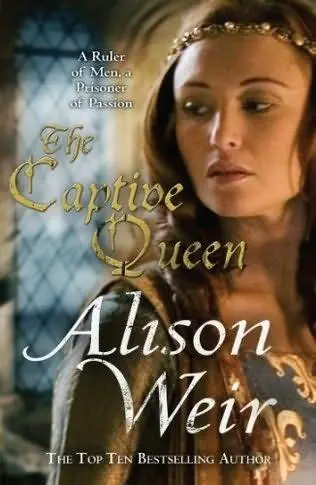
Alison Weir - Captive Queen
Здесь есть возможность читать онлайн «Alison Weir - Captive Queen» весь текст электронной книги совершенно бесплатно (целиком полную версию без сокращений). В некоторых случаях можно слушать аудио, скачать через торрент в формате fb2 и присутствует краткое содержание. Год выпуска: 2010, ISBN: 2010, Издательство: BALLANTINE, Жанр: Историческая проза, на английском языке. Описание произведения, (предисловие) а так же отзывы посетителей доступны на портале библиотеки ЛибКат.
- Название:Captive Queen
- Автор:
- Издательство:BALLANTINE
- Жанр:
- Год:2010
- ISBN:978-0-345-52195-8
- Рейтинг книги:3 / 5. Голосов: 1
-
Избранное:Добавить в избранное
- Отзывы:
-
Ваша оценка:
Captive Queen: краткое содержание, описание и аннотация
Предлагаем к чтению аннотацию, описание, краткое содержание или предисловие (зависит от того, что написал сам автор книги «Captive Queen»). Если вы не нашли необходимую информацию о книге — напишите в комментариях, мы постараемся отыскать её.
Renowned for her highly acclaimed and bestselling British histories, Alison Weir has in recent years made a major impact on the fiction scene with her novels about Queen Elizabeth and Lady Jane Grey. In this latest offering, she imagines the world of Eleanor of Aquitaine, the beautiful twelfth-century woman who was Queen of France until she abandoned her royal husband for the younger man who would become King of England. In a relationship based on lust and a mutual desire for great power, Henry II and Eleanor took over the English throne in 1154, thus beginning one of the most influential reigns and tumultuous royal marriages in all of history. In this novel, Weir uses her extensive knowledge to paint a most vivid portrait of this fascinating woman.
Captive Queen — читать онлайн бесплатно полную книгу (весь текст) целиком
Ниже представлен текст книги, разбитый по страницам. Система сохранения места последней прочитанной страницы, позволяет с удобством читать онлайн бесплатно книгу «Captive Queen», без необходимости каждый раз заново искать на чём Вы остановились. Поставьте закладку, и сможете в любой момент перейти на страницу, на которой закончили чтение.
Интервал:
Закладка:
“Ah, but that was after Rosamund had stolen that love. You didn’t love me anymore; you loved her—you told me so yourself. It was quite affecting!” She spoke the words with scorn, but deep inside the wounds were yet tender: she could still feel the pain. And the prospect of her continuing imprisonment was terrible to her. “Henry, how long do you mean to keep me shut up?”
He had been about to make some tart response to her remark about Rosamund but her sudden changing of the subject put that out of his mind. He wanted to hurt her, wanted to pay her back for the long and bitter year of struggle, strife, and hard fighting for which she, in part, was responsible.
“For as long as you live!” he said venomously.
49
Sarum, Wiltshire, 1175
The forbidding stone keep of Sarum sat solid and foursquare in a windswept position on a grassy mound atop a hill. The hill was in fact an Iron-Age fort, but no one knew much about “the old ones” who had built and occupied it. There were vague rumors that those humps on the top of various hills in the vicinity were their burial mounds, but no one wanted to go near them for fear of the evil shades that might be lurking there, protecting the dead. Later, the site had been colonized by the Romans; bits of masonry and pottery surfaced in the soil from time to time, and once, a fragment of a mosaic pavement, which had the town dwellers shaking their heads and murmuring about heathen spirits. Sarum—or Salisberie, as some now liked to call it—was the source of many legends, and the latest ones were already in the course of being embroidered from the gossip about the Queen of England, who was shut up in the castle.
Nobody had seen her, although she had been there for many moons. She had arrived in secret, at dead of night, and—rumor had it—was kept locked in a secret chamber high in the gloomy keep. Why she was there, no one knew for sure, so discreetly had the business been handled, but the word in the taverns was that she had somehow been responsible for the terrible wars that had raged in England and over the sea for the past year and more. A ferocious conflict it had been, between the King and his sons, who had throughout been abetted by the King of France—and God knew, the French were never to be trusted. It had been an unnatural war, with son against father, husband against wife—if rumor spoke truth. But what could you expect, when the King and all who were of his blood were descended from the Devil?
It was over now, the war, and the quarrel. That was all thanks to St. Thomas the Martyr! No sooner had King Henry done penance at Canterbury for his part in the saint’s wicked murder, than—God be praised—the holy, blissful Becket had won for him a victory against the Scots. The Scottish King, William the Lyon, had been taken prisoner, even as King Henry lay smarting from his stripes, a sure sign of Heaven’s forgiveness and approval. With God and St. Thomas as his allies, Henry FitzEmpress had been seen to be invincible; and King Louis had taken fright and made the Young King and his brothers call off their invasion—the news had been all over the marketplace, brought by carriers in their carts and a man with a dancing bear, lately come from London.
Next the townsfolk heard King Henry had returned to Normandy in triumph, the craven French King had sued for peace, and the English princes had made their submission, on their knees, to their father, who had given them the kiss of peace. A treaty had been signed, and they promised never again to rise against him. My, there had been such a ringing of bells throughout the land in celebration as never before!
Eleanor had heard the bells, clanging deafeningly from the tower of the half-built cathedral that stood, dark and squat like a crouching beast, on the hill beneath the castle mound. She knew those bells must betoken something momentous, some great victory—but whose? Had Henry triumphed over their sons at last? Or had he been defeated, and—joy of joys—would her sons soon come to free her?
Her heart ached for freedom. This was a bleak, inhospitable place—and a dirty one, for water was scarce. Isolated on its hill, and surrounded by strong walls and a deep, wooded ditch, Sarum was cut off from most civilized amenities. And the wind! It roared. Amaria had told her that in the cathedral a clerk could not even hear the man next to him singing. Even in summer the blasts whipped and whistled around the castle and its battlements, rattling doors and shutters; in winter the wind came in gales, lashing the walls and howling mercilessly through the window slits, repeatedly extinguishing the fires they tried to keep blazing in the inadequate braziers. Eleanor’s first winter here had been a martyrdom. She had been so cold, colder than ever before in her life. She had suffered miseries with chilblains, and could only thank God that she had not yet fallen victim to the rheumatism that was chronic in this benighted place.
Otherwise she had to admit that she had little cause to complain. Far from being immured in a dank prison, as the townsfolk imagined, she was housed and served as befit a queen. The chambers assigned to her were no worse than those in her palaces, and equipped with luxuries such as the cushions and rich hangings to which she was accustomed. That had been a welcome surprise until she realized that it betokened the permanence of her confinement. All the same, it was good to enjoy once more the privileges of her rank, even if she was deprived of her freedom. She was served reasonable fare, on silver plates, and the good wines of Bordeaux in jeweled goblets. She had even been provided with illuminated books from the treasury at Winchester, an ivory chess set, and the finest silks for her embroidery. For all this, though, the allowance allocated by the King for her household was small, and did not allow for the employment of more than the one maid.
She was grateful that Amaria had been allowed to accompany her to Sarum, yet exasperated that they were still required to share the same bed. At least she had tactfully succeeded in educating Amaria in the necessity of daily washing herself and changing her body linen, but all the same, they faced an uphill struggle to maintain hygiene in the face of the meager supply of water, and the sometimes brackish mess that passed for it in their washing bowl. She never ceased complaining that they were forced to go about smelling of damp weeds.
Her custodians were men of standing, much trusted by the King: the lawyer and diplomat, Ranulf Glanville, was the very man who had captured the Scottish King the previous year. He told her so himself: it was one of the few items of news she had been permitted to receive. Glanville was an energetic, versatile man, wise and well spoken. He had assisted Henry in his legal reforms, and even written a treatise on the laws and customs of England. Eleanor liked him, for all she suspected that his fidelity to the King precluded him from entirely approving of her, and she had early on taken the initiative in inviting him to dine with her. To her surprise, Glanville readily accepted, and his presence at her table was now a regular arrangement. Their lively and witty conversation, which never, by unspoken mutual consent, strayed to contentious matters, helped considerably to enliven the dreary monotony of her days.
Her other custodian—she was impressed to find that Henry had deemed two necessary to keep her under lock and key—was one of the royal chamberlains, Ralph FitzStephen. He was more taciturn than Glanville, yet although he never scanted his respect toward her, she knew he was wary of her, and she could not warm to him. She knew instinctively that if she wanted any favors, it was Glanville whom she should approach. And indeed, he did his best for her. He allowed her to take the air on the battlements, when the wind permitted; otherwise, it was dangerous to go up there, and she—and the guards who had to accompany her—would run a very real risk of being swept over the parapet if they defied the elements.
Читать дальшеИнтервал:
Закладка:
Похожие книги на «Captive Queen»
Представляем Вашему вниманию похожие книги на «Captive Queen» списком для выбора. Мы отобрали схожую по названию и смыслу литературу в надежде предоставить читателям больше вариантов отыскать новые, интересные, ещё непрочитанные произведения.











Обсуждение, отзывы о книге «Captive Queen» и просто собственные мнения читателей. Оставьте ваши комментарии, напишите, что Вы думаете о произведении, его смысле или главных героях. Укажите что конкретно понравилось, а что нет, и почему Вы так считаете.