Alison Weir - Captive Queen
Здесь есть возможность читать онлайн «Alison Weir - Captive Queen» весь текст электронной книги совершенно бесплатно (целиком полную версию без сокращений). В некоторых случаях можно слушать аудио, скачать через торрент в формате fb2 и присутствует краткое содержание. Год выпуска: 2010, ISBN: 2010, Издательство: BALLANTINE, Жанр: Историческая проза, на английском языке. Описание произведения, (предисловие) а так же отзывы посетителей доступны на портале библиотеки ЛибКат.
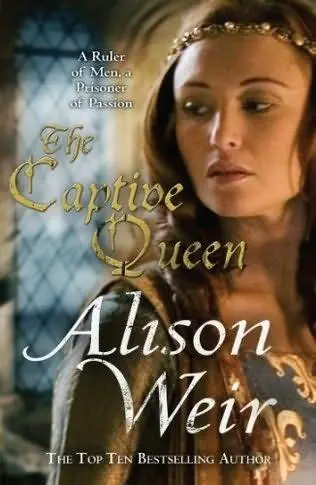
- Название:Captive Queen
- Автор:
- Издательство:BALLANTINE
- Жанр:
- Год:2010
- ISBN:978-0-345-52195-8
- Рейтинг книги:3 / 5. Голосов: 1
-
Избранное:Добавить в избранное
- Отзывы:
-
Ваша оценка:
Captive Queen: краткое содержание, описание и аннотация
Предлагаем к чтению аннотацию, описание, краткое содержание или предисловие (зависит от того, что написал сам автор книги «Captive Queen»). Если вы не нашли необходимую информацию о книге — напишите в комментариях, мы постараемся отыскать её.
Renowned for her highly acclaimed and bestselling British histories, Alison Weir has in recent years made a major impact on the fiction scene with her novels about Queen Elizabeth and Lady Jane Grey. In this latest offering, she imagines the world of Eleanor of Aquitaine, the beautiful twelfth-century woman who was Queen of France until she abandoned her royal husband for the younger man who would become King of England. In a relationship based on lust and a mutual desire for great power, Henry II and Eleanor took over the English throne in 1154, thus beginning one of the most influential reigns and tumultuous royal marriages in all of history. In this novel, Weir uses her extensive knowledge to paint a most vivid portrait of this fascinating woman.
Captive Queen — читать онлайн бесплатно полную книгу (весь текст) целиком
Ниже представлен текст книги, разбитый по страницам. Система сохранения места последней прочитанной страницы, позволяет с удобством читать онлайн бесплатно книгу «Captive Queen», без необходимости каждый раз заново искать на чём Вы остановились. Поставьте закладку, и сможете в любой момент перейти на страницу, на которой закончили чтение.
Интервал:
Закладка:
Raoul came. Eleanor had never before noticed how elegant and attractive he was; for years she’d had eyes for no other man than Henry, and the two men could not have been more different. At forty-nine, Raoul was just six years her senior, long wed to Elizabeth, the heiress of Faye-le-Vineuse, who had borne him two children. He had all the charm and humor of her mother’s family, the seigneurs of Châtellerault, and Eleanor felt entirely comfortable in his company. He was courtly in manner, ready to do her service in any capacity, and full of good advice, much of which she was happy to heed. Most important of all, he shared her tastes in music and literature, and in doing so proved himself to be a true son of the South.
The long hours they spent together discussing the affairs of Anjou and Aquitaine—how she delighted in hearing news of her own land!—lent an intimacy to their relationship. She found herself eagerly anticipating their meetings and captivated by Raoul’s wicked smile and sharp wit. He was capable of saying the most outrageous things—court gossip was his specialty, particularly the amorous exploits of the Queen’s ladies—and she enjoyed his earthy turns of phrase. She found herself laughing a lot of the time she was in his company—something she had not done very much with Henry in recent years. It was all exceedingly pleasant.
She was aware, of course, of something flowering between them. She knew instinctively that Raoul wanted more from her than an uncle should expect of a niece, but she could hardly blame him for that. Her scandalous affair with another uncle, Raymond of Antioch, was universally notorious, and gossip about it had been circulating for years. Raoul would surely have heard it and perhaps concluded that she would not be averse to a similar dalliance with him. The idea amused Eleanor, although she did not consider it seriously. She was content to enjoy flirting with him, indulging in the old familiar game of courtly love—so much a part of their common culture—and keeping him tantalizingly at arm’s length. There was no harm in that, was there?
There were, of course, more serious moments, as when they discussed the problem of Becket.
“I have never met him, but I know I would detest him,” Raoul declared loyally. “He is a dangerous man, and the King your husband is well rid of him.”
“But he is not rid of him, that’s just the point!” Eleanor exclaimed. “However far away he may be, Becket is a constant presence in our lives, stirring up trouble.”
“If I were the King, I would find a way to silence him,” Raoul declared.
“And think what a furor that would cause!” Eleanor rejoined.
“It could be managed … discreetly,” he suggested. She wondered if this was a game, if he was really in earnest.
“And tongues would wag. No, my dear uncle, it wouldn’t work. And Henry would never agree to it. He has many vices, but murder is not one of them.”
“Forgive me, I spoke only in his interests,” he hastened to assure her. “I would rid him of that bastard archbishop if I could.” The hostility in his voice was palpable.
“Why do you hate Becket so?” Eleanor asked curiously.
“Because he has been the cause of your pain,” Raoul answered, his hand closing on hers.
They were alone in her solar, seated at the table with a bank of scrolls and tally sticks before them and the sun streaming in through the windows. Eleanor silently withdrew her hand.
“You are still very beautiful,” Raoul said softly. “You have a fine bone structure that will never age. You are incredible.”
“Flatterer!” She smiled.
“It is the truth. I know beauty when I see it.”
She laughed. “You expect me to believe that—me, an old married woman, pregnant with her tenth child? Look at me, Raoul!”
He did, intently, his deep-set, dark eyes full of yearning, and suddenly they were no longer laughing.
“It is now, especially, that you should be cherished,” he said. “Does the King your husband cherish you as he should, sweet niece?”
“Henry cannot help the fact that the Welsh are in rebellion,” she answered lightly.
“But if he were here, would he be cherishing you as you deserve?” her uncle persisted.
“Of course,” Eleanor answered, although her voice betrayed a lack of conviction. The recent renewal of the bonds she shared with Henry was too fragile, too precious, to be taken for granted. He had never been one to cosset her when she was carrying his children, but then she herself had not encouraged it, preferring to carry on much as normal. Raoul, on the other hand, was a true son of the South, a ladies’ man in every sense, courtly and extravagantly devoted. He would not understand how she and Henry functioned together. He didn’t like Henry anyway, never had—and now he had an ulterior motive for finding fault with him.
He was frowning, still looking at her intently.
“You know he is unfaithful to you,” he said. His words hit her like a slap in the face. She reeled inwardly from the blow. Coming out of the blue, it forced her to confront a truth she had long feared to face. She had wondered countless times if, when they were apart, Henry took his pleasure where he would, but she’d had no proof. And there were those rumors she had heard … She had dismissed them as mere gossip. Yet now it all made sense; and there was no surprise in her. Of course Henry had been unfaithful. How could she ever have doubted it?
“Explain exactly what you mean by that!” she cried, rising and going over to the window, keeping her back to Raoul so he should not see how profoundly he had shocked her. If what he said were true, she would not want to look a fool—the poor, ignorant wife, the last to find out. Already, she feared, she had betrayed herself by her violent response.
Raoul swallowed. He had not expected her to react so explosively. He had thought only to cozen from her an admission of what she already knew, so they could forget Henry and proceed to amorous matters. Clearly he had miscalculated. Still, he had said the words and, hurt her though he knew he must, had no choice but to qualify them.
“When he was in Poitiers, there were women,” he said, swallowing again. “He made no secret of it. They were whores, brought up from the town. Everyone was drunk. It was the same each night.”
Eleanor took a deep breath. It was not as bad as she had feared. She was surprised to find that she was not as hurt by these casual betrayals as she would have expected. What she had feared most, could not have tolerated, emotionally, and as a wife and queen, was her husband becoming involved with one particular woman. It was almost a relief to hear that Henry had resorted to whores.
“Well, he is a man!” she said, as lightly as she could, and turned to face Raoul with a brittle smile. “Women learn to shut their eyes to such things. They mean nothing.”
Raoul guessed she was putting on a brave face, and resolved not to repeat what Henry had said in his cups about a beautiful mistress called Rohese …
He stood up and put his arms around her. He knew it was unfair to take advantage of her when she was so vulnerable, yet he could not help himself. She was still lovely, even in her maturity, and he wanted her. But although there was a brief moment when he thought she would yield, she gaily disentangled herself.
“Raoul, my life is complicated enough, not so much by other women, as by another man!” she told him. “And no, there’s no need to look so shocked. It is nothing like that, at least on Henry’s part.”
“You mean Becket …?” Raoul was staggered.
“I would swear to it. I could understand if it was that; it’s Henry being in thrall to him that is beyond me. He’s never explained it satisfactorily, and I don’t suppose he knows himself why Becket has this hold over him.”
Читать дальшеИнтервал:
Закладка:
Похожие книги на «Captive Queen»
Представляем Вашему вниманию похожие книги на «Captive Queen» списком для выбора. Мы отобрали схожую по названию и смыслу литературу в надежде предоставить читателям больше вариантов отыскать новые, интересные, ещё непрочитанные произведения.





Обсуждение, отзывы о книге «Captive Queen» и просто собственные мнения читателей. Оставьте ваши комментарии, напишите, что Вы думаете о произведении, его смысле или главных героях. Укажите что конкретно понравилось, а что нет, и почему Вы так считаете.