Alison Weir - Captive Queen
Здесь есть возможность читать онлайн «Alison Weir - Captive Queen» весь текст электронной книги совершенно бесплатно (целиком полную версию без сокращений). В некоторых случаях можно слушать аудио, скачать через торрент в формате fb2 и присутствует краткое содержание. Год выпуска: 2010, ISBN: 2010, Издательство: BALLANTINE, Жанр: Историческая проза, на английском языке. Описание произведения, (предисловие) а так же отзывы посетителей доступны на портале библиотеки ЛибКат.
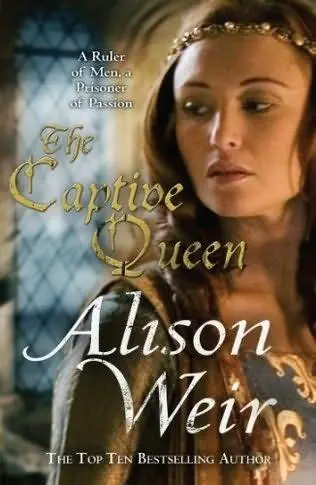
- Название:Captive Queen
- Автор:
- Издательство:BALLANTINE
- Жанр:
- Год:2010
- ISBN:978-0-345-52195-8
- Рейтинг книги:3 / 5. Голосов: 1
-
Избранное:Добавить в избранное
- Отзывы:
-
Ваша оценка:
Captive Queen: краткое содержание, описание и аннотация
Предлагаем к чтению аннотацию, описание, краткое содержание или предисловие (зависит от того, что написал сам автор книги «Captive Queen»). Если вы не нашли необходимую информацию о книге — напишите в комментариях, мы постараемся отыскать её.
Renowned for her highly acclaimed and bestselling British histories, Alison Weir has in recent years made a major impact on the fiction scene with her novels about Queen Elizabeth and Lady Jane Grey. In this latest offering, she imagines the world of Eleanor of Aquitaine, the beautiful twelfth-century woman who was Queen of France until she abandoned her royal husband for the younger man who would become King of England. In a relationship based on lust and a mutual desire for great power, Henry II and Eleanor took over the English throne in 1154, thus beginning one of the most influential reigns and tumultuous royal marriages in all of history. In this novel, Weir uses her extensive knowledge to paint a most vivid portrait of this fascinating woman.
Captive Queen — читать онлайн бесплатно полную книгу (весь текст) целиком
Ниже представлен текст книги, разбитый по страницам. Система сохранения места последней прочитанной страницы, позволяет с удобством читать онлайн бесплатно книгу «Captive Queen», без необходимости каждый раз заново искать на чём Вы остановились. Поставьте закладку, и сможете в любой момент перейти на страницу, на которой закончили чтение.
Интервал:
Закладка:
But Normandy, and the problems of the empire, could not concern her now. God had other priorities. True greatness lay in living in harmony with Him, and in living wisely and exercising power with humility. Often, she knew, she had signally failed, but in the main she had done her very best, even if her motives had not been the purest. You could not say much more for anyone than that. The book of her life was almost written, and nothing could now be changed. She was done with earthly things, had put them firmly behind her. John must go to Hell in his own way …
By the time of Arthur’s disappearance, she’d had enough. She was old and weary, and her task was done. All she sought was the peace and tranquillity of the cloister, and a quiet mind. She had benefited from the former, but doubted she would ever achieve the latter. Had it not been said, by someone very wise—she forgot whom; she was very forgetful these days—that the blood of the wicked would not thrive? Had she and Henry been so very wicked? She feared to answer that question, with death and Divine Judgment fast approaching. And yet—whatever she had done wrong, she’d done her best to atone for it and seek forgiveness. In the final accounting, God Himself would be all-merciful. Maybe she should do as the abbess said and put her trust in Him, and wait for death with serenity, embracing it rather than fearing it.
So here she was, shrouded among the shrouded women. She shifted a little in her narrow bed, causing the young nun to look up from her book. Still dead to the world, the girl thought. She did not know that in the old lady before her, a subtle change was taking place; but Eleanor was herself suddenly, joyously aware that a golden door had burst open, that it opened to receive her and that she was drifting toward the brilliant light streaming from it, dazzling her with its splendor. She had one last, lucid thought: that we none of us know exactly what lies beyond the door to eternity, but if Our Lord is kind, our loved ones will be waiting there for us, in His tender care, and we will be in a Paradise far beyond our earthly imaginings.
If she’d had a voice, she would have cried out in rapture, for, suspended in the light, she saw again, as she had seen in a dream all those years before, a circlet of blazing gold that shone with incomparable brightness, a crown with no beginning and no end, so gloriously pure and resplendent with its assurance of everlasting joy. And in that wonderful moment, as the candle beside her bed flickered gently and went out, and the young nun called in alarm for the abbess, Eleanor felt her soul suddenly take wings and fly, south to Poitiers, Bordeaux, Aquitaine.…
Author’s Note
This novel is based on historical facts. However, Eleanor of Aquitaine lived in the twelfth century, and contemporary sources for her life are relatively sparse, as I found when I was researching my biography of her in the 1970s and 1990s. It was while I was writing that book that I first conceived the idea of writing historical novels. Essentially, the nature of medieval biography, particularly of women, is the piecing together of fragments of information and making sense of them. It can be a frustrating task, as there are often gaps that you know you can never fill. It came to me one day, as I realized I could go no further with one particular avenue of speculation, that the only way of filling those gaps would be to write a historical novel, because—as I then thought—a novelist does not have to work within the same constraints as a historian.
But is that strictly true? What is the point of a historical novel (or film, for that matter) based on a real person if the author does not take pains to make it as authentic as possible? You can’t just make it up. I know, because my readers regularly—and forcefully—tell me so, that people care that what they are reading is close to the truth, given a little dramatic license and the novelist’s informed imagination. For lots of people—myself included—come to history through historical novels, and many will never make that leap from such novels to history books; they rely on the novelist to tell it as it was, and to set the story within an authentic background, with authentic detail. Of course, historical sources are subject to a wide variety of interpretations, but they are the only means we have of learning what happened centuries ago, and it is crucial that a historical novelist, just like a historian, uses them with integrity. Otherwise a novel must lack credibility.
But what of the gaps? How should they be filled? Yes, it is liberating to be able to use one’s imagination, but you can’t simply indulge in flights of fancy, and what you invent must always be credible within the context of what is known. Making up wild, unsubstantiated stories will always fail to convince, and sells short both those who know nothing about the subject and those who know a great deal. There should always be a sound basis for writing anything that is controversial, and any significant departure from the historical record should be explained in an author’s note like this one.
Hence, because this is a novel, I have taken some dramatic license. Eleanor’s sexual adventures, for example, have been the subject of much learned conjecture among historians, but I think there was some substance to the allegations, as I have shown in my biography. The Rosamund legends—the tales of the labyrinth at Woodstock and her murder by Eleanor—belong to much later periods, and are unfounded, yet I have made use of them here.
Elsewhere, for dramatic purposes, or to add descriptive color to the story, I have taken a few liberties. The “Hall of Lost Footsteps” in Poitiers, where Eleanor receives Henry in Chapter 6, was not called that until four decades later, when she remodeled it. Although Eleanor was in fact Duchess of Aquitaine and Countess of Poitou, in order to avoid confusion I have generally referred to her simply as Duchess of Aquitaine.
We know that Eleanor could read, but there is no extant example of her handwriting, so it is not certain that she could write. In this novel, I have assumed—credibly, I think—that she could.
Readers may find the descriptions of Henry II’s rages a little hard to believe, but the Plantagenet temper was notorious, and these scenes are just as they are described by contemporary chroniclers.
Eleanor’s sister Petronilla is sometimes called Aelith in contemporary sources; I have opted to use the name by which she is more commonly known. There is no record of the date of Petronilla’s death, so I have made up my own tale about her fate, suggested by the regular payments in the Exchequer records for generous sums of wine for her.
There is no evidence that Eleanor visited Woodstock in December 1166, when she was traveling in Oxfordshire, but I have made use of the conjectures of some biographers that she did indeed do so, and that she encountered Rosamund de Clifford there.
Nor is there any historical evidence for any homosexual relationship between Henry II and Thomas Becket, although theirs was certainly an exceptionally close friendship. Accounts vary as to the exact words that Henry II used on the occasion when, in great anger and distress, he castigated his courtiers for allowing him to be mocked with contempt by Becket, and so inadvertently prompted four knights to go secretly to England and murder the Archbishop. Traditionally, he is said to have cried, “Who will rid me of this turbulent priest?” Although those words do not appear in any contemporary source, I have used them in this novel because of their dramatic effect.
Some of the dialogue in the book comes from original sources, although I have modified it in parts to make it compatible with a twenty-first-century text. My inspiration, in writing the dialogue, comes from the film The Lion in Winter (1968 version) and Jean Anouilh’s Becket , in both of which pithily modern idioms combine with more archaic forms. This kind of language chimes well with translations of contemporary sources from Latin or Norman French. Such translations can sound surprisingly modern when compared with (for example) Tudor sources in old English.
Читать дальшеИнтервал:
Закладка:
Похожие книги на «Captive Queen»
Представляем Вашему вниманию похожие книги на «Captive Queen» списком для выбора. Мы отобрали схожую по названию и смыслу литературу в надежде предоставить читателям больше вариантов отыскать новые, интересные, ещё непрочитанные произведения.



Обсуждение, отзывы о книге «Captive Queen» и просто собственные мнения читателей. Оставьте ваши комментарии, напишите, что Вы думаете о произведении, его смысле или главных героях. Укажите что конкретно понравилось, а что нет, и почему Вы так считаете.