Alison Weir - Captive Queen
Здесь есть возможность читать онлайн «Alison Weir - Captive Queen» весь текст электронной книги совершенно бесплатно (целиком полную версию без сокращений). В некоторых случаях можно слушать аудио, скачать через торрент в формате fb2 и присутствует краткое содержание. Год выпуска: 2010, ISBN: 2010, Издательство: BALLANTINE, Жанр: Историческая проза, на английском языке. Описание произведения, (предисловие) а так же отзывы посетителей доступны на портале библиотеки ЛибКат.
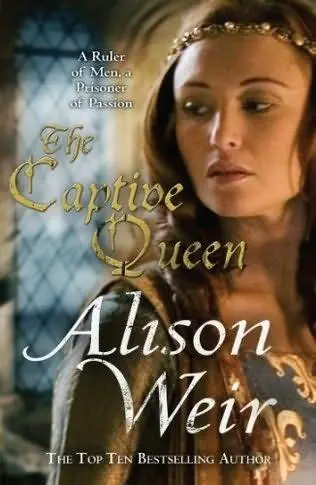
- Название:Captive Queen
- Автор:
- Издательство:BALLANTINE
- Жанр:
- Год:2010
- ISBN:978-0-345-52195-8
- Рейтинг книги:3 / 5. Голосов: 1
-
Избранное:Добавить в избранное
- Отзывы:
-
Ваша оценка:
Captive Queen: краткое содержание, описание и аннотация
Предлагаем к чтению аннотацию, описание, краткое содержание или предисловие (зависит от того, что написал сам автор книги «Captive Queen»). Если вы не нашли необходимую информацию о книге — напишите в комментариях, мы постараемся отыскать её.
Renowned for her highly acclaimed and bestselling British histories, Alison Weir has in recent years made a major impact on the fiction scene with her novels about Queen Elizabeth and Lady Jane Grey. In this latest offering, she imagines the world of Eleanor of Aquitaine, the beautiful twelfth-century woman who was Queen of France until she abandoned her royal husband for the younger man who would become King of England. In a relationship based on lust and a mutual desire for great power, Henry II and Eleanor took over the English throne in 1154, thus beginning one of the most influential reigns and tumultuous royal marriages in all of history. In this novel, Weir uses her extensive knowledge to paint a most vivid portrait of this fascinating woman.
Captive Queen — читать онлайн бесплатно полную книгу (весь текст) целиком
Ниже представлен текст книги, разбитый по страницам. Система сохранения места последней прочитанной страницы, позволяет с удобством читать онлайн бесплатно книгу «Captive Queen», без необходимости каждый раз заново искать на чём Вы остановились. Поставьте закладку, и сможете в любой момент перейти на страницу, на которой закончили чтение.
Интервал:
Закладка:
“Could not the doctors do anything to help him?” Eleanor was shaking her head. Her meat lay congealing in its gravy on her plate, forgotten.
“I doubt they could have done very much,” Marshal said, then took a deep breath. “Besides, he lost the will to live.”
“He must have been sorely grieved at Richard’s hostility, although really, he had only himself to blame for it,” Eleanor said sadly.
Marshal swallowed. “Richard had wounded him deeply. His pride was in the dust. But that was not what finished him. His vassals, vile traitors, had deserted him in droves and gone over to Richard’s side, and toward the end, they brought him a list of those traitors, so that he might know who was to be spared punishment under the terms of the peace treaty, and whom he could not trust in the future. The first name on the list was that of the Lord John.” Marshal was near to tears.
“John!” Eleanor exclaimed. “John betrayed his father? But John was his favorite, the one he loved above all his other children. Why would John have abandoned him?”
“I imagine that Richard and Philip offered sufficient inducements,” Marshal said heavily.
“Thirty pieces of silver, no doubt!” Eleanor cried. “That John, for whose gain Henry broke with Richard, should have forsaken him—I cannot credit it.”
“That was more or less what the King said. And it was at that moment that he lost the will to live. He turned his face to the wall and dismissed us, saying he cared no more for himself or aught for this world. Then he fell into delirium, moaning with grief and pain. His bastard Geoffrey kept watch over him, cradling his head and soothing him. At the last, Henry cried, ‘Shame, shame on a conquered king!’ and fell unconscious. He died the next day without having woken again.”
It had been two days now, and Eleanor had not yet wept for her loss. The numb feeling had persisted, yet she had been conscious of a great tide of emotion waiting to engulf her. Now it broke forth, and she bent her head in her hands and sobbed piteously while Amaria hastened to hold her tightly, and Marshal, unmanned by this display of grief to the point of weeping himself, placed a tentative hand on her heaving shoulders.
He would not tell her the worst of it, he decided. She had enough to bear without that. Of course, she would find it out eventually, but by then she would hopefully be stronger.
He himself had stayed at Chinon only to hear mass and make an offering for his late master’s soul; he knew he had to make all speed to convey to King Richard the news of his father’s death. But after a hurried dinner, when he went to bid a final farewell to his old master before taking the road north, Marshal had been shocked by what he found, for King Henry lay there naked, with even his privities left uncovered, and the room was bare of all his effects. It would have been his servants, he deduced afterward, discovering that they had fled. They must have invaded the death chamber the moment Geoffrey left it, and, like scavengers, stripped the body and stolen all the dead man’s personal belongings, even his trappings of kingship.
In a fever to be on his way, Marshal had enlisted the help of a young knight, William de Trihan, and together they made the body decent and laid it out for burial. They had shifted as best they could in the circumstances. A laundress found them a filet of gold embroidery to serve in place of a crown, and they managed to find a ring, a scepter, and a sword, and some fittingly splendid garments, including fine gloves and gold shoes. Marshal shuddered at the memory, for the body was not a pretty sight, and this last duty had been a great trial for both himself and de Trihan. It was high summer, and hot, and the King had been suffering from a noisome complaint …
No, he would not tell Eleanor any of this. She was still crying, her head against Amaria’s ample bosom, but the storm of her weeping had subsided now, and she was recovering herself, taking deep, gasping breaths. It was a relief to know that she could weep, he thought. It was a significant step on the hard road to coming to terms with her loss and the tragedies that had surrounded it. No doubt she would weep again, many times. But she would heal, for she was strong. She had weathered many tempests in her time, and this latest one would not crush her.
“Forgive me,” Eleanor said, sniffing. “I am forgetting myself.”
“Not at all, my lady,” he assured her.
“If anyone’s entitled to do that, it’s you!” Amaria said tartly, but with affection. William Marshal noted, and approved, of the familiarity. It was good to know that the Queen had someone like this sensible, homely woman to help her through this difficult time.
Eleanor reached for her goblet and took a gulp of the sweet vintage it held.
“That’s better,” she said, essaying a weak smile. “You have seen the King?”
For an awful moment, Marshal thought she was referring to Henry, but then realized she meant Richard.
“Yes, my lady. I brought him the news of King Henry’s passing.”
“And how did he take it?”
“He hastened to Chinon and bade me ride with him there. When he looked down on the late King’s body, his face was unreadable. I could not tell if he felt sorrow or grief …”
“Or even joy or triumph!” Eleanor put in. “I know my son, as I know myself. I am sure he would have experienced very mixed feelings.”
“I am sure of that too,” Marshal agreed. “He did pray awhile before the bier.” He omitted to add that no sooner had Richard gotten to his knees than he was up again, much to the disapproval of many who saw it. And there was no way that he would tell Eleanor that, as the new King rose to his feet, black blood began to flow from the nostrils of the corpse. Or that there were gasps and cries of horror from the observers, who later voiced the firm opinion that Henry’s spirit was angered by his son’s approach and hurried prayers. It had been a ghastly thing to witness, and Marshal still shuddered at the memory of it.
Still, he could tell Eleanor how Richard, no doubt belatedly racked by guilt, had been weeping and lamenting as he followed the body to Fontevrault, which the new King deemed a more fitting resting place for his father than Grandmont, where Henry had long ago expressed a wish to be buried.
“Is that where he lies?” Eleanor asked.
“Yes, my lady. They laid him to rest in the nuns’ choir.”
“It is more fitting than that austere abbey at Grandmont,” she observed. “Richard could not have chosen a better sepulchre, for Henry loved Fontevrault. That is where I myself mean to be buried when my time comes. Has Richard said anything about raising a tomb to his memory?”
“Yes, my lady. Already, he has sent for masons and commissioned an effigy to lie upon it.”
“It seems strange,” she brooded, “that a man to whom many realms were subject should be brought, in the end, to lay in a few feet of earth. Yet it is our mortal lot, and it does us good for God to remind us of the narrowness of death. Yet a tomb, even a fine one, hardly seems to suffice for a man like Henry—for whom the world was not enough.”
She smiled at him, all trace of her tears gone. “Forgive me, old friend. I am pondering aloud.”
“Your pondering was very profound,” he told her, returning the smile. “You are a great philosopher, my lady.”
“Ah, but I never benefit from my own wisdom, William!” She sipped the wine again and reflected. “There was much I did not like in Henry. He could be oppressive and unjust, and his morals were appalling. I hope he repented at the last. I should hate to think of him suffering the torments of Hell for his sins.”
“He did repent,” Marshal assured her.
Читать дальшеИнтервал:
Закладка:
Похожие книги на «Captive Queen»
Представляем Вашему вниманию похожие книги на «Captive Queen» списком для выбора. Мы отобрали схожую по названию и смыслу литературу в надежде предоставить читателям больше вариантов отыскать новые, интересные, ещё непрочитанные произведения.








Обсуждение, отзывы о книге «Captive Queen» и просто собственные мнения читателей. Оставьте ваши комментарии, напишите, что Вы думаете о произведении, его смысле или главных героях. Укажите что конкретно понравилось, а что нет, и почему Вы так считаете.