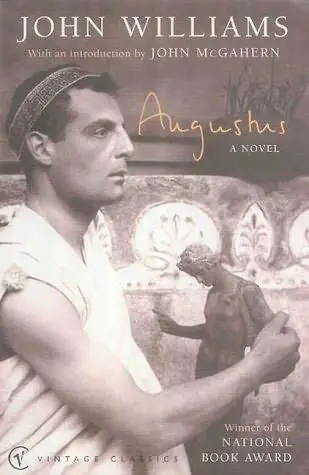
John Williams - Augustus
Здесь есть возможность читать онлайн «John Williams - Augustus» весь текст электронной книги совершенно бесплатно (целиком полную версию без сокращений). В некоторых случаях можно слушать аудио, скачать через торрент в формате fb2 и присутствует краткое содержание. Жанр: Историческая проза, на английском языке. Описание произведения, (предисловие) а так же отзывы посетителей доступны на портале библиотеки ЛибКат.
- Название:Augustus
- Автор:
- Жанр:
- Год:неизвестен
- ISBN:нет данных
- Рейтинг книги:3 / 5. Голосов: 1
-
Избранное:Добавить в избранное
- Отзывы:
-
Ваша оценка:
Augustus: краткое содержание, описание и аннотация
Предлагаем к чтению аннотацию, описание, краткое содержание или предисловие (зависит от того, что написал сам автор книги «Augustus»). Если вы не нашли необходимую информацию о книге — напишите в комментариях, мы постараемся отыскать её.
Augustus — читать онлайн бесплатно полную книгу (весь текст) целиком
Ниже представлен текст книги, разбитый по страницам. Система сохранения места последней прочитанной страницы, позволяет с удобством читать онлайн бесплатно книгу «Augustus», без необходимости каждый раз заново искать на чём Вы остановились. Поставьте закладку, и сможете в любой момент перейти на страницу, на которой закончили чтение.
Интервал:
Закладка:
My dear Vergil, I cannot tell you how long the silence lasted; and I cannot tell you the source ofthat silence, whether it was shock or fear, or whether all (like myself) had been entranced as if by a true Orphic lyre. The torches, burning low, flickered; and for a moment I had the odd feeling that we all, had, indeed, been in that underground of which Horace had been speaking, and were emerging from it, and dared not look back. Mevius stirred, and whispered fiercely, knowing that he would be heard by whom he intended:
"Philippi," he said. "Power of darkness, indeed! Is this not treason against the triumvir? Is this not treason?"
Octavius had not moved during Horace's recital. He raised himself on his couch and sat beside Livia. "Treason?" he said gently. "It is not treason, Mevius. You will not speak so again in my presence." He rose from his couch and crossed over to where Horace sat. "Horace, will you permit me to join you?" he asked.
Our young friend nodded dumbly. Octavius sat beside him, and they spoke quietly. Mevius said no more that night.
Thus, my dear Vergil, did our Horace, who has already endeared himself to us, find the friendship of Octavius Caesar. All in all, it was a successful evening.
IV. Letter: Mevius to Furius Bibaculus, from Rome (January, 38 B. c.)
My dear Furius, I really have not the heart to write you at any length about that disastrous evening at the home of Claudius Nero last September, the only pleasant aspect of which was the absence of our "friend" Vergil. But perhaps it is just as well; for certain events have transpired since that evening that make the whole affair even more ludicrous than it seemed then.
I don't really remember all who were there-Octavius, of course, and those odd friends of his: the Etruscan Maecenas, bejeweled and perfumed, and Agrippa, smelling of sweat and leather. It was ostensibly a literary evening, but my dear, to what low state have our letters fallen! Beside these, even that whining little fraud, Catullus, would have seemed almost a poet. There was Pollio, the pompous ass, to whom one must be pleasant because of his wealth and political power, and to whose works one must listen endlessly if one is foolish enough to attend his parties, stifling laughter at his tragedies and feigning emotion at his verses; Maecenas again, who writes lugubrious poems in a Latin that seems almost like a foreign tongue; Macer, who has discovered a Tenth Muse, that of Dullness; and that extraordinary little upstart, Horace, whom, you will be happy to hear, I rather effectively disposed of during the course of the evening. Garrulous politicians, luxuriant magpies, and illiterate peasants deface the garden of the Muses. It's a wonder that you and I can find the courage to persist!
But the social intrigues that evening were a good deal more interesting than the literary ones, and it is about that which I really want to write you.
We all have heard of Octavius's proclivities toward women. I really had not given the reports so much credence before that evening-he is such a pallid little fellow that one might think a glass of unmixed wine and a fervent embrace would send him lifeless to join his ancestors (whoever they might be)-but now I begin to suspect that there may be truth in them.
The wife of our host was one Livia, of an old and conservative Republican family (I have heard that her own father was slain by the Octavian army at Philippi). An extraordinarily beautiful girl, if you like the type-a modest and proper figure, blonde, perfectly regular features, rather thin lips, softly spoken, and so forth; very much the "patrician ideal," as they say. She is quite young-perhaps eighteen-yet she has already given her husband, who must be thrice her age, one son; and she was again rather visibly pregnant.
I must say, we all had had a great deal to drink; nevertheless, Octavius's conduct was really extraordinary. He mooned over her like a love-sick Catullus, stroking her hand, whispering in her ear, laughing like a boy (though of course he is really little more, despite the importance he has assigned to himself), all manner of nonsense; and all this wholly in view of his own wife (not that that really mattered, though she too is pregnant), and of Livia's husband, who seemed either not to notice or to smile benignly, like an ambitious father rather than a husband whose honor ought to have been offended. At any rate, at the time I thought little of it; I considered it rather vulgar behavior, but what (I asked myself) might one expect from the grandson of an ordinary small-town moneylender. If having filled one cart he wanted to ride in another that was full too, that was his business.
But now, four months after that evening, such an extraordinary scandal is buzzing over Rome that I am sure you would not forgive me if I failed to inform you of it.
Less than two weeks ago, his erstwhile wife, Scribonia, gave birth to a girl child-though it would seem that even the adoptive son of a god should have been able to manage a boy. On the same day of the birth, Octavius delivered to Scribonia a letter of divorce-which in itself was not surprising, the whole affair having been negotiated in advance, it is said.
But-and here is the scandal-in the week following, Tiberius Claudius Nero gave Li via a divorce; and the next day gave her (though pregnant still), and with a substantial dowry, to Octavius as wife; the whole affair was sanctioned by the Senate, priests made sacrifices, the whole foolish business.
How can anyone take such a man seriously? And yet they do.
V. The Journal of Julia, Pandateria (A.D. 4)
The circumstances of my birth were known to all the world long before they were known to me; and when at last I had the age to comprehend them, my father was the ruler of the world, and a god; and the world has long understood that the behavior of a god, however odd to mortals, is natural to himself, and comes at last to seem inevitable to those who must worship him.
Thus it was not strange to me that Livia should be my mother, and Scribonia merely an infrequent visitor to my home-a distant but necessary relative whom everyone endured out of an obscure sense of obligation. My memories ofthat time are dim, and I do not fully trust them; but it seems to me now that those years were ordinarily pleasant. Livia was firm, majestic, and coldly affectionate; it was what I grew to expect.
Unlike most men of his station, my father insisted that I be brought up in the old way, in his own household, in the care of Livia rather than a nurse; that I learn the ways of the household -to weave and sew and cook-in the ancient manner; and yet that I be educated in the degree that would befit the daughter of an Emperor. So in my early years I wove with the slaves of the household, and I learned my letters, Latin and Greek, from my father's slave Phaedrus; and later I studied at wisdom under his old friend and tutor Athenodorus. Though I did not know it at the time, the most significant circumstance of my life was the fact that my father had no other children of his own. It was a fault of the Julian line.
Though I must have seen him seldom in those years, his presence was the strongest of any in my life. I learned my geography from his letters, which were read to me daily; they were sent in packets from wherever he had to be-in Gaul, or Sicily, or Spain; Dalmatia, Greece, Asia, or Egypt.
As I said, I must have seen him seldom; yet even now it seems that he was always there. I can close my eyes, and almost feel myself thrown into the air, and hear the ecstatic laughter of a child's safe terror, and feel the hands catch me from the nothingness into which I had been tossed. I can hear the deep voice, comforting and warm; I can feel the caresses upon my head; I can remember the games of handball and pebbles; and I can feel my legs strain up the little hills in the garden behind our house on the Palatine, as we walked to a point where we could see the city spread out like a gigantic toy beneath us. Yet I cannot remember the face, then. He called me Rome, his "Little Rome."
Читать дальшеИнтервал:
Закладка:
Похожие книги на «Augustus»
Представляем Вашему вниманию похожие книги на «Augustus» списком для выбора. Мы отобрали схожую по названию и смыслу литературу в надежде предоставить читателям больше вариантов отыскать новые, интересные, ещё непрочитанные произведения.











Обсуждение, отзывы о книге «Augustus» и просто собственные мнения читателей. Оставьте ваши комментарии, напишите, что Вы думаете о произведении, его смысле или главных героях. Укажите что конкретно понравилось, а что нет, и почему Вы так считаете.