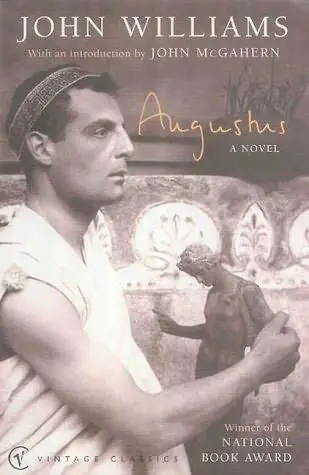
John Williams - Augustus
Здесь есть возможность читать онлайн «John Williams - Augustus» весь текст электронной книги совершенно бесплатно (целиком полную версию без сокращений). В некоторых случаях можно слушать аудио, скачать через торрент в формате fb2 и присутствует краткое содержание. Жанр: Историческая проза, на английском языке. Описание произведения, (предисловие) а так же отзывы посетителей доступны на портале библиотеки ЛибКат.
- Название:Augustus
- Автор:
- Жанр:
- Год:неизвестен
- ISBN:нет данных
- Рейтинг книги:3 / 5. Голосов: 1
-
Избранное:Добавить в избранное
- Отзывы:
-
Ваша оценка:
Augustus: краткое содержание, описание и аннотация
Предлагаем к чтению аннотацию, описание, краткое содержание или предисловие (зависит от того, что написал сам автор книги «Augustus»). Если вы не нашли необходимую информацию о книге — напишите в комментариях, мы постараемся отыскать её.
Augustus — читать онлайн бесплатно полную книгу (весь текст) целиком
Ниже представлен текст книги, разбитый по страницам. Система сохранения места последней прочитанной страницы, позволяет с удобством читать онлайн бесплатно книгу «Augustus», без необходимости каждый раз заново искать на чём Вы остановились. Поставьте закладку, и сможете в любой момент перейти на страницу, на которой закончили чтение.
Интервал:
Закладка:
The coast of Greece boasts few harbors that may be defended, and thus we had no trouble landing the troops that would fight Antonius on the land; and the ships under my command blockaded the sea routes of supply from Syria and Egypt, so that the forces of Cleopatra and Marcus Antonius would have to depend upon the land that they had invaded for food and supplies.
Loath to take Roman lives, throughout the spring we skirmished, hoping to accomplish our ends by blockade rather than warfare; and in the summer, we moved in strength to the Bay of Actium, where the largest enemy force was concentrated, hoping to lure there those who would prevent our pretended invasion, in which effort we succeeded. For Antonius and Cleopatra sailed in full complement to rescue the ships and men we did not intend to attack, and we fell back before the advance of their ships, and let them enter into the bay, whence we knew eventually they would have to emerge. We would force them to do battle upon sea, though their strength was upon the land.
The mouth of the Bay of Actium is less than one half a mile in width, though the bay itself widens considerably within, so that the enemy ships had sufficient room to harbor; and while they rested inside with the soldiers encamped ashore, Caesar Augustus sent troops of infantry and cavalry around them, and fortified the encirclement, so that they would have retreated overland at great cost. And we waited; for we knew that the armies of the East suffered from hunger and disease, and could not muster the strength for a retreat by land. They would fight by sea.
The ships of war that we had returned to Antonius after the defeat of Sextus Pompeius were the largest of the fleet, and I had learned that those which Antonius had built to war against us were even larger, some carrying as many as ten banks of oars and girded by bands of iron against ramming; such ships are nearly invincible against smaller ships in direct combat, when there is no room for maneuvering. Therefore I had much earlier resolved to rely upon a preponderance of lighter and more maneuverable craft, with as few as two and as many as six banks of oars, and none larger; and resolved to be so patient as to lure the Eastern fleets into the open sea. For at Naulochus, against Pompeius, we had had to engage the enemy ships at shore, where swiftness meant nothing.
We waited; and on the first day of September we saw the lines of vessels draw up for battle, and saw those burned for which there were no rowers; and we made ready for what must ensue on the morrow.
The morning came bright and clear; the harbor and the sea beyond were smooth like a table of translucent stone. The Eastern fleet raised sail, as if hoping to pursue us when a wind came up; the oarsmen dipped their oars; and the fleet, like a solid wall, moved slowly across the water. Antonius himself commanded the starboard squadron of the three groups, which were so close that often the opposing oars clashed together, and the fleet of Cleopatra followed behind the center squadron at some distance.
My own squadron opposed that of Antonius; and those ships commanded by Caesar Augustus were at the port. We were beyond the mouth of the bay, and spread thinly out in a curving line, so that we had no ships behind us.
As the enemy advanced toward us, we did not move; he paused at the mouth, and no oar was dipped for several hours. He wished us to move upon him; we did not move; we waited.
And at last, out of impatience or an excess of boldness, the commander of the port squadron moved forward; Caesar Augustus made as if to withdraw from danger; the squadron pursued him without thought, and the rest of the Eastern fleet followed. Our center squadron fell back, we lengthened our line, and the enemy fleet rode in like fish into a net, and we surrounded them.
Until nearly dusk the battle raged, though the issue was at no time in serious doubt. We had not raised sail, and we could move swiftly about the heavier ships; and having hoisted sail, the enemy's decks did not afford room for slingers and archers to work effectively; and the sails offered easy targets for the fireballs that we catapulted. Our own decks were clear so that when we grappled a ship, our soldiers in superior numbers could board the enemy and overcome him with some ease.
He would attempt to form a wedge so that he could break our line; we darted upon him and broke his formation, so that he had to fight singly; he tried to form again, and we broke him again, so that at last each ship fought for its own survival, as best it could. And the sea blazed with ships that we fired, and we heard above the roar of the flames the screams of men who burned with their ships, and the sea darkened with blood and was awash with bodies that had thrown off armor and struggled weakly to escape the fire and the sword and the javelin and the arrow. Though they opposed us, they were Roman soldiers; and we were sickened at the waste.
During all the fighting, the ships of Cleopatra had hung back in the harbor; and when at last a breeze sprang up, she had her sails set into the wind, and swung around the ships that were locked in battle and made toward the open sea where we could not follow.
It was one of those curious moments in the confusion of warfare with which all soldiers are familiar. The vessel which carried Caesar Augustus and my own ship had come so close together that we could look into each other's eyes and could even shout to be heard above the furor; not thirty yards away, where it had been pursued and then left, was the ship of Marcus Antonius. I believe that all three of us saw the purple sail of Cleopatra's departing flagship at the same time. None of us moved; Antonius stood at the prow of his ship as if he were a carven figurehead, looking after his departing Queen. And then he turned to us, though whether he recognized either of us I do not know. His face was without expression, as if it were that of a corpse. Then his arm lifted stiffly, and dropped; and the sails were thrust into the wind, and the great ship turned slowly and gathered speed, and Marcus Antonius followed after his Queen. We watched the pitiful remains of his own ships that escaped the slaughter, and we did not attempt to pursue. I did not see Marcus Antonius again.
Deserted by their leaders, the remaining ships surrendered; we cared for our wounded enemies, who were also our brothers, and we burned those ships that remained of the Antonian force; and Caesar Augustus said that no Roman soldier who had been our enemy should suffer for his bravery, but should be returned to honor and the safety of Rome.
We knew that we had won the world; but there were no songs of victory that night, nor joy among any of us. Late into the night the only sound that could be heard was the lap and hiss of water against the burning hulls and the low moans of the wounded; a glow of burning hung over the harbor, and Caesar Augustus, his face stark and reddened in that glow, stood at the prow of his ship and looked upon the sea that held the bodies of those brave men, both comrade and foe, as if there were no difference between them.
XIII. Letter: Gains Cilnius Maecenas to Titus Livius (12 B. c.)
In reply to your questions:
Did Marcus Antonius plead for his life? Yes. It is a matter best forgotten. I had a copy of the letter once. I have destroyed it. Octavius did not reply to the letter. Antonius was not murdered; he did commit suicide, though he bungled the job and died slowly. Let him remain in peace; do not pursue these matters too far.
The matter of Cleopatra: (1) No, Octavius did not arrange her murder. (2) Yes, he did speak to her in Alexandria before she took her life. (3) Yes, he would have spared her life; he did not want her dead. She was an excellent administrator, and could have retained titular control of Egypt. (4) No, I do not know what went on in the interview at Alexandria; he has never chosen to speak of it.
Читать дальшеИнтервал:
Закладка:
Похожие книги на «Augustus»
Представляем Вашему вниманию похожие книги на «Augustus» списком для выбора. Мы отобрали схожую по названию и смыслу литературу в надежде предоставить читателям больше вариантов отыскать новые, интересные, ещё непрочитанные произведения.











Обсуждение, отзывы о книге «Augustus» и просто собственные мнения читателей. Оставьте ваши комментарии, напишите, что Вы думаете о произведении, его смысле или главных героях. Укажите что конкретно понравилось, а что нет, и почему Вы так считаете.