Bernard Cornwell - Excalibur
Здесь есть возможность читать онлайн «Bernard Cornwell - Excalibur» весь текст электронной книги совершенно бесплатно (целиком полную версию без сокращений). В некоторых случаях можно слушать аудио, скачать через торрент в формате fb2 и присутствует краткое содержание. Год выпуска: 1999, Издательство: MacMillan Publishers, Жанр: Историческая проза, на английском языке. Описание произведения, (предисловие) а так же отзывы посетителей доступны на портале библиотеки ЛибКат.
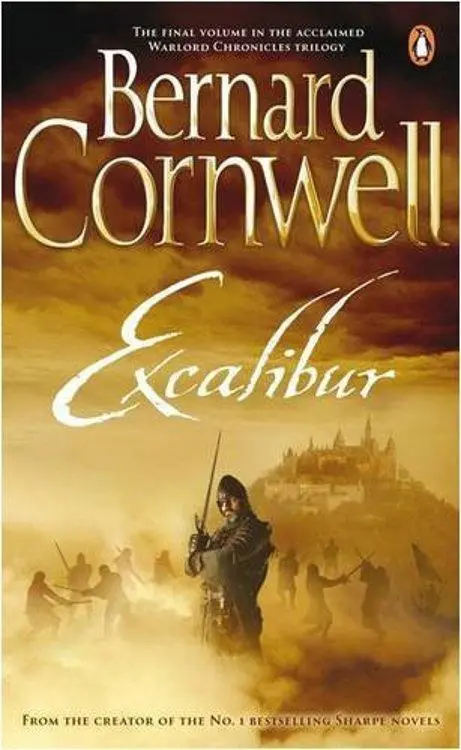
- Название:Excalibur
- Автор:
- Издательство:MacMillan Publishers
- Жанр:
- Год:1999
- ISBN:нет данных
- Рейтинг книги:4 / 5. Голосов: 2
-
Избранное:Добавить в избранное
- Отзывы:
-
Ваша оценка:
Excalibur: краткое содержание, описание и аннотация
Предлагаем к чтению аннотацию, описание, краткое содержание или предисловие (зависит от того, что написал сам автор книги «Excalibur»). Если вы не нашли необходимую информацию о книге — напишите в комментариях, мы постараемся отыскать её.
to Marion Zimmer Bradley's
, the legend of King Arthur has haunted and inspired generations of writers to reinvent the ancient story. In
and
, Bernard Cornwell demonstrated his astonishing ability to make the oft-told legend of King Arthur fresh and new for our time. Now, in this riveting final volume of the
, Cornwell tells the story of Arthur's desperate attempt to triumph over a ruined marriage and the Saxons' determination to destroy him.
Set against the backdrop of the Dark Ages, this brilliant saga continues as seen through the eyes of Derfel, an orphan brought up by Merlin and one of Arthur's warriors. In this book, the aging Arthur has been betrayed by, among others, his beloved Guinevere; but although he is alone and deeply saddened, he still embraces his dreams of a world in which civilization triumphs over brute force. Arthur and his warriors must face the dreaded Saxons — now allied with Arthur's betrayer Lancelot — for the throne of Britain.
This is the tale not only of a broken love remade but also of enemies more subtle than any Saxon spearman — of forces both earthly and unearthly that threaten everything Arthur stands for. When Merlin and Nimue embark on a dangerous quest to summon the Gods back to Britain, they unleash forces that will lead to a last desperate battle on the sands of Camlann, where it seems that Arthur must fail unless Merlin's final enchantment can avert the horror.
Peopled by princesses and bards, warriors and magicians, Excalibur is a story of love, war, loyalty, and betrayal, the unforgettable conclusion to a brilliant retelling of one of the most powerful legends of all time.
Excalibur — читать онлайн бесплатно полную книгу (весь текст) целиком
Ниже представлен текст книги, разбитый по страницам. Система сохранения места последней прочитанной страницы, позволяет с удобством читать онлайн бесплатно книгу «Excalibur», без необходимости каждый раз заново искать на чём Вы остановились. Поставьте закладку, и сможете в любой момент перейти на страницу, на которой закончили чтение.
Интервал:
Закладка:
‘So did you, Lady,’ I said.
She grimaced, and I wished I had not invited the unspoken thought that her great love had been spoiled, though in truth both she and Arthur had outlived that unhappiness. I suppose it must have been there still, a shadow deep back and sometimes during those years a fool would mention Lancelot’s name and a sudden silence would embarrass the air, and once a visiting bard had innocently sung us the Lament of Blodeuwedd, a song that tells of a wife’s unfaithfulness, and the smoky air in the feasting-room had been taut with silence at the song’s end, but for most of that time Arthur and Guinevere were truly happy.
‘Yes,’ Guinevere said, ‘I’m lucky too.’ She spoke curtly, not out of dislike for me, but because she was always uncomfortable with intimate conversations. Only at Mynydd Baddon had she overcome that reserve, and she and I had very nearly become friends at that time, but since then we had drifted apart, not into our old hostility, but into a wary, though affectionate, acquaintanceship. ‘You look good without a beard,’ she said now, changing the subject, ‘it makes you look younger.’
‘I have sworn to grow it again only after Mordred’s death,’ I said.
‘May it be soon. How I would hate to die before that worm fetches his deserts.’ She spoke savagely, and with a real fear that old age might kill her before Mordred died. We were all in our forties now, and few folk lived longer. Merlin, of course, had lasted twice forty years and more, and we all knew others who had made fifty or sixty or even seventy years, but we thought of ourselves as old. Guinevere’s red hair was heavily streaked with grey, but she was still a beauty and her strong face looked on the world with all its old force and arrogance. She paused to watch Gwydre, who had ridden a horse into the arena He raised a hand to her, then put the horse through its paces. He was training the stallion to be a warhorse; to rear and kick with its hoofs and to keep its legs moving even when it was stationary so that no enemy could slice its hamstrings. Guinevere watched him for a while. ‘Do you think he’ll ever be King?’ she asked wistfully.
‘Yes, Lady,’ I said. ‘Mordred will make a mistake sooner or later and then we’ll pounce.’
‘I hope so,’ she said, slipping her arm into mine. I do not think she was trying to give me comfort, but rather to take it for herself. ‘Has Arthur spoken to you of Amhar?’ she asked.
‘Briefly, Lady.’
‘He doesn’t blame you. You do know,that, don’t you?’
‘I’d like to believe it,’ I said.
‘Well you can,’ she said brusquely. ‘His grief is for his failings as a father, not for the death of that little bastard.’
Arthur, I suspect, was far more grieved for Dumnonia than he was for Amhar, for he had been deeply embittered by the news of the massacres. Like me, he wanted revenge, but Mordred commanded an army and Arthur had fewer than two hundred men who would all need to cross the Severn by boat if they were to fight Mordred. In all honesty, he could not see how it was to be done. He even worried about the legality of such vengeance. ‘The men he killed,’ he told me, ‘were his oath-men. He had a right to kill them.’
‘And we have a right to avenge them,’ I insisted, but I am not sure Arthur entirely agreed with me. He always tried to elevate the law above private passion, and according to our law of oaths, which makes the King the source of all law and thus of all oaths, Mordred could do as he wished in his own land. That was the law, and Arthur, being Arthur, worried about breaking it, but he also wept for the men and women who had died and for the children who had been enslaved, and he knew that still more would die or be slave-chained while Mordred lived. The law, it seemed, would have to be bent, but Arthur did not know how to bend it. If we could have marched our men through Gwent, and then led them so far east that we could drop down into the border lands with Lloegyr and so have joined forces with Sagramor, we would have had the strength to beat down Mor-dred’s savage army, or at least meet it on equal terms, but King Meurig obstinately refused to let us cross his lands. If we crossed the Severn by boat we must go without our horses, and then we would find ourselves a long way from Sagramor and divided from him by Mordred’s army. Mordred could defeat us first, then turn back to deal with the Numidian. At least Sagramor still lived, but that was small consolation. Mordred had slaughtered some of Sagramor’s men, but he had failed to find Sagramor himself and he had pulled his men back from the frontier country before Sagramor could launch a savage reprisal. Now, we heard, Sagramor and a hundred and twenty of his men had taken refuge in a fort in the south country. Mordred feared to make an assault on the fort, and Sagramor lacked the strength to sally out and defeat Mordred’s army, and so they watched each other but did not fight, while Cerdic’s Saxons, encouraged by Sagramor’s impotence, again spread west into our land. Mordred detached warbands to oppose those Saxons, oblivious of the messengers who dared cross his land to link Arthur and Sagramor. The messages reflected Sagramor’s frustration — how could he extricate his men and bring them to Siluria? The distance was great and the enemy, far too numerous, lay in his path. We truly did seem helpless to revenge the killings, but then, three weeks after my return from Dumnonia, news came from Meurig’s court. The rumour reached us from Sansum. He had come to Isca with me, but had found Arthur’s company too galling and so, leaving Morgan in her brother’s care, the Bishop had fled to Gwent and now, perhaps to show us how close to the King he was, he sent us a message saying that Mordred was seeking Meurig’s permission to bring his army through Gwent to attack Siluria. Meurig, Sansum said, had not yet decided on an answer.
Arthur repeated Sansum’s message to me. ‘Is the mouse lord plotting again?’ he asked me.
‘He’s supporting both you and Meurig, Lord,’ I said sourly, ‘so that both of you will be grateful to him.’
‘But is it true?’ Arthur wondered. He hoped it was, for if Mordred attacked Arthur, then no law could condemn Arthur for fighting back, and if Mordred marched his army north into Gwent then we could sail south across the Severn Sea and link forces with Sagramor’s men somewhere in southern Dumnonia. Both Galahad and Bishop Emrys doubted that Sansum spoke truly, but I disagreed. Mordred hated Arthur above all men, and I thought that he would be unable to resist the attempt to defeat Arthur in battle.
So, for a few days we made plans. Our men trained with spear and sword, and Arthur sent messengers to Sagramor outlining the campaign he hoped to fight, but either Meurig denied Mordred the permission he needed, or else Mordred decided against an attack on Siluria, for nothing happened. Mordred’s army stayed between us and Sagramor, we heard no more rumours from Sansum and all we could do was wait.
Wait and watch Ceinwyn’s agony. Watch her face sink into gauntness. Listen to her raving, feel the terror in her grip and smell the death that would not come.
Morgan tried new herbs. She laid a cross on Ceinwyn’s naked body, but the touch of the cross made Ceinwyn scream. One night, when Morgan was sleeping, Taliesin made a counter-charm to avert the curse he still believed was the cause of Ceinwyn’s sickness, but though we killed a hare and painted its blood on Ceinwyn’s face, and though we touched her boil-ravaged skin with the burnt tip of an ash wand, and though we surrounded her bed with eagle-stones and elf-bolts and hagstones, and though we hung a bramble sprig and a bunch of mistletoe cut from a lime tree over her bed, and though we laid Excalibur, one of the Treasures of Britain, by her side, the sickness did not lift. We prayed to Grannos, the God of healing, but our prayers were unanswered and our sacrifices ignored. ‘It is a magic too strong,’ Taliesin said sadly. The next night, while Morgan slept again, we brought a Druid from northern Siluria into the sick chamber. He was a country Druid, all beard and stink, and he chanted a spell, then crushed the bones of a skylark into a powder that he stirred into an infusion of mugwort in a holly cup. He trickled the mixture into Ceinwyn’s mouth, but the medicine achieved nothing. The Druid tried feeding her scraps of a black cat’s roasted heart, but she spat them out and so he used his strongest charm, the touch of a corpse’s hand. The hand, which reminded me of the crest of Cerdic’s helmet, was blackened. The Druid touched it on Ceinwyn’s forehead, on her nose and her throat, then pressed it against her scalp as he muttered an incantation, but all he achieved was to transfer a score of his lice from his beard onto her scalp and when we tried to comb them from her head we pulled out the last of her hair. I paid the Druid, then followed him into the courtyard to escape the smoke of the fires on which Taliesin was burning herbs. Morwenna came with me. ‘You must rest, father,’ she said.
Читать дальшеИнтервал:
Закладка:
Похожие книги на «Excalibur»
Представляем Вашему вниманию похожие книги на «Excalibur» списком для выбора. Мы отобрали схожую по названию и смыслу литературу в надежде предоставить читателям больше вариантов отыскать новые, интересные, ещё непрочитанные произведения.




Обсуждение, отзывы о книге «Excalibur» и просто собственные мнения читателей. Оставьте ваши комментарии, напишите, что Вы думаете о произведении, его смысле или главных героях. Укажите что конкретно понравилось, а что нет, и почему Вы так считаете.