Bernard Cornwell - Excalibur
Здесь есть возможность читать онлайн «Bernard Cornwell - Excalibur» весь текст электронной книги совершенно бесплатно (целиком полную версию без сокращений). В некоторых случаях можно слушать аудио, скачать через торрент в формате fb2 и присутствует краткое содержание. Год выпуска: 1999, Издательство: MacMillan Publishers, Жанр: Историческая проза, на английском языке. Описание произведения, (предисловие) а так же отзывы посетителей доступны на портале библиотеки ЛибКат.
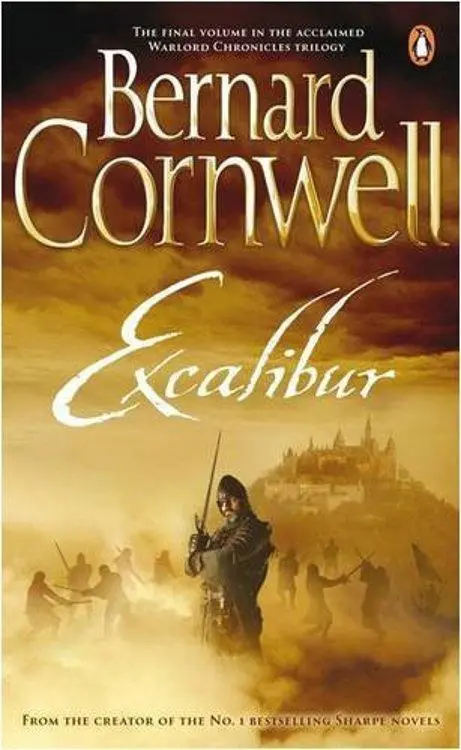
- Название:Excalibur
- Автор:
- Издательство:MacMillan Publishers
- Жанр:
- Год:1999
- ISBN:нет данных
- Рейтинг книги:4 / 5. Голосов: 2
-
Избранное:Добавить в избранное
- Отзывы:
-
Ваша оценка:
Excalibur: краткое содержание, описание и аннотация
Предлагаем к чтению аннотацию, описание, краткое содержание или предисловие (зависит от того, что написал сам автор книги «Excalibur»). Если вы не нашли необходимую информацию о книге — напишите в комментариях, мы постараемся отыскать её.
to Marion Zimmer Bradley's
, the legend of King Arthur has haunted and inspired generations of writers to reinvent the ancient story. In
and
, Bernard Cornwell demonstrated his astonishing ability to make the oft-told legend of King Arthur fresh and new for our time. Now, in this riveting final volume of the
, Cornwell tells the story of Arthur's desperate attempt to triumph over a ruined marriage and the Saxons' determination to destroy him.
Set against the backdrop of the Dark Ages, this brilliant saga continues as seen through the eyes of Derfel, an orphan brought up by Merlin and one of Arthur's warriors. In this book, the aging Arthur has been betrayed by, among others, his beloved Guinevere; but although he is alone and deeply saddened, he still embraces his dreams of a world in which civilization triumphs over brute force. Arthur and his warriors must face the dreaded Saxons — now allied with Arthur's betrayer Lancelot — for the throne of Britain.
This is the tale not only of a broken love remade but also of enemies more subtle than any Saxon spearman — of forces both earthly and unearthly that threaten everything Arthur stands for. When Merlin and Nimue embark on a dangerous quest to summon the Gods back to Britain, they unleash forces that will lead to a last desperate battle on the sands of Camlann, where it seems that Arthur must fail unless Merlin's final enchantment can avert the horror.
Peopled by princesses and bards, warriors and magicians, Excalibur is a story of love, war, loyalty, and betrayal, the unforgettable conclusion to a brilliant retelling of one of the most powerful legends of all time.
Excalibur — читать онлайн бесплатно полную книгу (весь текст) целиком
Ниже представлен текст книги, разбитый по страницам. Система сохранения места последней прочитанной страницы, позволяет с удобством читать онлайн бесплатно книгу «Excalibur», без необходимости каждый раз заново искать на чём Вы остановились. Поставьте закладку, и сможете в любой момент перейти на страницу, на которой закончили чтение.
Интервал:
Закладка:
I saw that the gate had been thrown off its hinges, but there was no sign of a fight and I suspected that the men who had done this thing had been invited into the compound as guests.
‘Who did it, Lord?’ one of my spearmen asked.
‘Mordred,’ I said bleakly.
‘But he’s dead! Or dying!’
‘He just wants us to think that,’ I said, and I could conjure up no other explanation. Taliesin had warned me, and I feared the bard was right. Mordred was not dying at all, but had returned and loosed his warband on his own country. The rumour of his death must have been designed to make people feel safe, and all the while he had been planning to return and kill every spearman who might oppose him. Mordred was throwing off his bridle, and that meant, surely, that after this slaughter at Dun Caric he must have gone east to find Sagramor, or maybe south and west to discover Issa. If Issa still lived. It was our fault, I suppose. After Mynydd Baddon, when Arthur had given up his power, we had thought that Dumnonia would be protected by the spears of men loyal to Arthur and his beliefs, and that Mordred’s power would be curtailed because he had no spearmen. None of us had foreseen that Mynydd Baddon would give our King a taste for war, nor that he would be so successful at battle that he would attract spearmen to his banner. Mordred now had spears, and spears give power, and I was seeing the first exercise of that new power. Mordred was scouring the country of the folk who had been set to limit his power and who might support Gwydre’s claim to the throne.
‘What do we do, Lord?’ Eachern asked me.
‘We go home, Eachern,’ I said, ‘we go home.’ And by ‘home’ I meant Siluria. There was nothing we could do here. We were only eleven men, and I doubted we had any chance of reaching Sagramor whose forces lay so far to the east. Besides, Sagramor needed no help from us in looking after himself. Dun Caric’s small garrison might have given Mordred easy pickings, but he would find plucking the Numidian’s head a much harder task. Nor could I hope to find Issa, if Issa even lived, and so there was nothing to do but go home and feel a frustrated fury. It is hard to describe that fury. At its heart was a cold hate for Mordred, but it was an impotent and aching hate because I knew I could do nothing to give swift vengeance to these folk who had been my people. I felt, too, as though I had let them down. I felt guilt, hate, pity and an aching sadness.
I put one man to stand guard at the open gate while the rest of us dragged the bodies into the hall. I would have liked to burn them, but there was not enough fuel in the compound and we had no time to collapse the hall’s thatched roof onto the corpses, and so we contented ourselves with putting them into a decent line, and then I prayed to Mithras for a chance to bring these folk a fitting revenge. ‘We’d better search the village,’ I told Eachern when the prayer was done, but we were not given the time. The Gods, that day, had abandoned us.
The man at the gate had not been keeping proper watch. I cannot blame him. None of us were in our right minds on that hilltop, and the sentry must have been looking into the blood-soaked compound instead of watching out of the gate, and so he saw the horsemen too late. I heard him shout, but by the time I ran out of the hall the sentry was already dead and a dark-armoured horseman was pulling a spear from his body. ‘Get him!’ I shouted, and started running towards the horseman, and I expected him to turn his horse and ride away, but instead he abandoned his spear and spurred further into the compound and more horsemen immediately followed him.
‘Rally!’ I shouted, and my nine remaining men crowded about me to make a small shield circle, though most of us had no shields for we had dropped them while we hauled the dead into the hall. Some of us did not even have spears. I drew Hywelbane, but I knew there was no hope for there were more than twenty horsemen in the compound now and still more were spurring up the hill. They must have been waiting in the woods beyond the village, maybe expecting Issa’s return. I had done the same myself in Benoic. We would kill the Franks in some remote outpost, then wait in ambush for more, and now I had walked into an identical trap.
I recognized none of the horsemen, and none bore an insignia on their shields. A few of the horsemen had covered their leather shield faces with black pitch, but these men were not Oengus mac Airem’s Blackshields. They were a scarred group of veteran warriors, bearded, ragged-haired and grimly confident. Their leader rode a black horse and had a fine helmet with engraved cheekpieces. He laughed when one of his men unfurled Gwydre’s banner, then he turned and spurred his horse towards me. ‘Lord Derfel,’ he greeted me.
For a few heartbeats I ignored him, looking about the blood-soaked compound in a wild hope that there might still be some means of escape, but we were ringed by the horsemen who waited with spears and swords for the order to kill us. ‘Who are you?’ I asked the man in the decorated helmet. For answer he simply turned back his cheekpieces. Then smiled at me. It was not a pleasant smile, but nor was he was a pleasant man. I was staring at Amhar, one of Arthur’s twin sons. ‘Amhar ap Arthur,’ I greeted him, then spat.
‘Prince Amhar,’ he corrected me. Like his brother Loholt, Amhar had ever been bitter about his illegitimate birth and he must now have decided to adopt the title of Prince even though his father was no king. It would have been a pathetic pretension had not Amhar changed so much since my last brief glimpse of him on the slopes of Mynydd Baddon. He looked older and much more formidable. His beard was fuller, a scar had flecked his nose and his breastplate was scored with a dozen spear strikes. Amhar, it seemed to me, had grown up on the battlefields of Armorica, but maturity had not decreased his sullen resentment. ‘I have not forgotten your insults at Mynydd Baddon,’ he told me, ‘and have longed for the day when I could repay them. But my brother, I think, will be even more pleased to see you.’ It had been I who had held Loholt’s arm while Arthur struck off his hand.
‘Where is your brother?’ I asked.
‘With our King.’
‘And your King is who?’ I asked. I knew the answer, but wanted it confirmed.
‘The same as yours, Derfel,’ Amhar said. ‘My dear cousin, Mordred.’ And where else, I thought, would Amhar and Loholt have gone after the defeat at Mynydd Baddon? Like so many other masterless men of Britain they had sought refuge with Mordred, who had welcomed every desperate sword that came to his banner. And how Mordred must have loved having Arthur’s sons on his side!
‘The King lives?’ I asked.
‘He thrives!’ Amhar said. ‘His Queen sent money to Clovis, and Clovis preferred to take her gold than to fight us.’ He smiled and gestured at his men. ‘So here we are, Derfel. Come to finish what we began this morning.’
‘I shall have your soul for what you did to these folk,’ I said, gesturing with Hywelbane at the blood that still lay black in Dun Caric’s yard.
‘What you will have, Derfel,’ Amhar said, leaning forward on his saddle, ‘is what I, my brother and our cousin decide to give you.’
I stared up at him defiantly. ‘I have served your cousin loyally.’
Amhar smiled. ‘But I doubt he wants your services any more.’
‘Then I shall leave his country,’ I said.
‘I think not,’ Amhar said mildly. ‘I think my King would like to meet you one last time, and I know my brother is eager to have words with you.’
‘I would rather leave,’ I said.
‘No,’ Amhar insisted. ‘You will come with me. Put the sword down.’
‘You must take it, Amhar.’
Читать дальшеИнтервал:
Закладка:
Похожие книги на «Excalibur»
Представляем Вашему вниманию похожие книги на «Excalibur» списком для выбора. Мы отобрали схожую по названию и смыслу литературу в надежде предоставить читателям больше вариантов отыскать новые, интересные, ещё непрочитанные произведения.



Обсуждение, отзывы о книге «Excalibur» и просто собственные мнения читателей. Оставьте ваши комментарии, напишите, что Вы думаете о произведении, его смысле или главных героях. Укажите что конкретно понравилось, а что нет, и почему Вы так считаете.