Anchee Min - Empress Orchid
Здесь есть возможность читать онлайн «Anchee Min - Empress Orchid» весь текст электронной книги совершенно бесплатно (целиком полную версию без сокращений). В некоторых случаях можно слушать аудио, скачать через торрент в формате fb2 и присутствует краткое содержание. Жанр: Историческая проза, на английском языке. Описание произведения, (предисловие) а так же отзывы посетителей доступны на портале библиотеки ЛибКат.
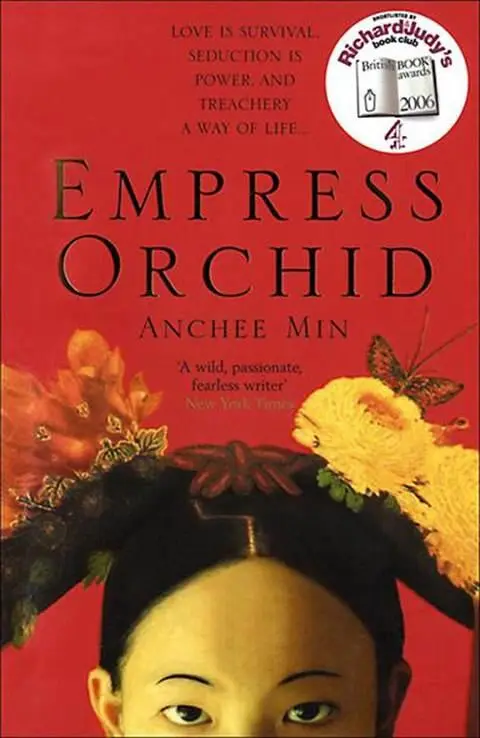
- Название:Empress Orchid
- Автор:
- Жанр:
- Год:неизвестен
- ISBN:нет данных
- Рейтинг книги:3 / 5. Голосов: 1
-
Избранное:Добавить в избранное
- Отзывы:
-
Ваша оценка:
Empress Orchid: краткое содержание, описание и аннотация
Предлагаем к чтению аннотацию, описание, краткое содержание или предисловие (зависит от того, что написал сам автор книги «Empress Orchid»). Если вы не нашли необходимую информацию о книге — напишите в комментариях, мы постараемся отыскать её.
To rescue her family from poverty and avoid marrying her slope-shouldered cousin, seventeen-year-old Orchid competes to be one of the Emperor's wives. When she is chosen as a lower-ranking concubine she enters the erotically charged and ritualised Forbidden City. But beneath its immaculate facade lie whispers of murders and ghosts, and the thousands of concubines will stoop to any lengths to bear the Emperor's son. Orchid trains herself in the art of pleasuring a man, bribes her way into the royal bed, and seduces the monarch, drawing the attention of dangerous foes. Little does she know that China will collapse around her, and that she will be its last Empress.
Empress Orchid — читать онлайн бесплатно полную книгу (весь текст) целиком
Ниже представлен текст книги, разбитый по страницам. Система сохранения места последней прочитанной страницы, позволяет с удобством читать онлайн бесплатно книгу «Empress Orchid», без необходимости каждый раз заново искать на чём Вы остановились. Поставьте закладку, и сможете в любой момент перейти на страницу, на которой закончили чтение.
Интервал:
Закладка:
The good news for me was that I had heard no report of any other pregnancy.
From Prince Kung’s letters I learned that Emperor Hsien Feng had been avoiding audiences since he had signed a new treaty with the foreigners, which acknowledged China’s defeat. Ashamed and humiliated, His Majesty spent his days alone in the Imperial gardens. At night, bodily pleasures had become his escape.
Sick as he was, he demanded round-the-clock entertainment. An-te-hai found out the details from a new friend, His Majesty’s chamber attendant, a eunuch named Chow Tee, a boy from An-te-hai’s hometown.
“His Majesty is drunk most of the time, and he is unable to perform his manhood,” An-te-hai told me. “He enjoys watching his women and orders them to touch themselves while dancing. The parties last all night while His Majesty sleeps.”
I recalled our last visit together. Hsien Feng couldn’t stop talking about his fall. “I have no doubt that I will be shredded into ten thousand pieces by my ancestors when I meet them.” He laughed nervously and coughed. His chest sounded like a wind box. “Doctor Sun Pao-tien has prescribed opium for my pain,” he said. “I don’t really mind dying, because I look forward to being released from my troubles.”
It was no longer a secret to the nation that the Emperor’s health had once again begun to decline. His pale face and empty eyes concerned everyone. Since we had moved back to the Forbidden City, the court’s ministers were ordered to report their state matters to him in his bedroom.
It broke my heart to see Hsien Feng giving up hope. Before he left my palace he said, “I am sorry.” Raising his face from his son’s cradle, he smiled sadly at me. “It is not up to me anymore.”
I looked at my child’s father putting on his dragon robe. He had no strength even to lift his sleeves. It took him three long breaths to get into his shoes.
I must ask him before it is too late to grant me the right to raise our son! The thought came to me while I held the baby and watched Hsien Feng enter his palanquin. I had mentioned my wish before, but there had been no response. According to An-te-hai, the Emperor would never hurt Nuharoo by taking away her right to be the first mother.
My son, who was born on May 1, 1856, was officially named Tung Chih. Tung also stood for “togetherness,” and Chih for “ruling”-that is, ruling together. If I had been superstitious, I would have seen that the name was a prediction itself.
The celebration started the day after his birth and lasted an entire month. Overnight the Forbidden City was turned into a festival. Red lanterns hung from all the trees. Everyone was dressed in red and green. Five opera troupes were invited to the palace to perform. Drums and music filled the air. The shows went on day and night. Drunkenness was rampant among men and women of all ages. The most asked question was “Where is the chamber pot?”
Unfortunately, all the gaiety didn’t stop bad news. No matter how many symbols of good luck and victory we wore, we were losing to the barbarians at the negotiating tables. Minister Chi Ying and Grand Secretary Kuei Liang, Prince Kung’s father-in-law, were sent to represent China. They came back with another humiliating treaty: thirteen nations, including England, France, Japan and Russia, had formed an al-liance against China. They insisted that we open more ports for opium and trade.
I sent a messenger to Prince Kung inviting him to meet his newborn nephew, but secretly I hoped he would also be able to persuade Hsien Feng to attend his audiences.
Prince Kung came immediately, and he looked agitated. I offered him fresh cherries and Lung Ching tea from Hangchow. He drank the tea in gulps as if it was plain water. I felt that I had chosen a bad time for the visit. But the moment Prince Kung saw Tung Chih, he picked the little thing up. The child smiled, and his uncle was completely taken. I knew Kung meant to stay longer, but a messenger came with a document for his signature, and he had to put Tung Chih down.
I sipped my tea as I rocked the cradle. After the messenger was gone, Prince Kung looked tired. I asked if it was the new treaty that weighed on him.
He nodded and smiled. “I don’t feel twenty-three, that’s for sure.”
I asked if he could tell me a bit about the treaty. “Is it really as awful as I hear?”
“You don’t want to know” was his reply.
“I already have some ideas about it,” I ventured to say. “I have been helping His Majesty with court documents.”
Prince Kung raised his eyes and looked at me.
“Sorry to surprise you,” I said.
“Not really,” he said. “I only wish that His Majesty would take a greater interest.”
“Why don’t you talk to him again?”
“His ears are stuffed with cotton balls.” He sighed. “I can’t shake him.”
“I might be able to influence His Majesty if you could inform me a bit,” I said. “After all, I need to learn for the sake of Tung Chih.”
The words seemed to make sense to Prince Kung, and he started talking. I was shocked to learn that the treaty allowed foreigners to open consulates in Peking.
“Each country has selected its own site, not far from the Forbidden City,” he said. “The treaty allows foreign merchant ships to travel along the Chinese coast, and missionaries are given the government’s protection.”
Tung Chih cried in my arms. He probably needed changing. I gently rocked him and he became quiet.
“Also, we are expected to agree to hire foreign inspectors to run our customs, and worst of all”-Prince Kung paused, then continued-“we are given no choice but to legalize opium.”
“His Majesty will not allow it,” I said, imagining Prince Kung coming for his brother’s signature.
“I wish it were up to him. The reality is that the foreign merchants are backed by the military powers of their countries.”
We sat staring out the window.
Tung Chih began to cry again. His voice was neither loud nor strong. It was like a kitten’s. A maid came to change him. Afterward I rocked him to sleep.
I thought about Hsien Feng’s health and the possibility that my son might grow up without a father.
“This is what a five-thousand-year-old civilization comes down to.” Prince Kung sighed as he rose from his seat.
“I haven’t seen His Majesty myself for a while,” I said, putting Tung Chih back in his cradle. “Has he been in touch with you?”
“He doesn’t want to see me. When he does, he calls me and my ministers a bunch of idiots. He threatens to behead Chi Ying and my father-in-law. He suspects them of being traitors. Before Chi Ying and Kuei Liang went to negotiate with the barbarians, they held farewell ceremonies with their families. They expected to be beheaded because they saw little hope that His Majesty would have his way. Our families drank and sang poems to send them off. My wife has been distraught. She blames me for involving her father. She threatens to hang herself if anything should happen to him.”
“What would happen if Hsien Feng refused to sign the treaty?”
“His Majesty doesn’t have a choice. Foreign troops are already stationed in Tientsin. Their target would be Peking. The bayonet is at our throat.” Looking at Tung Chih, Prince Kung said, “I am afraid I must go back to work now.”
As I watched him walk down the corridor, I felt fortunate that at least Tung Chih had this man as an uncle.
Fifteen
WITHIN WEEKS of his birth, Tung Chih was due for his first ceremony. It was called Shih-san, the Three Baths. According to the scripture of our ancestors, the ritual would ensure Tung Chih’s place in the universe. The night before the event, my palace was decorated anew by the eunuchs, who wrapped the beams and eaves in cloth dyed red and green. By nine o’clock the next morning everything was set. Pumpkin-shaped red lanterns hung in front of the gates and hallways.
Читать дальшеИнтервал:
Закладка:
Похожие книги на «Empress Orchid»
Представляем Вашему вниманию похожие книги на «Empress Orchid» списком для выбора. Мы отобрали схожую по названию и смыслу литературу в надежде предоставить читателям больше вариантов отыскать новые, интересные, ещё непрочитанные произведения.


Обсуждение, отзывы о книге «Empress Orchid» и просто собственные мнения читателей. Оставьте ваши комментарии, напишите, что Вы думаете о произведении, его смысле или главных героях. Укажите что конкретно понравилось, а что нет, и почему Вы так считаете.