Frances Itani - Requiem
Здесь есть возможность читать онлайн «Frances Itani - Requiem» весь текст электронной книги совершенно бесплатно (целиком полную версию без сокращений). В некоторых случаях можно слушать аудио, скачать через торрент в формате fb2 и присутствует краткое содержание. Город: Toronto, Год выпуска: 2012, ISBN: 2012, Издательство: A Phyllis Bruce Book, Жанр: Историческая проза, на английском языке. Описание произведения, (предисловие) а так же отзывы посетителей доступны на портале библиотеки ЛибКат.
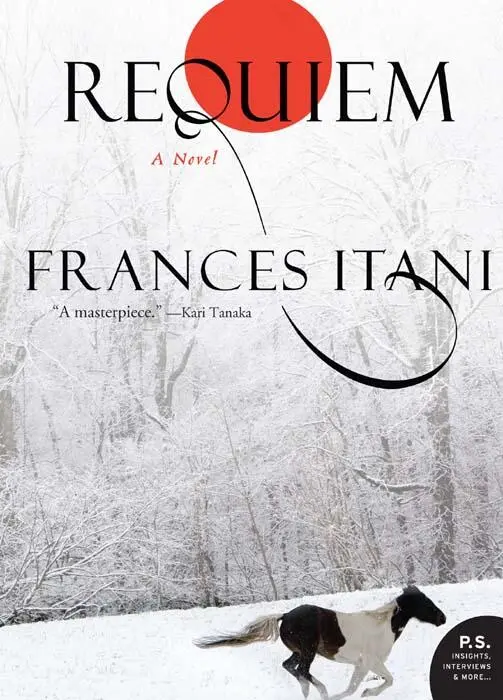
- Название:Requiem
- Автор:
- Издательство:A Phyllis Bruce Book
- Жанр:
- Год:2012
- Город:Toronto
- ISBN:978-1-44340-690-1
- Рейтинг книги:4 / 5. Голосов: 1
-
Избранное:Добавить в избранное
- Отзывы:
-
Ваша оценка:
Requiem: краткое содержание, описание и аннотация
Предлагаем к чтению аннотацию, описание, краткое содержание или предисловие (зависит от того, что написал сам автор книги «Requiem»). Если вы не нашли необходимую информацию о книге — напишите в комментариях, мы постараемся отыскать её.
delicately probes the complex adjustments we make to live with our sorrows…. [A] perfectly modulated novel.”
—
An extraordinary researcher and scholar of detail, Frances Itani—author of the best-selling novel
—excels at weaving breathtaking fiction from true-life events. In her new novel, she traces the lives, loves, and secrets in one Japanese-Canadian family during and after their internment in the 1940s.
In 1942, in retaliation for the attack on Pearl Harbor, the Canadian government removed Bin Okuma’s family from their home on British Columbia’s west coast and forced them into internment camps. They were allowed to take only the possessions they could carry, and Bin, as a young boy, was forced to watch neighbors raid his family’s home before the transport boats even undocked. One hundred miles from the “Protected Zone,” they had to form new makeshift communities without direct access to electricity, plumbing, or food—for five years.
Fifty years later, after his wife’s sudden death, Bin travels across Canada to find the biological father who has been lost to him. Both running from grief and driving straight toward it, Bin must ask himself whether he truly wants to find First Father, the man who made a fateful decision that almost destroyed his family all those years ago. With his wife’s persuasive voice in his head and the echo of their love in his heart, Bin embarks on an unforgettable journey into his past that will throw light on a dark time in history.
Requiem — читать онлайн бесплатно полную книгу (весь текст) целиком
Ниже представлен текст книги, разбитый по страницам. Система сохранения места последней прочитанной страницы, позволяет с удобством читать онлайн бесплатно книгу «Requiem», без необходимости каждый раз заново искать на чём Вы остановились. Поставьте закладку, и сможете в любой момент перейти на страницу, на которой закончили чтение.
Интервал:
Закладка:
I slow to watch a fox as it crosses the road, unhurried, and disappears behind the trees. It leaves its image behind, a palette of cream-coloured fur, its winter thickness streaked with rusty red. I want to tell Lena how different the landscape is so early in the year. From the highway, it’s possible to peer inside the naked forest to witness repetitive scenes of post-winter disarray. Birches have snapped and tumbled as if they’ve retreated in disordered haste. A month from now none of this will be visible. Deciduous trees will be in full leaf and will block the view from the road. They’ll link arms with the firs and present a dense wall of forest. But for now, it’s like seeing through transparent skin.
I haven’t had breakfast and have to keep an eye out for town or village. Hunger is gnawing, but not enough to make me get out and dig through the cooler to see what’s inside—apart from dregs of melting ice. Lake Superior is on my left—the vast Great Lake, with the United States unseen on its other side. I drove away from the cabin this morning at daybreak, and did not stop to explore the creek below. The van was gone, which meant that the two women had departed, though I didn’t hear them leave. I wonder now if they left after dinner and didn’t stay overnight at all. The evil fortune sticking in the craw.
A white-tailed doe, her flanks bony and thin, is feeding at the edge of the road, attracted to traces of salt left over from heavy equipment that sprayed the highway all winter. She looks up and stares as I pass. Yellow signs with images of deer captured mid-leap are posted along the road, but these gradually change to warnings of moose: NIGHT DANGER. An antlered animal is pictured: long sloping nose, left foreleg bent, shoulder to the road, challenging any driver foolish enough to be in its path while it’s on the move.
The signs are a long cry from what I now begin to see in ditches to my right. Massive carcasses, evidence of collisions between moose and transport truck. The animals weigh close to a ton, and when I see the first carcass on its back, its limbs reaching upwards in rigor mortis, I don’t understand what it is until I drive past another, and then another. I see four in all. Hit by trucks in the night and bounced back to the ditches to die. They are black in death, charred as if by fire. Not the majestic beasts Lena and I used to see in the forests when we were hiking, the ones that clip-clopped across the highway with their big, ungainly feet. These carcasses are sculptures gone bad, miscalculated shapes. And while I’m lamenting their calamitous deaths, I drive past a shallow gully and glance down to see a live moose looking out, a high, dark hulk almost hidden by moss and fallen trees.
When I drive past the sign for Old Woman Bay, I can’t remember what it is about the place that is familiar. And then I do, and I pull over and sit there, staring straight ahead. I think of an essay I read earlier in the week and I turn the car around, drive back to the sign, leave the main road and enter a parking area where I’m at once surrounded by woods, except for a clearing before a strip of beach. The sky is big-lake sky, white and expansive, streaked with blue. Every cloud shaped with clarity. Mine is the only car in the lot, and I let Basil out the back. “It’s yours, Basil,” I tell him. “The entire place. Look out for small stones.” But he has already taken off with a yelp, running in and around the trees, ears dragging as he follows some scent. He heads for the water, passing through beach gravel, sniffing and exploring as he slows and pads along.
I follow him down to the lake, my hiking boots sliding in and out of stone broken to millions of fragments along the edge of the bay. It was Böll’s essay, Heinrich Böll, and he wrote about how one road sign, one name, could set off an outburst of memories. For me, it was this one sign that has stopped me completely: OLD WOMAN BAY.
I plunk down on a massive but smooth driftwood log. The air is cool, the sun strong. The time I cannot bypass is a summer in the seventies. The event, our first car trip, when we drove as far as Manitoba for an adventure and then aimed the car south, following the Red River for a while. We decided to go to North Dakota, then Minnesota, and we returned via a southern route home again. Southern for us, but still quite far north.
We owned a station wagon then, too. Old and clunky. We’d bought it used, at bargain price. Greg was not yet born. We travelled with a small tent in the wheel well where the spare tire was kept, along with sleeping bags and a cooler. We could be self-sufficient when we had to be. But one night we were travelling through hard rain. There was nothing around but woods and rock, and we were far from hotels and motels. We kept driving and driving until we were so fatigued it was unsafe to go on.
“We have to stop,” Lena said. “It’s after one in the morning. Even the windshield wipers are dragging.”
“Stop where? We’ve been looking for hours. There’s nothing to be had.”
“No lodgings at the inn,” she said. “But we’re both falling asleep. If we continue, we’re going to kill ourselves.”
We saw the sign for Old Woman Bay.
I pulled into this parking lot. The same one. From the car windows we saw nothing but blackness and trees. Our headlights lit up a posted sign: NO OVERNIGHT CAMPING—STRICTLY ENFORCED.
“We’ll have to spend the night in the car,” I told her. “There’s nobody here, so it won’t matter to anyone.”
The back seat was already flattened, so we climbed over and unzipped our sleeping bags. These could be used separately, as singles, or opened out flat and fitted together to make a double, which is what we did, to make a wider bed for two. We crouched low, bumping our heads against the ceiling as we zipped the outer edges and stretched out our makeshift bed. We took off our clothes and tossed them towards our feet and climbed into the padded bag, which was now spacious and warm. The car rocked every time we moved. Lena reached out a bare arm, opened a window half an inch and pushed down the locks from inside. “I don’t want any bears knocking at the doors,” she said.
Once inside the zipped-together bags, we lay flat on our backs and started to laugh. “Tell me a river story,” Lena said. “One with a good ending, not something with cataracts and turmoil that will keep me awake.”
“Let me think for a minute,” I said. “Okay, here goes. A young man was once travelling through Germany, and as it happened, it was the year before he would meet the woman who would become his wife. He didn’t know that then, because she was living in Montreal, still unmet, and he was in Europe, travelling alone. As a matter of fact, she was sleeping in his bed in Montreal, having rented his share of a student apartment while he was away.
“The young man was following the great rivers of Europe. He had a sketch pad in his pack, the usual supplies, and he was trying to capture something he could not quite put a name to, some understanding of the rivers he encountered. Something lost, perhaps, or something not yet found. He lingered in Bonn, Beethoven’s birthplace, and visited Köln and the cathedral, and he travelled upriver to Speyer and climbed the highest hill and looked down over the ancient Rhine and watched barge traffic below. He thought he would stay overnight nearby because he also wanted to see the Neckar. He had been told that it was a beautiful river, more green than blue, with castles strung like jewels at the top of the hills. He proceeded to Heidelberg and found a hotel, and while there he bought a ticket for a boat that would take him on a new journey the next day.
“The next morning, he boarded a boat that travelled upriver through a series of narrow locks. He inhaled a breath of river air, which did not satisfy in any way because the day was uncomfortably hot. The boat had two decks, and swans paddled to the side and stretched up their long throats, demanding food, which tourists tossed down: chunks of bread, pieces of chocolate, even sausage.”
Читать дальшеИнтервал:
Закладка:
Похожие книги на «Requiem»
Представляем Вашему вниманию похожие книги на «Requiem» списком для выбора. Мы отобрали схожую по названию и смыслу литературу в надежде предоставить читателям больше вариантов отыскать новые, интересные, ещё непрочитанные произведения.





Обсуждение, отзывы о книге «Requiem» и просто собственные мнения читателей. Оставьте ваши комментарии, напишите, что Вы думаете о произведении, его смысле или главных героях. Укажите что конкретно понравилось, а что нет, и почему Вы так считаете.