Frances Itani - Requiem
Здесь есть возможность читать онлайн «Frances Itani - Requiem» весь текст электронной книги совершенно бесплатно (целиком полную версию без сокращений). В некоторых случаях можно слушать аудио, скачать через торрент в формате fb2 и присутствует краткое содержание. Город: Toronto, Год выпуска: 2012, ISBN: 2012, Издательство: A Phyllis Bruce Book, Жанр: Историческая проза, на английском языке. Описание произведения, (предисловие) а так же отзывы посетителей доступны на портале библиотеки ЛибКат.
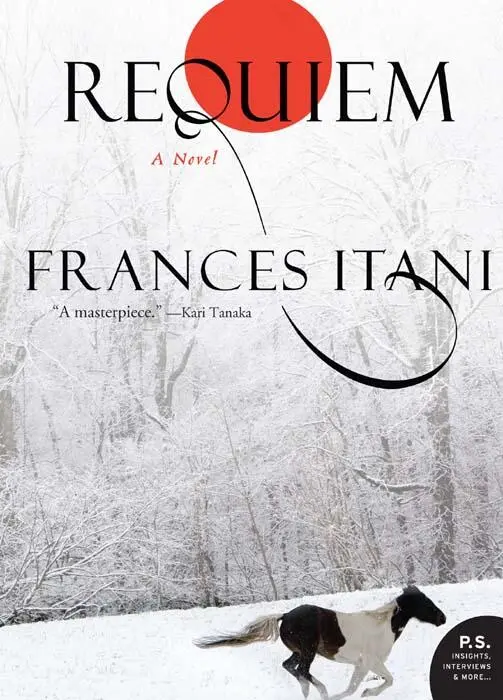
- Название:Requiem
- Автор:
- Издательство:A Phyllis Bruce Book
- Жанр:
- Год:2012
- Город:Toronto
- ISBN:978-1-44340-690-1
- Рейтинг книги:4 / 5. Голосов: 1
-
Избранное:Добавить в избранное
- Отзывы:
-
Ваша оценка:
Requiem: краткое содержание, описание и аннотация
Предлагаем к чтению аннотацию, описание, краткое содержание или предисловие (зависит от того, что написал сам автор книги «Requiem»). Если вы не нашли необходимую информацию о книге — напишите в комментариях, мы постараемся отыскать её.
delicately probes the complex adjustments we make to live with our sorrows…. [A] perfectly modulated novel.”
—
An extraordinary researcher and scholar of detail, Frances Itani—author of the best-selling novel
—excels at weaving breathtaking fiction from true-life events. In her new novel, she traces the lives, loves, and secrets in one Japanese-Canadian family during and after their internment in the 1940s.
In 1942, in retaliation for the attack on Pearl Harbor, the Canadian government removed Bin Okuma’s family from their home on British Columbia’s west coast and forced them into internment camps. They were allowed to take only the possessions they could carry, and Bin, as a young boy, was forced to watch neighbors raid his family’s home before the transport boats even undocked. One hundred miles from the “Protected Zone,” they had to form new makeshift communities without direct access to electricity, plumbing, or food—for five years.
Fifty years later, after his wife’s sudden death, Bin travels across Canada to find the biological father who has been lost to him. Both running from grief and driving straight toward it, Bin must ask himself whether he truly wants to find First Father, the man who made a fateful decision that almost destroyed his family all those years ago. With his wife’s persuasive voice in his head and the echo of their love in his heart, Bin embarks on an unforgettable journey into his past that will throw light on a dark time in history.
Requiem — читать онлайн бесплатно полную книгу (весь текст) целиком
Ниже представлен текст книги, разбитый по страницам. Система сохранения места последней прочитанной страницы, позволяет с удобством читать онлайн бесплатно книгу «Requiem», без необходимости каждый раз заново искать на чём Вы остановились. Поставьте закладку, и сможете в любой момент перейти на страницу, на которой закончили чтение.
Интервал:
Закладка:
Abruptly, on the third day, we were ordered to leave the train. Once more, we gathered our bundles and left behind a place that had become familiar. A place where I had memorized every anxious face, every seat in the coach, every paint chip, every streak in the glass. Hiroshi and Keiko and I had walked up and down the aisle so that we could exercise our legs. We had fidgeted as much as our parents had allowed. Our legs were cramped, our mother’s feet swollen, our father’s temper barely held beneath the surface. Now we stepped down from the coach and stood in a huddle in unbearable cold, staring up at empty windows as the train pulled away and abandoned us.
I turned a full circle, feeling cinders grate under the soles of my rubber boots. Everyone was looking up because all around, in every direction, were the looming shapes of mountains. The town had sprung up in the centre of what appeared to be a four-square fold of peaks and valleys. White mountaintops glistened as if they’d been iced.
We boarded buses and were driven across the town bridge, over the swift and muddy Fraser River, arriving at a more or less flat, narrow field at the base of a mountain on the other side. Oversized tents had arrived from Vancouver on another train, and Father’s name and Uncle Aki’s were called out because, at their request, one large tent had been assigned to our two families.
The entire trainload of people began the business of setting up a tent village in the bitter cold of the mountains. And though we were wrapped and bundled and blanketed, I had never been as cold as I was in that place, high above a valley we had never seen, across from an angry town that did not want us on either side of the river. Mother told us to keep moving, and we clapped our hands and bent our knees and walked in circles and stomped our feet.
I could hear Father grunting, his anger visible as he pried at the boards of the crate. He had removed his jacket, his tendons taut beneath the surface of his skin. As he lifted out parts of the stove, muscles rippled up his fisherman’s arms, partly hidden by the sleeves of his shirt. With a steady flow of Japanese curses and with the help of Uncle Aki and another man, he put the stove together piece by piece and levelled it on rock and damp ground in an open space not far from the tent where we would be living. Hiroshi and Keiko and I were sent to look for downed branches and dry brush on the lower slope of the mountain, at the edge of the field. While I was dragging a branch through patches of snow, I heard Hiroshi mutter, “Arse-arse-arse.” Keiko began to giggle but no one else paid any attention. Hiroshi and Keiko dragged back larger pieces from blowdowns, and a fire was started in what had become, by necessity, an outdoor stove. Mother found and unpacked two pots—one being the rice pot from my bundle—and she began to melt snow so that she could boil water and prepare our meal. While we waited for the rice to cook, we leaned forward, sharing the space with Auntie Aya and some of our new neighbours. Hands and arms reached towards the burners in an attempt to capture thin waves of heat before they escaped into the mountain air.
Father put on his jacket again, and he scowled and planted his feet wide and stood behind the stove. He was taller than the other men and he wore a wool cap with earflaps, the chin strap dangling. His eyebrows scrunched as he gestured to the surrounds of ponderosa pine and Douglas fir that shadowed the slopes at his back. In places where there was no snow, the soil was a mixture of rough gravel and sand. In the woods, there was only darkness. High above, on the side of the mountain, a rockslide had left its mark, a slate-coloured vee now gathering dusk.
I shifted my weight, planted my feet in the way my father had, crossed my arms and tucked my hands into my armpits. Arse , I said to myself, knowing it was meant to be a bad word. Arse-arse .
I tried my best to remember our warm kitchen, the one we had left behind on the island so many weeks ago. I thought of Missisu’s piano and I turned my head sharply as if I might be ambushed by a fog of wavy, familiar notes. I looked to Mother’s face for a sign as she leaned forward to pull dishes from the willow basket.
But it was clear that Mother was not thinking about music or about our old, comfortable kitchen. I could see that she was thinking about getting food out of the pot and into the rice bowls, out of the rice bowls and into our bellies. I could see that she was thinking about warm water, which she had already begun to heat, so that she could wash the soot and train dirt off the three of us before putting us to bed on cots set up inside the heavy canvas tent.
And there we stood. Our family. The five of us captured in memory for all time, looking as if we had signed up for some bizarre adventure trek, having brought a stove with us to defeat the treachery of winter.
Uncle Aki, Auntie Aya and a few neighbours crowd into the edges of this memory. They are seeking our shared heat because no other man in camp has thought to pack a stove in a wooden crate. On the fringes of the same picture, more deadwood has been gathered. Campfires have been started all along the rows of tents. A baby wails. Food preparation has begun. The sound of high-pitched, rhythmic sobbing starts up from the far edge of the field. The same sobbing that kept us awake at Hastings Park has followed us here, to the camp. Auntie Aya shudders, and Uncle Aki puts his arm around her shoulder. Father surveys the scene and nods. Because, for the moment, our own small family is the only one that has a stove, and a poker to rattle its embers, a lifter to lift the burners and an open chimney pipe through which smoke curls up and up, into the circle of tightening darkness.
CHAPTER 10
Six hundred and ninety-seven kilometres between the Soo and Thunder Bay, and I am somewhere between. I try to envisage five million square kilometres of Shield and all I can conjure is the idea of immensity. An eye looking down over lake and rock, peering into crevice to see hibernating bear, or moose knee-deep in muskeg, or wolf skulking in shadow. Water is high in ponds and craters because it has no easy place to drain. Trees lean as if a mythical wind has bent an entire forest all at the same moment and in the same direction. I feel that I’m on some vast and bumpy map, uncharted landscape from which there is no exit except the one I draw for myself. But for thousands of years, Native tribes have travelled this route. And for hundreds of years, voyageurs, Métis , missionaries and explorers pushed their way deep inside the continent.
I’ve been stopping here and there, mostly for Basil, but sometimes to do quick sketches on paper. Creeks and streams and rivers all head towards the big lake; dark waters bubble over jutting stones; circles puddle atop thin ice. And old conversations with Lena surface as I drive. A lidded eye pushes up from below, from the morass of memory that I have been holding down. I can’t prevent what bursts through. I keep thinking: Lena as … Lena doing … Lena trying … I remember her excitement when we travelled here together. Her insistence that we stop so that she could examine the upheaval of massive slabs of rock. She wrote down the names of road signs: Widow Pond, Dead Horse Cove, Lost Boy Creek, Old Mine Road, Bear Paw Landing, Horse Thief Bay. “Every name contains its own story,” she told Greg. “In the way that rivers hold stories, so do roads and pathways. Sometimes, if we dig around and listen hard, we can find out what the stories are.”
She and Greg began to invent their own legends during long drives and camping trips. One day, we followed a sign for a place called Hope Lane all the way to a dead end, and Lena, peeved, declared the sign to be a malcontent’s idea of perversity.
Читать дальшеИнтервал:
Закладка:
Похожие книги на «Requiem»
Представляем Вашему вниманию похожие книги на «Requiem» списком для выбора. Мы отобрали схожую по названию и смыслу литературу в надежде предоставить читателям больше вариантов отыскать новые, интересные, ещё непрочитанные произведения.






Обсуждение, отзывы о книге «Requiem» и просто собственные мнения читателей. Оставьте ваши комментарии, напишите, что Вы думаете о произведении, его смысле или главных героях. Укажите что конкретно понравилось, а что нет, и почему Вы так считаете.