Ben Elton - Two Brothers
Здесь есть возможность читать онлайн «Ben Elton - Two Brothers» весь текст электронной книги совершенно бесплатно (целиком полную версию без сокращений). В некоторых случаях можно слушать аудио, скачать через торрент в формате fb2 и присутствует краткое содержание. Город: London, Год выпуска: 2012, ISBN: 2012, Издательство: Transworld Publishers, Жанр: Историческая проза, на английском языке. Описание произведения, (предисловие) а так же отзывы посетителей доступны на портале библиотеки ЛибКат.
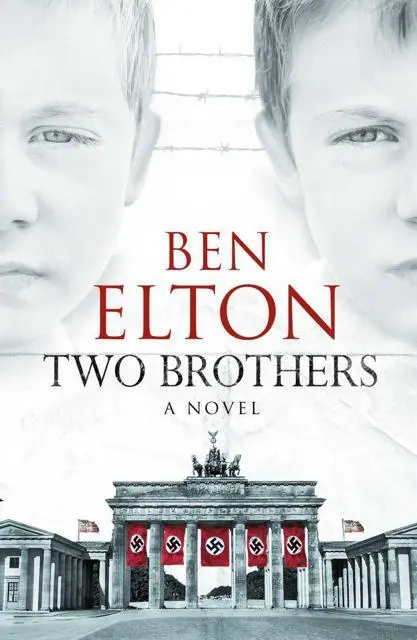
- Название:Two Brothers
- Автор:
- Издательство:Transworld Publishers
- Жанр:
- Год:2012
- Город:London
- ISBN:9780593062050
- Рейтинг книги:4 / 5. Голосов: 1
-
Избранное:Добавить в избранное
- Отзывы:
-
Ваша оценка:
Two Brothers: краткое содержание, описание и аннотация
Предлагаем к чтению аннотацию, описание, краткое содержание или предисловие (зависит от того, что написал сам автор книги «Two Brothers»). Если вы не нашли необходимую информацию о книге — напишите в комментариях, мы постараемся отыскать её.
Two Brothers BEN ELTON’s career as both performer and writer encompasses some of the most memorable and incisive comedy of the past twenty years. In addition to his hugely influential work as a stand-up comic, he is the writer of such TV hits as
and
. Most recently he has written the BBC series
on the subject of young parenthood. Elton has written three musicals,
and
and three West End plays. His internationally bestselling novels include *
,
,
,
and
. He wrote and directed the successful film
based on his novel
starring Hugh Laurie and Joely Richardson. About the Author
Two Brothers — читать онлайн бесплатно полную книгу (весь текст) целиком
Ниже представлен текст книги, разбитый по страницам. Система сохранения места последней прочитанной страницы, позволяет с удобством читать онлайн бесплатно книгу «Two Brothers», без необходимости каждый раз заново искать на чём Вы остановились. Поставьте закладку, и сможете в любой момент перейти на страницу, на которой закончили чтение.
Интервал:
Закладка:
They might perhaps have given way to tears if they had received their beatings alone, but neither was prepared to be the first to break in front of the other.
And particularly not in front of Dagmar.
Silke was also present at the gala with her school and, although she hadn’t seen the incident, she quickly heard all about it, as word of what had happened spread like wildfire amongst the children. Later when the competition resumed (minus the disgraced Stengel twins), Silke pushed her way through the various school groups to confront Dagmar. Facing each other, the two little girls made quite a contrast. Dagmar, tall for eight, her beautifully fitted school swimsuit of the latest two-way stretch elastic. Silke, small and tough, in a baggy suit of knitted wool (holed in a number of places), her legs bruised and scratched as they always were from some fight or other.
‘You got our boys a beating!’ Silke snarled.
‘Don’t be stupid,’ Dagmar replied loftily. ‘I didn’t ask them to take the blame, did I?’
‘You should have said! They wouldn’t have whipped a girl.’
‘That would have just looked ridiculous. Paulus and Otto had already given different stories. I don’t think a third would have helped, would it? They’d still have been beaten. Besides, the boys wanted to help me, isn’t that what the Saturday Club’s about? I think it was very noble.’
Silke’s fists clenched. She was red-faced. Angry but also embarrassed and ill-at-ease, a scruffy kid amongst so many little rich girls, all dressed in the same identical, beautiful bathing costumes that Dagmar was wearing.
‘Who is this child?’ a stern female voice snapped as Dagmar’s forbidding-looking teacher approached. ‘She should be with her own school. Girl, why have you left your group?’
‘I came to talk to Dagmar, miss,’ Silke mumbled at the ground.
‘Chin up and speak out, girl! We are not at home to Mrs Mumble here,’ the teacher snapped, provoking much giggling from the posh girls, which turned Silke positively crimson.
‘I came to see Dagmar Fischer,’ Silke said, raising her head a little.
The school mistress gave Dagmar a dubious look.
‘Do you know this little girl, Fräulein Fischer?’
‘Yes, Frau Sinzheim. She is the daughter of the woman who cleans the apartment where I have my music lessons.’
Silke’s jaw dropped to hear herself so dismissively described.
‘We’re friends!’ Silke asserted.
This caused further giggling amongst Dagmar’s classmates and it was Dagmar’s turn to go red.
‘Well, she must run along now,’ Frau Sinzheim said with a dubious look at Silke, ‘as the finals are upon us and you need to concentrate, Dagmar. Under-tens freestyle, breaststroke and the relay. I look to you to deliver Gold in all three.’
‘Yes, Frau Sinzheim.’
The mistress turned back to Silke.
‘Get away now, little girl. You have no business here.’
Frau Sinzheim moved on, leaving Silke staring at Dagmar with blazing eyes and poking out her tongue.
‘Come on, Silke,’ Dagmar said. ‘You’re just jealous. You wouldn’t have minded one bit if it had been you the boys took a whipping for. But do you think they would have done?’
Silke looked as if she was about to reply but then didn’t. It seemed that perhaps Dagmar’s observation had hit the mark.
Two Parties and a Crash
Munich, Berlin and New York, 1929
TWENTY-FOURTH OF FEBRUARY.
Two birthday parties.
One in an apartment in Friedrichshain, Berlin.
The other in Munich in a house at Schellingstrasse 50.
Paulus, Otto and the Nationalsozialistische Deutsche Arbeiterpartei .
All nine years old that day.
Only one of them would live to beyond the age of twenty-five.
The other two, like countless millions of other youngsters around the world, were doomed.
The Munich nine-year-old would murder them before perishing itself.
The birthday party in Berlin was a very jolly affair.
There were games and cake and American soda. The awkwardness of the meeting up of Paulus and Otto’s school friends with Dagmar and Silke from the Saturday Club was soon overcome. Dagmar even let her hair down sufficiently to take her turn with the blindfold in Blind Man’s Bluff.
There was much to celebrate, as the boys’ grandfather pointed out in a rather lengthy toast that he insisted on being allowed to make during tea and which the children largely ignored, not unnaturally preferring to concentrate on the rolls and cold chicken.
‘These lucky boys will achieve more than we ever have,’ Herr Tauber said, ‘for Germany’s long nightmare is over and every opportunity is open to them.’
It was in fact for this very reason that the Munich celebration was not such a happy event. Germany’s increasing success might have been good for the Stengel boys but it had left the National Socialist German Workers’ Party thin and ailing.
Its message of violent, uncompromising outrage and hatred had begun to sound somewhat hollow as life in the Fatherland continued to improve. In the Reichstag elections of 1924 they had gained 3 per cent of the national vote. In 1928, after four more years of screaming, shouting, marching and fist-banging up and down the country, they were down to just 2.6 per cent.
The brown-shirted men were at a loss.
Their brown-shirted leader was at a loss also. Although of course he hid his confusion behind the stern face of an ‘implacable’ and ‘unalterable’ will.
What was going wrong?
Their message was clear enough. Despite the confusing and self-contradictory ‘twenty-five points’ with which Hitler had launched the party, it really boiled down to just one thing: ‘Blame the Jews for everything.’
What could be simpler? And yet this message was proving increasingly difficult to either explain or sustain.
Should the Jews be blamed for the increasingly stable money?
The improving employment situation?
The efficient social services?
Membership of the League of Nations?
People liked all of those things. They were the very reason that in Berlin old Herr Tauber felt able to state that the country’s nightmare was over.
Even the great outrage of November 1918, the so-called ‘stab in the back’ theory which had long been a Nazi Party favourite, was beginning to sound like a paranoid obsession. Over and over again throughout the 1920s Hitler had railed against the ‘November Criminals’, those rich and cowardly Jews skulking in Berlin who had deliberately, maliciously (and for no apparent reason that Hitler cared to explain) conspired to organize the defeat of the Imperial German Army.
People had used to lap that one up but now nobody seemed to give a damn.
Germany had moved on.
The Munich Baby was dying.
And yet unbeknownst to those glum brown-shirted men sitting around the table at the house in Munich, everything was about to change. The Nazi Party would have to wait eight months for its birthday present, but when it came, it was the best they could possibly have hoped for.
Chaos.
On 24 October 1929, six and a half thousand kilometres from Schelling Street. On another street. An infinitely more famous one, called Wall Street, there began the greatest collapse in market confidence in all history and with it a global depression.
Germany’s economic recovery had been the most fragile, the abyss from which it had hauled itself the darkest and most deep. Its vulnerability to this new financial madness was therefore all the greater.
The Munich Baby was about to get its chance.
Fighting over Dagmar
Berlin, 1932
OTTO WAS VERY surprised. What had got into Paulus?
Читать дальшеИнтервал:
Закладка:
Похожие книги на «Two Brothers»
Представляем Вашему вниманию похожие книги на «Two Brothers» списком для выбора. Мы отобрали схожую по названию и смыслу литературу в надежде предоставить читателям больше вариантов отыскать новые, интересные, ещё непрочитанные произведения.









Обсуждение, отзывы о книге «Two Brothers» и просто собственные мнения читателей. Оставьте ваши комментарии, напишите, что Вы думаете о произведении, его смысле или главных героях. Укажите что конкретно понравилось, а что нет, и почему Вы так считаете.