Stewart Binns - Conquest
Здесь есть возможность читать онлайн «Stewart Binns - Conquest» весь текст электронной книги совершенно бесплатно (целиком полную версию без сокращений). В некоторых случаях можно слушать аудио, скачать через торрент в формате fb2 и присутствует краткое содержание. Город: London, Год выпуска: 2011, ISBN: 2011, Издательство: Penguin Books, Жанр: Историческая проза, на английском языке. Описание произведения, (предисловие) а так же отзывы посетителей доступны на портале библиотеки ЛибКат.
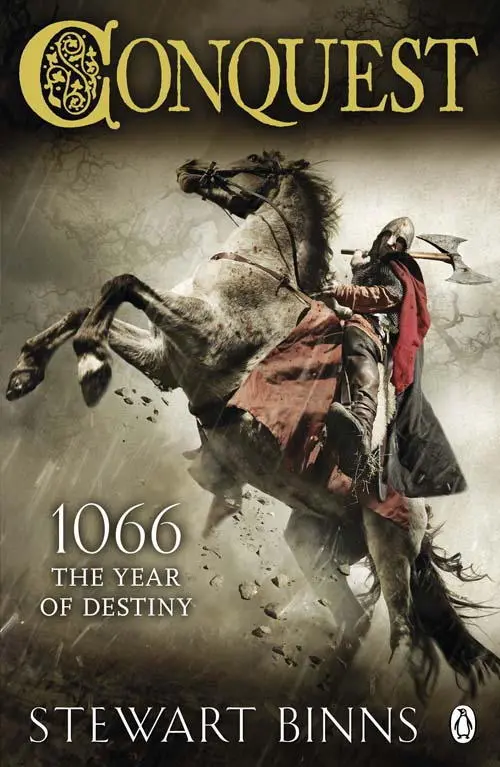
- Название:Conquest
- Автор:
- Издательство:Penguin Books
- Жанр:
- Год:2011
- Город:London
- ISBN:978-0-141-96059-3
- Рейтинг книги:5 / 5. Голосов: 1
-
Избранное:Добавить в избранное
- Отзывы:
-
Ваша оценка:
Conquest: краткое содержание, описание и аннотация
Предлагаем к чтению аннотацию, описание, краткое содержание или предисловие (зависит от того, что написал сам автор книги «Conquest»). Если вы не нашли необходимую информацию о книге — напишите в комментариях, мы постараемся отыскать её.
The battle is hard fought and bloody, the lives of thousands have been spent, including that of King Harold. But England will not be conquered easily, the Anglo-Saxons will not submit meekly to Norman rule.
Although his heroic deeds will nearly be lost to legend, one man unites the resistance. His name is Hereward of Bourne, the champion of the English. His honour, bravery and skill at arms will change the future of England. His is the legacy of the noble outlaw.
This is his story.
Conquest — читать онлайн бесплатно полную книгу (весь текст) целиком
Ниже представлен текст книги, разбитый по страницам. Система сохранения места последней прочитанной страницы, позволяет с удобством читать онлайн бесплатно книгу «Conquest», без необходимости каждый раз заново искать на чём Вы остановились. Поставьте закладку, и сможете в любой момент перейти на страницу, на которой закончили чтение.
Интервал:
Закладка:
‘But you haven’t always lived here?’
‘I have been here most of my life, but I was born a long way from here, close to the burgh of Winchester, where, as a young man, I was ordained.’
Hereward settled back, sensing that a long story was about to unfold.
The old man described how the life of a priest had, at first, been perfect. He had absorbed knowledge like a sponge and soon became renowned for his intellect and grasp of ancient texts and languages. But he eventually lost his way and his faith. His drinking increased and an affair with a lady-in-waiting at court led him to be defrocked, banished from Winchester and, like Hereward, cast out into the forest.
‘Life is so short. I worry about how many more seasons I’m destined to see. The priests tell us we will go on to a better life in the blessed company of God, but I have my doubts. I fear my likely eternity is right here, in the earth of my own wood, rotting in the mulch like the leaves of my trees. But where will my deepest thoughts and fanciful dreams go?’
‘Isn’t that why we should all leave a legacy?’
The old man smiled.
‘Spoken like a sage, young Hereward! But you are right; if our legacy is wholesome and true, we can face death with equanimity.’
There was a long silence as both men contemplated the forbidding prospect of death without the comfort of God and his Heaven.
The old man broke the silence. ‘It takes a brave man to consider a world without God to relieve its burdens, and an even braver one to contemplate eternity without Him.’
‘I don’t know that it’s brave; I think it’s got more to do with the way a man feels about his own frailties and those of his fellow men.’ Hereward paused and looked at the old man for some time before continuing. ‘Why do you choose to be a hermit when you could have found a woman and raised a family, or joined a band of forest people?’
‘I don’t have much time for other people; they were the source of my problems. I found the frivolities of women too superficial and the friendship of men too unreliable.’
Over the coming days, the two men talked for many hours. As time passed, Hereward realized that the old man’s cynicism disguised a highly intelligent mind that had discovered profound contentment through an ascetic existence.
Late one night, as their fire subsided and the first chill wind of autumn rushed through their clearing, the Old Man of the Wildwood seemed reluctant to sleep and sat staring into the distance for some time before speaking. ‘I fear for this land, it is very precious to me.’
‘But Edward is a good king and people prosper. Harold of Wessex leads his armies and there is peace.’
‘Yes, I know. It is the future I worry about. Edward has no heir and England is the greatest prize in northern Europe; it is rich, its people industrious, its land bountiful. There are many envious eyes: the Scandinavians, of course, but it is the Normans who concern me most. Edward is fond of them, but I know them only too well. They are ruthless and will bring the avarice and deceit of Europe with them.’
‘Surely the English thegns and their housecarls would never let that happen?’
‘Perhaps not, but there would be great bloodshed in the reckoning of it. England could be overrun, our way of life destroyed. I see it in my dreams: burning, rape, death. An everlasting hell where England and the English are cleansed from their homeland like lice from a dog.’
‘Those are the visions of a seer. Is that what you are, old man?’
‘Perhaps that’s what I’ve become, Hereward. It is of no importance; what matters is the future, and our destiny as a people. In my many years here, deep in the forest, I have come to understand the importance of our way of life and our traditions. We have to preserve them. They are what makes us who we are. Our ancestors have lived in the forests and heathlands of England for generations. They have crossed its downs and hills and built their temples and shrines there.’
‘But there are many peoples on this island. There are many tribes of Celts, and the Danish clans – including my own ancestors through my mother.’
‘Yes, but they share the traditions. We all know the legend of Wodewose; he sees only men, not their language nor their race. He lives here, in these woods; he lives throughout our ancient land. He is the Green Man of our childhood and reminds us of the eternal cycle of life and death and the need to live with nature, not to fight it. These Normans, with their homage to the sophistry of the Church of Rome, dismiss our ways as pagan and destroy them. We must never let that happen.’
‘But Wodewose is a mythical creature to frighten children.’
‘Not so, my young friend. He is deep in our memories. The Celts call him Myrddin Wyllt – the sire of Mother Earth. Don’t ever forget him.’
Their conversations about the ancient ways of England continued over many days.
The Old Man of the Wildwood told Hereward many stories that he had never heard before. He talked about the old ways of the Saxons; the Norse sagas of gods and heroes; the ancient beliefs of the Romans and the cults of pagan Rome; and the rituals of the Druids, who believed in the power of the sun, the moon and the earth itself.
After a while, Hereward came to realize that it mattered little whether these stories were true or simply myths. What was more important was that England’s heritage should survive the trauma it was soon to endure.
Then, one evening without warning, the old man brought their time together to a sudden close. ‘You should leave in the morning and go to Gloucester. It is only three days’ walk. You will find a new path there. Follow it to your destiny, which lies far from here.’
‘Is that the seer speaking?’
‘Yes it is. You should listen.’
‘What will you do?’
‘If you are asking whether I will miss you, the answer is, yes, I will miss you. I have come to like you, Hereward of Bourne. But I am not sad, for I now know what my legacy will be.’
‘Will you share it with me?’
‘It is you.’
‘Me? I don’t understand; I have no future.’
‘You are mistaken.’
The Old Man of the Wildwood looked towards the east and the encroaching darkness. ‘You will help shape the destiny of many. Hopefully, through you, much we have spoken about will be remembered and will survive. You will see many things, visit many places and live a long life. But I must warn you, you will face great turmoil and despair, with little respite, except in great old age, when you will find solace in a small measure of wisdom, as I do.’
Hereward was shocked. ‘How will all this come to pass, I am an outlaw?’
‘I sense it in you. You must do two things. First, you must find my daughter –’
Hereward interrupted him. ‘You have a daughter!’
‘Yes, her mother died in childbirth; the child is my illegitimate daughter. Her mother was a lady-in-waiting to Queen Emma at Winchester, the mother of King Edward. I was chaplain to Queen Emma and she took pity on me, despite my failings, and helped me get away with my daughter.’
‘You raised her in these woods?’
‘Until she was fourteen. Then she went to the nuns at Hereford, where I knew she would be safe and could continue her education. I raised her as well as I could. I taught her Greek and Latin, English and French, how to make medicine from the herbs of the forest, and as much of the sciences and philosophies of the ancients as I could remember. She took my books and manuscripts with her; they were her safe passage for the future.’
‘And the second thing I must do?’
‘Ask her to give you the Talisman.’
‘What is the Talisman?’
‘She will tell you.’
Читать дальшеИнтервал:
Закладка:
Похожие книги на «Conquest»
Представляем Вашему вниманию похожие книги на «Conquest» списком для выбора. Мы отобрали схожую по названию и смыслу литературу в надежде предоставить читателям больше вариантов отыскать новые, интересные, ещё непрочитанные произведения.








Обсуждение, отзывы о книге «Conquest» и просто собственные мнения читателей. Оставьте ваши комментарии, напишите, что Вы думаете о произведении, его смысле или главных героях. Укажите что конкретно понравилось, а что нет, и почему Вы так считаете.