Stewart Binns - Conquest
Здесь есть возможность читать онлайн «Stewart Binns - Conquest» весь текст электронной книги совершенно бесплатно (целиком полную версию без сокращений). В некоторых случаях можно слушать аудио, скачать через торрент в формате fb2 и присутствует краткое содержание. Город: London, Год выпуска: 2011, ISBN: 2011, Издательство: Penguin Books, Жанр: Историческая проза, на английском языке. Описание произведения, (предисловие) а так же отзывы посетителей доступны на портале библиотеки ЛибКат.
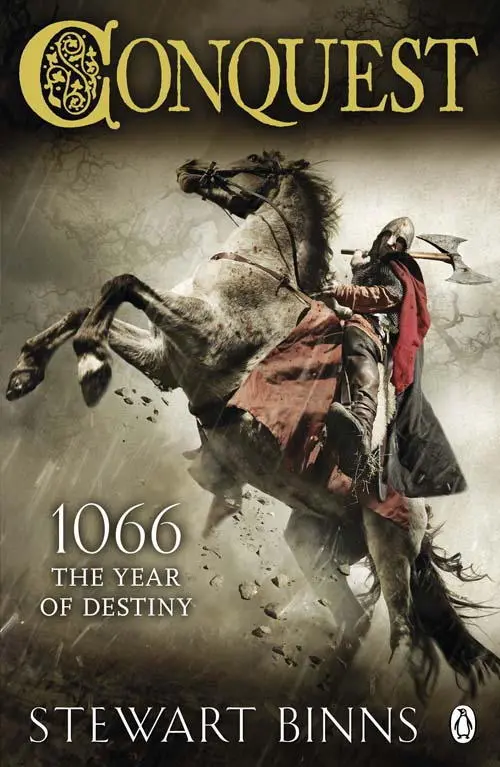
- Название:Conquest
- Автор:
- Издательство:Penguin Books
- Жанр:
- Год:2011
- Город:London
- ISBN:978-0-141-96059-3
- Рейтинг книги:5 / 5. Голосов: 1
-
Избранное:Добавить в избранное
- Отзывы:
-
Ваша оценка:
Conquest: краткое содержание, описание и аннотация
Предлагаем к чтению аннотацию, описание, краткое содержание или предисловие (зависит от того, что написал сам автор книги «Conquest»). Если вы не нашли необходимую информацию о книге — напишите в комментариях, мы постараемся отыскать её.
The battle is hard fought and bloody, the lives of thousands have been spent, including that of King Harold. But England will not be conquered easily, the Anglo-Saxons will not submit meekly to Norman rule.
Although his heroic deeds will nearly be lost to legend, one man unites the resistance. His name is Hereward of Bourne, the champion of the English. His honour, bravery and skill at arms will change the future of England. His is the legacy of the noble outlaw.
This is his story.
Conquest — читать онлайн бесплатно полную книгу (весь текст) целиком
Ниже представлен текст книги, разбитый по страницам. Система сохранения места последней прочитанной страницы, позволяет с удобством читать онлайн бесплатно книгу «Conquest», без необходимости каждый раз заново искать на чём Вы остановились. Поставьте закладку, и сможете в любой момент перейти на страницу, на которой закончили чтение.
Интервал:
Закладка:
He paused to take a deep breath. ‘Because you despatched them before they could answer the charge, there is only indirect evidence to support your accusation that the men you killed had murdered the woman Gythin. The crime against her was a heinous offence, but I have not been asked to rule on that and thus it is not within my jurisdiction here. I can act only on evidence, and there is nothing substantial to link the woman’s murder to Abbot Thurstan. You descended upon Ely with murder in your heart, when, if you felt a crime had been committed, the appropriate recourse would have been the good offices of Earl Leofric at Peterborough. You killed three men in the premises of Edgar the Tanner, before attacking one of my abbots and maiming him for life. You should thank God Almighty that your father’s application means I do not have to order your execution; there has been enough killing. I shall accept the argument of Leofric, Earl of Mercia, on behalf of your father, and confirm that the punishment they seek against you is appropriate.’
The King paused again and stared at Hereward intently. ‘I am going to cast you out from everything that you have known and all those things that bring a man comfort and warmth. You will be denied the sight of God and His priests’ confessionals. May God have mercy on your soul.’
The King continued to stare at Hereward for a long time, contemplating the traumas the boy had already lived through in his short life.
Perhaps Edward could also sense something of what might become of the young man, because he suddenly broke the silence and, beyond anyone else’s hearing, whispered to the Earl of Wessex, ‘Why do I sense that this may not be the last I see of him?’
The Great Hall of Winchester was full as Harold Godwinson, Earl of Wessex, rose to read King Edward’s judgement. Abbot Thurstan sat solemnly, his right arm limp and withered, while Leofric, sitting opposite him, looked like a broken man.
It had taken many months of care by the nuns of Peterborough before Hereward was fit enough to stand trial. During this time, his father wrestled with the dilemma which his son had created for him. After seeking the advice of Earl Leofric, he had to face a dreadful decision. The only certain way to save the life of his son and forestall his execution was to disown him and claim the ancient right to have him banished as an outlaw.
‘Let all here understand that on this fifteenth day of April, 1054, King Edward of England has issued a proclamation granting judgement to Leofric, Thegn of Bourne, in the matter of his son, Hereward, as petitioned by Leofric, Earl of Mercia.’
Harold spoke solemnly, with all the authority of the Earl Marshal of England. He stood tall, his flaxen hair resting on the collar of his ceremonial cloak, his right hand clasping his sword of office and his left hand holding the proclamation that condemned Hereward as an outcast.
‘From this day forward, Hereward of Bourne will be banished from his lands and his people and will be placed beyond the law and the sight of God. All his rights to taxes, titles and service are confiscated forthwith, as are his lands, holdings and possessions. Anyone granting succour, solace or having anything to do with this man will, in turn, also be banished. This proclamation will be heard across the land by order of our sovereign lord, King Edward.’
As the Earl finished speaking, the entire assembly rose and the King’s housecarls presented arms. Edward remained seated, slightly slumped on his throne, saddened by the finality of the act of banishment. In his thirteen-year reign, he could remember only four occasions when he had ordered that a man be made an outlaw.
Hereward knew what he had to do: he bowed to the King, turned, and made his way towards the huge double doors of the Great Hall of Winchester.
His father watched him go with tears in his eyes.
No one else looked at Hereward as he limped into the streets of Winchester. Only the blacksmith approached him, to snap around his neck an iron collar and daub his head with pig’s blood – the symbols of an outlaw. A mounted housecarl then rode in front of him to the city walls and closed the gates behind him. Now, no burgh would open its gates to him; no village would give him food or water; no man, woman or child would speak to him; even priests were required to shun him. The heavy collar of the outlaw, inscribed with the chilling word ‘condemned’, ensured that no one could mistake his status. Although a blacksmith would have the tools and skill to remove the collar, the clasp bore the King’s seal and breaking it was punishable by banishment.
Hereward’s fate was to be a living death.
As Hereward walked away from Winchester, he attempted to walk with the proud, upright gait of a dashing young thegn, but it was futile. There was no semblance of pride left in his heart; he was a broken man. For the second time he had come close to death and once again endured a long and painful recovery from wounds so severe that they would have killed most men. This time, however, his rehabilitation had been a period of deep introspection and regret, not one of simmering rage. Gone was the festering anger brought about by his first encounter with mortality; he had thought only of his stupidity and selfishness. He now realized he had been stupid in believing in his own invincibility, in thinking only of his own pain and revenge, and in failing to bring Thurstan to justice by legitimate means.
The torment of being hoisted like a defenceless animal, and tortured for several hours, had been a purgatory in which an entire childhood of fears and nightmares had been visited upon him. Now, many months later, the memories still haunted him.
Throughout Hereward’s recovery, he had longed to be able to return to Bourne – to seek forgiveness for a lifetime of conceit and bullying, and to see Gythin again in a time before the whole tragic business had begun – but he knew these thoughts were no more than daydreams. He knew that he would never see his family again and he knew that Gythin had gone for ever.
Hereward’s melancholy was suddenly jolted by the distinct sound of a horse snorting. It was only a few yards away, but its rider was difficult to discern; he wore a dark hooded cape and neither horse nor rider bore any distinguishing features. As soon as the mounted figure spoke, Hereward realized it was his nemesis, Thurstan.
‘You should have killed me.’ Thurstan paused, assuming Hereward would answer.
But no response came. No anger rose in Hereward’s heart and he resumed his journey, turning his gaze to the track ahead.
‘Make sure the forest hides you well; you will need its every leaf and branch to conceal you and its darkest corners to prevent you casting shadows. Look behind every tree and bush and in the tall grass in every clearing, because if I ever hear word of you, I will hunt you down and, when I’m ready, I will strike, be sure of that.’
Hereward did not turn round, and seemed oblivious to everything that had been said to him.
Thurstan did not move for several minutes, nor did he blink, but fixed his eyes on Hereward’s back as he disappeared into the gloom of the forest.
The distraught figure walked for the rest of that day and slept for only three or four hours before continuing on his aimless route deep into the forest. At every turn, he took the lesser track and was soon walking a path barely wide enough for a man’s shoulders. By the end of the second day, he was marooned in the vast wildwood of southern England.
Hereward’s biggest challenge in his banishment was not the well-being of his body, but of his mind. He had hunted in the Bruneswald almost every day of his life and survival was second nature to him. Days passed into weeks. He drank from streams and took a bird or a hare when he needed one; he fashioned traps and snares, even without a sharp blade; he collected flints of stone or shale whenever he saw them. He spent countless days roaming deeper into the hinterland and, knowing that the power of the King’s law diminished the further west he went, he moved in the direction of the sunset. As the days grew shorter and the air colder, he prepared for winter and chose a clearing high on a hillside facing south-west to build a refuge. There he spent the long, cold winter in total isolation with only his own thoughts for company.
Читать дальшеИнтервал:
Закладка:
Похожие книги на «Conquest»
Представляем Вашему вниманию похожие книги на «Conquest» списком для выбора. Мы отобрали схожую по названию и смыслу литературу в надежде предоставить читателям больше вариантов отыскать новые, интересные, ещё непрочитанные произведения.









Обсуждение, отзывы о книге «Conquest» и просто собственные мнения читателей. Оставьте ваши комментарии, напишите, что Вы думаете о произведении, его смысле или главных героях. Укажите что конкретно понравилось, а что нет, и почему Вы так считаете.