Stewart Binns - Conquest
Здесь есть возможность читать онлайн «Stewart Binns - Conquest» весь текст электронной книги совершенно бесплатно (целиком полную версию без сокращений). В некоторых случаях можно слушать аудио, скачать через торрент в формате fb2 и присутствует краткое содержание. Город: London, Год выпуска: 2011, ISBN: 2011, Издательство: Penguin Books, Жанр: Историческая проза, на английском языке. Описание произведения, (предисловие) а так же отзывы посетителей доступны на портале библиотеки ЛибКат.
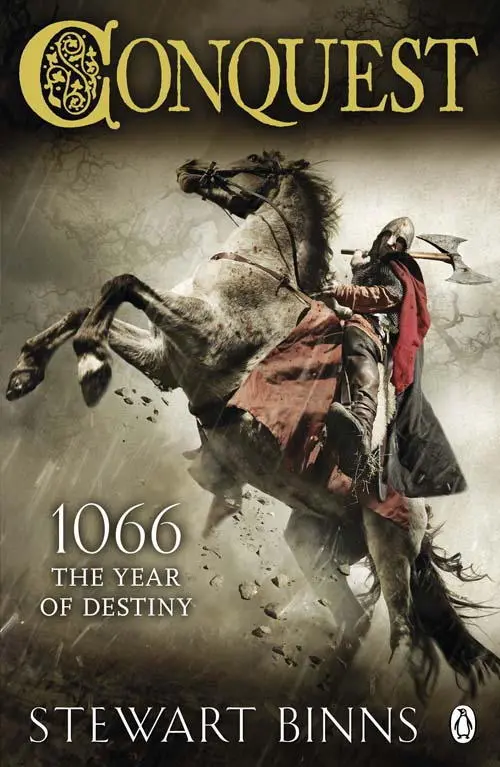
- Название:Conquest
- Автор:
- Издательство:Penguin Books
- Жанр:
- Год:2011
- Город:London
- ISBN:978-0-141-96059-3
- Рейтинг книги:5 / 5. Голосов: 1
-
Избранное:Добавить в избранное
- Отзывы:
-
Ваша оценка:
Conquest: краткое содержание, описание и аннотация
Предлагаем к чтению аннотацию, описание, краткое содержание или предисловие (зависит от того, что написал сам автор книги «Conquest»). Если вы не нашли необходимую информацию о книге — напишите в комментариях, мы постараемся отыскать её.
The battle is hard fought and bloody, the lives of thousands have been spent, including that of King Harold. But England will not be conquered easily, the Anglo-Saxons will not submit meekly to Norman rule.
Although his heroic deeds will nearly be lost to legend, one man unites the resistance. His name is Hereward of Bourne, the champion of the English. His honour, bravery and skill at arms will change the future of England. His is the legacy of the noble outlaw.
This is his story.
Conquest — читать онлайн бесплатно полную книгу (весь текст) целиком
Ниже представлен текст книги, разбитый по страницам. Система сохранения места последней прочитанной страницы, позволяет с удобством читать онлайн бесплатно книгу «Conquest», без необходимости каждый раз заново искать на чём Вы остановились. Поставьте закладку, и сможете в любой момент перейти на страницу, на которой закончили чтение.
Интервал:
Закладка:
Hereward was now fully conscious and would have cried out if he could, but there was no air in his lungs to carry a sound.
He thought about his short life – remembering Gythin, his village and his parents – and, for the first time, he was frightened. He had always thought of himself as invincible; now he was helpless, lonely and minutes from death.
Tears stung his eyes and rolled down his face.
He now understood why other boys cried; he remembered the fear and loathing in their eyes as he bested them in their countless contests. He was suddenly overwhelmed by an immense sense of guilt. He knew that it was his reckless pursuit of Gythin that had caused her death, and he felt ashamed.
Never was a man less ready to meet his Maker; surely these were the fires of Hell already consuming his flesh.
Leofric knew instantly where his son had gone when he disappeared from the village.
The same loyal group of men who had accompanied him on the fateful journey to Gythin’s cottage once more travelled with him to seek the aid of Earl Leofric. The Earl helped him formulate a plan to save his son’s life.
With the Captain of the Earl’s Guard, a dozen of his men and a warrant for Hereward’s arrest, Leofric burst into Abbot Thurstan’s hall just after midnight.
The men stopped dead in their tracks at the scene before them. Hereward’s limp body, silhouetted by the dying embers of the fire, twisted slowly as it hung from the roof. The faces of his torturers glistened with sweat; the room was dark, more like a dungeon than a place of worship. Thurstan, again in a state of unconsciousness, was slumped in his chair with his men standing around him, not knowing what to do.
Hereward seemed lifeless, almost beyond hope.
For a few moments, a stand-off ensued between clerical law and the Earl’s secular domain.
Leofric spoke with the authority of a thegn of England, trained as one of Edward’s elite housecarls. ‘Who here speaks for Thurstan?’
A tall monk stepped forward. ‘I do.’
‘I have a warrant for the arrest of Hereward of Bourne. It is signed by Leofric, Earl of Mercia. I will take him now.’
‘This is a matter for the Church. It will be resolved when Abbot Thurstan recovers.’
‘You address a thegn of the realm, priest. This matter will be judged by the King at Winchester; he rules on all matters, temporal and ecclesiastical. I suggest you make a quick decision, or you will be held to account for what has happened here.’
The monk glanced at his colleagues and surveyed the Earl’s Guard with Leofric.
‘We will require guarantees that this young thug –’
Sensing the priest’s capitulation, Leofric pushed past him before he could finish his sentence.
Hereward was cut down.
He seemed lifeless, his skin the pallor of limewash. Leofric rushed to him, pulled him up by his shoulders and searched for signs of life. His body was cool and stiff, as if rigor mortis had begun.
Leofric’s head sank in despair as he gently rested his son’s head on the stone floor.
‘He’s alive.’ The Captain of the Earl’s Guard spoke quietly but confidently. ‘He’s breathing.’
The Captain knelt, then pushed down hard on Hereward’s chest. As he released the pressure, the injured man’s lungs filled with air and the faintest of breaths could be felt across his lips.
Leofric leapt to his feet. ‘Get him on to the cart. Let’s get him to Peterborough.’
3. Outlaw in the Wildwood
In a petition that both fired his imagination and taxed his intellect, it was many months later that King Edward heard the plea of Leofric, Thegn of Bourne, concerning his son, Hereward. The evidence had taken the whole of a morning session and it was now well into the afternoon, and still the King had not passed judgement. No one at the King’s Council at Winchester could think of a precedent. Edward had withdrawn from the Great Hall and was pacing his cloisters deep in thought; the formidable Harold Godwinson, Earl of Wessex and England’s senior earl, who also happened to be Edward’s brother-in-law, strode a few feet behind.
Life in England under the saintly King Edward was peaceful, but there were great anxieties about the future. His formidable mother, Emma, was the daughter of Richard I, Duke of Normandy and, during the reign of the Danish kings, Edward had spent his early life exiled in Normandy. Much more comfortable with Normans, he had appointed many of them to powerful positions in the realm. Also, despite his marriage to Edith, the daughter of Earl Godwin – who, until his recent death, had been England’s most powerful earl – he had spent most of his reign at odds with the Anglo-Saxon aristocracy, especially the Godwin clan, now led by Edith’s brother, Harold Godwinson, the eldest of Earl Godwin’s five sons.
Thought by many to be far too effete and intellectual to be king amid the much more robust Anglo-Saxon earls, Edward had nevertheless brought the rule of law to his kingdom and had earned the grudging respect of his people. The anxiety was now about who would succeed him: Edward’s marriage to Edith was childless and there was no direct heir to the throne.
Harold Godwinson broke the silence of the cloisters. ‘Sire, under law, the boy should be executed. He is the son of a thegn and we cannot allow our local dignitaries to behave like cut-throats.’
The King did not respond.
‘The boy is uncontrollable.’
‘He intrigues me.’
‘Sire, he killed three men and almost cut in half one of your clerics!’
‘Thurstan is not one of my clerics; he was preffered by the Church hierarchy against my judgement. He is corrupt and conniving, and probably deserved what the boy did to him. If I had my way, I’d execute him, not the boy.’
‘Sire, it is your duty to uphold the law.’
‘I know my duty; I don’t need to be reminded of it by the Earl of Wessex. Bring the boy and his father. I will speak to them before I pass judgement.’
Leofric of Bourne and his son entered Edward’s cloisters as meekly as their station demanded and bowed in unison. The King of England was an impressive figure. He had the kindly features of a devout man of God, his hair was greying auburn and he wore a full, well-cut beard. His smock and leggings were of finely woven wool and his cloak, a rich burgundy, was elaborately embroidered in fine thread and gathered over his left shoulder by a large circular clasp in gold filigree decorated with garnets and amethysts. Hereward could also see the gilded pommel of the King’s sword, its engraved design of serpents and dragons representing England’s fierce Anglo-Saxon origins. Even though Edward, a man of letters, had never drawn it in anger, it was the ancient weapon of the Cerdician Kings of Wessex and England, a proud lineage going back hundreds of years to the time of Alfred the Great and beyond.
The King spoke to Leofric first. ‘How are you, Leofric?’
‘I am well in body, sire, but my heart is heavy with regret. I have caused you great turmoil and my son is lost to me. I have brought him before you because I want him to salvage his life. If you grant me my claim, there is just a chance that he can find a way to redeem himself.’
‘You have served me well many times, Leofric; I will try to help you.’
‘I am grateful, Sire.’
The King turned to Hereward. ‘You are a troublesome young man who vexes me greatly.’
‘Sire –’ Hereward tried to speak.
The King cut him short. ‘Your father has saved your life twice. He is a brave and loving father; you have wronged him beyond belief. I am about to pass judgement on you but, before I do, I want you to know that your father is also very wise. You should die for the appalling crime you have committed, but by going to the Earl of Mercia and seeking a father’s ancient right of retribution against a son, he has saved your life for a third time.’
Читать дальшеИнтервал:
Закладка:
Похожие книги на «Conquest»
Представляем Вашему вниманию похожие книги на «Conquest» списком для выбора. Мы отобрали схожую по названию и смыслу литературу в надежде предоставить читателям больше вариантов отыскать новые, интересные, ещё непрочитанные произведения.









Обсуждение, отзывы о книге «Conquest» и просто собственные мнения читателей. Оставьте ваши комментарии, напишите, что Вы думаете о произведении, его смысле или главных героях. Укажите что конкретно понравилось, а что нет, и почему Вы так считаете.