Stewart Binns - Crusade
Здесь есть возможность читать онлайн «Stewart Binns - Crusade» весь текст электронной книги совершенно бесплатно (целиком полную версию без сокращений). В некоторых случаях можно слушать аудио, скачать через торрент в формате fb2 и присутствует краткое содержание. Город: London, Год выпуска: 2012, ISBN: 2012, Издательство: Penguin Books, Жанр: Историческая проза, на английском языке. Описание произведения, (предисловие) а так же отзывы посетителей доступны на портале библиотеки ЛибКат.
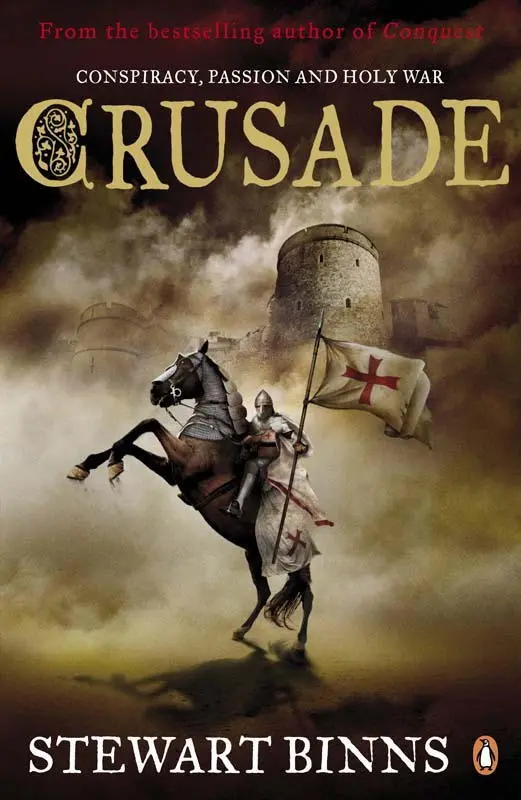
- Название:Crusade
- Автор:
- Издательство:Penguin Books
- Жанр:
- Год:2012
- Город:London
- ISBN:978-0-241-95758-5
- Рейтинг книги:3 / 5. Голосов: 1
-
Избранное:Добавить в избранное
- Отзывы:
-
Ваша оценка:
Crusade: краткое содержание, описание и аннотация
Предлагаем к чтению аннотацию, описание, краткое содержание или предисловие (зависит от того, что написал сам автор книги «Crusade»). Если вы не нашли необходимую информацию о книге — напишите в комментариях, мы постараемся отыскать её.
In the face of chaos and death, Edgar and his allies form a secret brotherhood, pledging to fight for justice and freedom wherever they are denied. But soon they are called to fight for an even greater cause: the plight of the Holy Land. Embarking on the epic First Crusade to recapture Jerusalem, together they will participate in some of the cruellest battles the world has ever known, the savage Siege of Antioch and the brutal Fall of Jerusalem, and together they will fight to the death.
Crusade — читать онлайн бесплатно полную книгу (весь текст) целиком
Ниже представлен текст книги, разбитый по страницам. Система сохранения места последней прочитанной страницы, позволяет с удобством читать онлайн бесплатно книгу «Crusade», без необходимости каждый раз заново искать на чём Вы остановились. Поставьте закладку, и сможете в любой момент перейти на страницу, на которой закончили чтение.
Интервал:
Закладка:
The towers were over fifty feet tall – mounted on wheels and built on three levels, they were designed to sit hard against the city walls. The assault troops were protected by thatch, covered with several layers of hide.
Then Tancred of Hauteville began his particular brand of intimidation.
First, a captured Muslim knight was paraded in front of the walls before being beheaded by one of Tancred’s henchmen. Then Tancred began to catapult bodies into the city, some already dead, some not so fortunate, who met their deaths dashed against its ramparts and buildings. To his credit, the governor did not retaliate in kind, but did expel all the Orthodox Christians from the city – a reasonable response that seemed only to anger the Crusaders even more.
One of the many zealots and visionaries with the army was a priest, Peter Desiderous, who claimed to have had a visitation from the much respected Adhemar Le Puy, Pope Urban’s Apostolic Legate, who had only recently died. Le Puy had commanded him to remind the Crusaders that they were pilgrims and that they should form a procession around the city, praying for strength from God for their attack on the walls.
Although it may have seemed a trifle too devout for the more worldly of the Crusaders, it had a dramatic impact. Not only did many of them work themselves up into a religious frenzy, but the arrows, stones, excrement and hot oil that were hurled at them by the inhabitants of the city only added to their fury.
The assault began on the morning of the 14th of July 1099, with the Crusaders attacking the city on two fronts at once. The sky was immediately filled with missiles flung from both sides. There were stones, firebrands and a whole range of improvised projectiles, flammable, sharp or heavy.
The fighting lasted for two days until Gaston of Brean’s towers made a breakthrough. With Godfrey of Bouillon himself on the highest level, one of the towers reached the top of the wall. The defenders had one defensive weapon left, which they had held in reserve, a form of Greek fire that was thought to be impossible to extinguish. They poured vats of it on to the tower, but the banished Christians from the city had revealed the secret of how to kill the deadly blaze: vinegar, which the Crusaders had stored on the inside of the tower in skin sacks and used liberally to douse the fire.
As soon as the flames were out, Godfrey let down the hide-covered protective wooden lattice at the front of the tower and used it as a bridge to stride on to the wall, leading a mass of knights behind him. As soon as this bridgehead was established, dozens of scaling ladders were thrown against the wall and the Crusaders poured into the city.
What followed brought shame on us all.
After three years of struggling against overwhelming odds, on a tortuous journey replete with astonishing acts of bravery, for what most thought was the noblest of causes, the Crusaders once more behaved like wild animals. All sense of decency deserted them; their humanity was forgotten in order to slake their bloodlust.
There had been other atrocities and much cruel barbarity, but what happened in Jerusalem over the course of the night of the 15th of July was on an unprecedented scale. Almost the entire population of the city was raped, tortured and butchered; Muslims and Jews, none was spared, save a few of the elite Egyptian cavalry and the Governor, Iftikar ad-Daulah, who hid in the Tower of David and negotiated surrender.
It is difficult to estimate how many died, but it must have been in the tens of thousands.
Robert led our Brethren as we struggled in vain to prevent the carnage. He ordered his contingent to stand down, but only a few did. We were joined by some who were loyal to the Mos Militum and we managed to get a few poor souls into a safe house and keep it guarded while we went in search of more to rescue.
Harrowingly, when we returned, the guards had been overwhelmed and their charges massacred. In all, we managed to get two dozen out of the city and sent them with an escort towards the coast.
Word spread that, before they were killed, many of the richer citizens had swallowed their gold bezants and jewellery to prevent the Crusaders stealing them. Thus there followed horror upon horror, as crazed Crusaders sliced open the bellies of the dead in a grisly hunt for coins and gems.
Every place of worship, every public building, every home was looted until the carts could carry no more. Nothing of any value remained; the city was cleansed of everything with the blood of its people.
Within minutes of the end of the carnage, the Crusaders flocked to the Holy Sepulchre to give thanks for their deliverance. Heaving from their exertions, dripping in their sweat and the still-warm blood of their victims, they knelt in prayer.
We turned away; whichever God they were praying to, it was not our God.
There was one final battle to be fought in the Crusade.
News arrived within a few hours of the slaughter at Jerusalem that Malik al-Afdal, the Vizier of the Caliphate of Cairo, was approaching with a Fatimid army 30,000 strong, landing his force at the port of Ascalon. It had elite Egyptian cavalry at its core and troops from all over the Caliphate: Berbers, Bedouin, Ethiopians and squadrons from the personal bodyguards of all the emirs of the Fatimid cities along the North African coast. It was at least as powerful as any army we had faced in the entire Crusade.
The Princes, emboldened and briefly united by their achievements, decided on yet another unpredictably daring response. They would not sit behind the walls of Jerusalem and wait for the attack; they would ride out and meet it head on. Although their newly purchased horses were less sturdy than their European mounts, the knights could fight on horseback once more and relished the prospect.
We had no stomach for any more fighting of the sort that had come to be the hallmark of Crusader behaviour. Sweyn, Hereward, Adela and Estrith took Harold and headed north to Jaffa with Hugh Percy and an escort of Robert’s men to organize a fleet for our departure from the Holy Land.
Robert and I took advice from the Brethren and wrestled with the dilemma for many hours before deciding that it would be wrong to desert the cause at the moment when its objective had been achieved, no matter how much unnecessary blood had been spilled in doing so.
We reached the vicinity of Ascalon on the evening of the 11th of August. It soon became clear from the reports of our scouts that we had been fortunate and that the audacity of the Princes had worked in our favour once more. Malik al-Afdal had spent the day preparing his army to march on Jerusalem the next morning and then bedded it down for the night. Feeling certain that his quarry would hole up in Jerusalem, he had posted few sentries and made no provision to defend his camp against a surprise attack.
Godfrey of Bouillon led a Council of War, where the decision was quickly taken to rest for only a few hours and then to form up as close to the Fatimid army as possible during the darkest hours of the night, waiting for the first hint of dawn. When there was just enough light to illuminate our path, we would charge, en masse, straight into the Fatimid camp.
When the moment came, Raymond of Toulouse took the right flank, Godfrey of Bouillon the left, with Robert of Flanders, Tancred of Hauteville, Robert and myself in the centre. The first rays of the sun caught the crimson of our flags and war banners before bathing us all in its early morning gleam. With the light radiating behind us in an iridescent glow, and the thunder of our horses booming ever louder, we must have presented a terrifying vision as we fell upon the enemy camp out of the night.
We were outnumbered by at least three to one, but our group of men was the elite residue of an army which itself was the best Europe had to offer when it set out three years earlier. It had survived battle, deprivation and disease and had been forged in incredibly challenging circumstances.
Читать дальшеИнтервал:
Закладка:
Похожие книги на «Crusade»
Представляем Вашему вниманию похожие книги на «Crusade» списком для выбора. Мы отобрали схожую по названию и смыслу литературу в надежде предоставить читателям больше вариантов отыскать новые, интересные, ещё непрочитанные произведения.





Обсуждение, отзывы о книге «Crusade» и просто собственные мнения читателей. Оставьте ваши комментарии, напишите, что Вы думаете о произведении, его смысле или главных героях. Укажите что конкретно понравилось, а что нет, и почему Вы так считаете.