Stewart Binns - Crusade
Здесь есть возможность читать онлайн «Stewart Binns - Crusade» весь текст электронной книги совершенно бесплатно (целиком полную версию без сокращений). В некоторых случаях можно слушать аудио, скачать через торрент в формате fb2 и присутствует краткое содержание. Город: London, Год выпуска: 2012, ISBN: 2012, Издательство: Penguin Books, Жанр: Историческая проза, на английском языке. Описание произведения, (предисловие) а так же отзывы посетителей доступны на портале библиотеки ЛибКат.
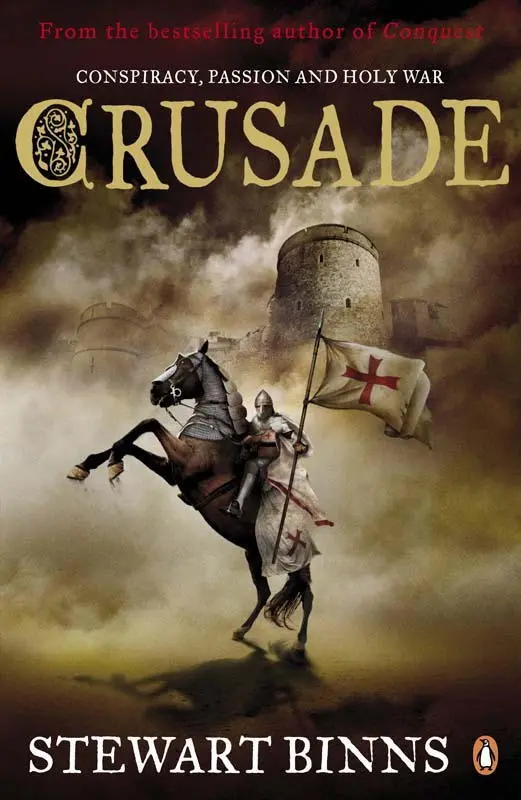
- Название:Crusade
- Автор:
- Издательство:Penguin Books
- Жанр:
- Год:2012
- Город:London
- ISBN:978-0-241-95758-5
- Рейтинг книги:3 / 5. Голосов: 1
-
Избранное:Добавить в избранное
- Отзывы:
-
Ваша оценка:
Crusade: краткое содержание, описание и аннотация
Предлагаем к чтению аннотацию, описание, краткое содержание или предисловие (зависит от того, что написал сам автор книги «Crusade»). Если вы не нашли необходимую информацию о книге — напишите в комментариях, мы постараемся отыскать её.
In the face of chaos and death, Edgar and his allies form a secret brotherhood, pledging to fight for justice and freedom wherever they are denied. But soon they are called to fight for an even greater cause: the plight of the Holy Land. Embarking on the epic First Crusade to recapture Jerusalem, together they will participate in some of the cruellest battles the world has ever known, the savage Siege of Antioch and the brutal Fall of Jerusalem, and together they will fight to the death.
Crusade — читать онлайн бесплатно полную книгу (весь текст) целиком
Ниже представлен текст книги, разбитый по страницам. Система сохранения места последней прочитанной страницы, позволяет с удобством читать онлайн бесплатно книгу «Crusade», без необходимости каждый раз заново искать на чём Вы остановились. Поставьте закладку, и сможете в любой момент перейти на страницу, на которой закончили чтение.
Интервал:
Закладка:
We were all sad to hear about Cristina, and Hereward in particular was unhappy to know that the Cid was losing the great strength and vigour for which he was famous.
He made himself a promise. ‘When this campaign is over, I will travel to Valencia to see my good friend the Cid. We can reminisce together before time has its way with us both.’
Estrith suddenly looked heartbroken.
‘I thought you would come back to England with us?’
‘If only I could, my darling Estrith! I would love to see England’s forests, heaths and fens once more. But many years ago, I gave a king my word, a vow I will never break. I will be content to end my days on my mountain, watching the sun going down to the west, until the sun sets for me also.’
He did not need to elaborate, and quickly changed the subject to a happier theme.
‘So, what shall we call the boy? He can’t live his life with a name like “Herry”!’
Estrith put her disappointment to one side. ‘Adela and I thought you would all have some good ideas about names and that we would name him here.’
Sweyn then spoke up, as a boy’s father should, firmly and clearly.
‘It is obvious what his name should be – Harold. Harold of Hereford.’
Robert looked perplexed.
‘I think I understand the reason for Harold – your noble King before my father put his large Norman boot in it – but why Hereford?’
Hereward was delighted.
‘It is where Torfida and I met and this long saga began. A good choice, Sweyn; it gets my vote.’
Everyone concurred and toasts were made to the boy’s health and prosperity. Sweyn picked up the child and handed him to Hereward.
‘Hereward, I would be honoured if you would proclaim his name. I want him to be told about this moment when he is old enough, so that he can remember it all his life and pass the story on to his children.’
Hereward held the boy in the cup of his mighty palm and raised him high above us. The baby thought about crying for a moment, then realized that the occasion was too significant for such trivialities and instead gurgled to himself contentedly.
‘In the presence of the Brethren of the Blood of the Talisman – Hereward of Bourne; Estrith of Melfi, Abbess of Fécamp; Adela of Bourne, Knight of Islam; Sweyn of Bourne, Knight of Normandy; Edgar the Atheling, Prince of England; and Robert, Sovereign Duke of Normandy – I name this child Harold of Hereford.
‘May his life be a long and honourable one, lived by the traditions and oaths of our Brethren. We welcome him to our midst.’
31. Jerusalem
The Crusader army, refreshed, replenished and reinvigorated, marched out of Antioch on the morning of the 13th of January 1099. But it was not the mighty host that had left Europe two and a half years earlier. No more than 1,000 knights and 6,000 infantry were under the command of the Latin Princes, now a handful of men, the only survivors of the cream of the aristocracy of Christian Europe.
Bohemond bade us farewell; he was too preoccupied with securing his hold on Antioch and its satellite cities to join us. But before he did so, he had offered Sweyn an extremely enticing inducement to join his contingent of Italian Normans – the lordship of Harim, a fortress city thirty miles to the east of Antioch.
‘You have a family now. It is time to settle down; there can be no better place than here in this new Christian world. Help me make it secure for our children and grandchildren.’
‘My Lord, your offer is extremely generous, but I must continue to Jerusalem and complete our mission.’
‘Are you implying that I am not completing mine?’
‘No, sire, I just want to see Jerusalem.’
‘I hear that you have been at the heart of much debate among the knights about the ethics of war.’
‘I and many others, including many Muslim knights, follow the Mos Militum, a code of chivalry that encourages us to behave with honour and discipline.’
‘I have heard of it. It is dangerous. There is only one code to follow in war: kill or be killed.’
‘I don’t think my prowess in battle has ever been questioned. But what concerns me is fair treatment for our vanquished opponents, and the protection of civilians.’
‘Do you mean Muslims?’
‘Yes, my Lord.’
‘That is dangerous talk, Sir Sweyn. There are many on this Crusade who would call that heresy.’
‘I know, my Lord, but they are misguided.’
‘Count Raymond tells me that you once eloped with a Muslim girl while still married to the brave Adela. Is she the one who seduced you with the sinister ways of the infidel?’
Sweyn bristled. Hereward put his heavy, battle-scared gauntlet on the young knight’s forearm, while Robert intervened.
‘Prince Bohemond, we have much to do; Jerusalem beckons.’
Bohemond, clearly angered that Sweyn had turned him down, sneered at us all and rode away.
Hereward reassured Sweyn. ‘You handled that well. Bohemond is not a man to pick a fight with, even when he provokes you. Come, let’s move off. I want to see Jerusalem.’
It took us five months of steady progress to reach Jerusalem. With Robert in a position of much greater influence, our progress was marked by shows of force and negotiation with the local emirs rather than naked brutality. Tripoli, Tyre, Beirut, Haifa and Caesarea all fell under our control.
But Jerusalem would be a different matter.
The Fatimids from the Caliphate of Cairo – Shia Muslims of a very different persuasion from their Sunni brothers, the Seljuk Turks – were in control of the Holy City, and its governor, Iftikar ad-Daulah, was a shrewd and resourceful leader. Much smaller than Antioch, less than half a square mile in area, the city had towering walls and a resolute garrison stiffened by 400 elite cavalrymen dispatched from Cairo.
Despite its formidable fortifications, it was nevertheless a thing of wonder. We climbed to the top of the Mount of Olives to see the holiest place in the world for the three religions of Abraham. There before us, beyond its lofty walls, were the Dome of the Rock, the Temple of Solomon, the al-Aksa Mosque, and the Holy Sepulchre – the most revered buildings in the world. They glowed in the sun, their walls bleached white, their domes, minarets and crosses gleaming symbols of man’s devotion to his maker.
Estrith was moved to tears. ‘Why would men fight over such a place?’
Sweyn was moved to anger. ‘Let’s try to make sure that they don’t.’
Iftikar ad-Daulah had prepared his ground well. Every stick of timber for miles around had either been taken inside the city or burned, all the wells had been poisoned, livestock taken, granaries emptied, and he had a strong supply base on the coast at Ascalon, fifty miles to the west.
To avoid a repeat of the disaster of Antioch, an immediate attempt to scale the walls was made, with disastrous consequences. The lack of timber meant we had far too few scaling ladders and no siege towers, so the attack was called off before any more casualties were inflicted.
At the end of June, finally abandoning their greedy marauding across Syria and Palestine, more Crusaders arrived from the north. They swelled our numbers to 1,000 knights and 12,000 infantry, but also brought their bigotry and avarice.
Robert found it hard to keep control in the camp. Raymond of Toulouse had lost all sense and reason and, with the newly arrived Peter the Hermit and other zealots, had taken to walking barefoot around the walls of the city in prayer.
Despite his overbearing manner, Bohemond would have been useful to us, but, alas, his own cupidity had got the better of him.
One group of new arrivals became a godsend. William Embriaco, a gifted builder, boat builder and siege engineer, appeared from the coast with a large contingent of Genoese sailors. They had dismantled their boats at Jaffa and hauled the massive timbers, ropes and shipwright’s tools overland. We immediately got them together with Gaston of Brean, a genius in the science of siege engineering, and together they built battering rams, mangonels, scaling ladders and towers of amazing scale and power.
Читать дальшеИнтервал:
Закладка:
Похожие книги на «Crusade»
Представляем Вашему вниманию похожие книги на «Crusade» списком для выбора. Мы отобрали схожую по названию и смыслу литературу в надежде предоставить читателям больше вариантов отыскать новые, интересные, ещё непрочитанные произведения.



Обсуждение, отзывы о книге «Crusade» и просто собственные мнения читателей. Оставьте ваши комментарии, напишите, что Вы думаете о произведении, его смысле или главных героях. Укажите что конкретно понравилось, а что нет, и почему Вы так считаете.