Stewart Binns - Crusade
Здесь есть возможность читать онлайн «Stewart Binns - Crusade» весь текст электронной книги совершенно бесплатно (целиком полную версию без сокращений). В некоторых случаях можно слушать аудио, скачать через торрент в формате fb2 и присутствует краткое содержание. Город: London, Год выпуска: 2012, ISBN: 2012, Издательство: Penguin Books, Жанр: Историческая проза, на английском языке. Описание произведения, (предисловие) а так же отзывы посетителей доступны на портале библиотеки ЛибКат.
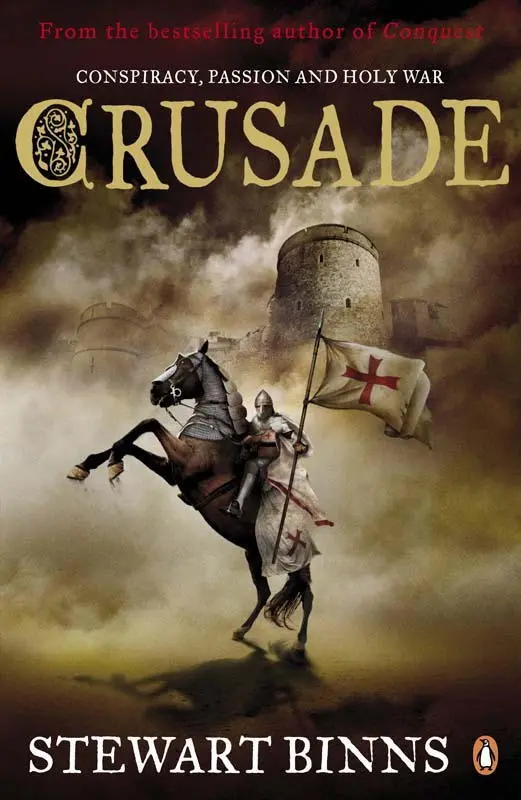
- Название:Crusade
- Автор:
- Издательство:Penguin Books
- Жанр:
- Год:2012
- Город:London
- ISBN:978-0-241-95758-5
- Рейтинг книги:3 / 5. Голосов: 1
-
Избранное:Добавить в избранное
- Отзывы:
-
Ваша оценка:
Crusade: краткое содержание, описание и аннотация
Предлагаем к чтению аннотацию, описание, краткое содержание или предисловие (зависит от того, что написал сам автор книги «Crusade»). Если вы не нашли необходимую информацию о книге — напишите в комментариях, мы постараемся отыскать её.
In the face of chaos and death, Edgar and his allies form a secret brotherhood, pledging to fight for justice and freedom wherever they are denied. But soon they are called to fight for an even greater cause: the plight of the Holy Land. Embarking on the epic First Crusade to recapture Jerusalem, together they will participate in some of the cruellest battles the world has ever known, the savage Siege of Antioch and the brutal Fall of Jerusalem, and together they will fight to the death.
Crusade — читать онлайн бесплатно полную книгу (весь текст) целиком
Ниже представлен текст книги, разбитый по страницам. Система сохранения места последней прочитанной страницы, позволяет с удобством читать онлайн бесплатно книгу «Crusade», без необходимости каждый раз заново искать на чём Вы остановились. Поставьте закладку, и сможете в любой момент перейти на страницу, на которой закончили чтение.
Интервал:
Закладка:
We formed ourselves into four distinct groups within the walls: Godfrey of Bouillon led the Lotharingians and Germans; the Papal Legate, Adhemar Le Puy, took charge of Raymond of Toulouse’s southern Franks; Bohemond headed his Italian Normans; and Robert, together with Robert of Flanders, commanded the northern Franks as well as the Normans and my English contingent.
We poured from different gates of the city in the hottest part of the day, taking our attackers completely by surprise, and fanned out in a wide arc. The dual keys to the manoeuvre were speed and ferocity. Our momentum would force the Turks to retreat and try to make a stand – which we had to prevent them finding the ground to make – and our reputation as awesome warriors would strike fear into the hearts of our retreating enemies.
Few of us had steeds of any sort – some knights even took to going into battle on donkeys and mules – but we had to mount a classic infantry charge in full armour in the middle of the Syrian summer. Not a very tempting prospect, but one about which we had no choice.
The plan worked perfectly and the Turks began to fall back towards their main camp in droves. Then simple battlefield psychology played its part. As soon as he saw our attack, Kerbogha should have committed his main force, which would easily have halted our momentum and, caught in open ground, on foot and vastly outnumbered, we would have been annihilated. But he hesitated and prepared his army to hold its ground and defend our attack, rather than come out and meet it head on.
It was a crucial mistake.
Our much smaller army was made up of the most fearsome warriors in Europe, fighting for their survival; his much larger force was full of mercenaries, allies of dubious commitment and men whose homes and families were far away and far from peril.
As Kerbogha’s main force took up its positions, all they could see were hundreds of their colleagues streaming past them and all they could hear were their cries of terror and the sound of mayhem in their wake. Realizing that his army’s will to fight was beginning to desert it, Kerbogha compounded his original mistake in hesitating by ordering a belated attack.
It was the worst possible decision: some of his men followed orders and advanced with intent, others advanced, but reluctantly, while the remainder just turned and joined their fleeing colleagues.
It became a rout as Kerbogha’s massive army disintegrated and scattered, leaving the Atabeg to return to Mosul with his tail between his legs. The Crusader army achieved many remarkable feats on the battlefield; this was undoubtedly its finest moment.
The Atabeg’s tents were captured intact, full of gold and other treasures, including huge stockpiles of arms and strings of horses and, most important of all, food, the like of which we had not seen for months. We looked on in wonder, not at the chests of coin, the gold goblets, fine carpets and tapestries, but at the pens of sheep, the butts of wine and the sacks of corn and flour.
We were in the Garden of Eden, and Jerusalem beckoned.
However, Bohemond got his way and took control of the city. He was in no mood to strike out immediately for the prize we had come for. In truth, few were – enough was enough, and it was time to take stock.
Alexius failed to join us, as had been promised, and so there was no pressure on us to move on. The Emperor had set out from Constantinople, but had met Stephen of Blois halfway across Anatolia at Philomelium. Stephen told him that the Crusaders’ cause was finished and that most were already dead, and so Alexius returned home.
The rest of 1098 became a bizarre mix of blissful recuperation, interspersed with frequent bouts of squabbling between the Princes about who should be in control of the many cities that now fell within their sphere of interest.
Now that all the local sultans, emirs and atabegs had been neutralized, all the cities of Anatolia, Syria and Mesopotamia were at the Crusaders’ mercy, and they took full advantage.
The inhabitants of each city that fell were put to the sword without mercy, only adding to the already murderous reputation of the Crusaders. Sweyn used his ever growing influence to try to persuade the young knights of the values of chivalry and the importance of the Mos Militum. Many sympathized with his basic philosophy, but few were prepared to extend to their Muslim enemies the status of an equal and to treat them as fellow warriors worthy of respect. The hardships of the Crusade had been too great, the hatred of the enemy too ingrained. The preaching of zealots such as Raymond of Toulouse, which cast Muslims as inferior and heretics, was too powerful for most to resist.
Sweyn talked openly about leading a revolt against the zealots by the younger, more enlightened knights, but Hereward, Robert and I managed to persuade him to keep his arrows in his quiver for the time being – certainly until we reached Jerusalem.
In October of 1098, the few remaining Princes in Antioch who still determined to go on to Jerusalem – Raymond of Toulouse, Tancred of Hauteville, Robert and I – decided that we would prepare to march on the Sacred Places in mid-January, as soon as the worst of the winter rains had stopped.
Shortly afterwards, the most special moment of the year occurred: a bodyguard of Alexius’s imperial troops, accompanied by a platoon of Varangians, appeared through the Bridge Gate of the city. They were leading an elaborate covered carriage from the Emperor’s personal caravan. It was strange to see a body of men dressed, armed and behaving like highly disciplined soldiers; it had been such a long time since we had had the same bearing.
As soon as it came to a halt, Estrith rushed to greet us, shortly followed by Adela, who moved more slowly thanks to a severe limp and the hindrance of the care she had to show the bundle in her arms, a child they had not yet formally named. The three-month-old baby was a boy, who went by the title ‘Herry’ for the time being.
He was dark like his father, bright-eyed and lively, and everyone wanted to assign his looks and character to various of his parents and grandparents. Sweyn was the first to pick up his son, soon followed by Hereward, proud to hold his grandson.
A feast was hastily organized and we sat and listened to one another’s stories. The birth had been straightforward; the Emperor Alexius had treated Estrith and Adela like his daughters; life in the Blachernae was a little like being a bird in a gilded cage, but splendid all the same.
Adela had eventually recovered, but only just. The Emperor’s physicians immediately stopped the use of the hot iron, saying that too much tissue had already been lost. They used instead the maggots of the blowfly, bred especially for the purpose and much more effective than the maggots used by the Crusader physicians. The treatment was uncomfortable at best and involved her lying on her stomach most of the time, but it worked. She had been left with a large hollow where her right buttock should have been, a mass of ugly scarring and a pronounced limp.
Adela, as ever, put it in her own inimitable way.
‘I’m still not a bad offering for a quick tryst, as long as I stay in the maiden’s position.’
The only sad story they brought was that the Emperor’s emissary had returned from Oviedo with the news that Cristina had died a few years earlier, but had lived out her days happily in the care of Doña Viraca, the Countess of Oviedo, who was Doña Jimena’s formidable mother.
The emissary also brought news from Spain that Doña Jimena was alive and well in Valencia with the Cid, who was still Lord of the Taifa, but that he was not faring so well. His age and many battle scars were catching up with him and his body groaned and moaned at him all the time.
Читать дальшеИнтервал:
Закладка:
Похожие книги на «Crusade»
Представляем Вашему вниманию похожие книги на «Crusade» списком для выбора. Мы отобрали схожую по названию и смыслу литературу в надежде предоставить читателям больше вариантов отыскать новые, интересные, ещё непрочитанные произведения.




Обсуждение, отзывы о книге «Crusade» и просто собственные мнения читателей. Оставьте ваши комментарии, напишите, что Вы думаете о произведении, его смысле или главных героях. Укажите что конкретно понравилось, а что нет, и почему Вы так считаете.