Nicola Griffith - Hild
Здесь есть возможность читать онлайн «Nicola Griffith - Hild» весь текст электронной книги совершенно бесплатно (целиком полную версию без сокращений). В некоторых случаях можно слушать аудио, скачать через торрент в формате fb2 и присутствует краткое содержание. Город: New York, Год выпуска: 2013, ISBN: 2013, Издательство: Farrar, Straus and Giroux, Жанр: Историческая проза, на английском языке. Описание произведения, (предисловие) а так же отзывы посетителей доступны на портале библиотеки ЛибКат.
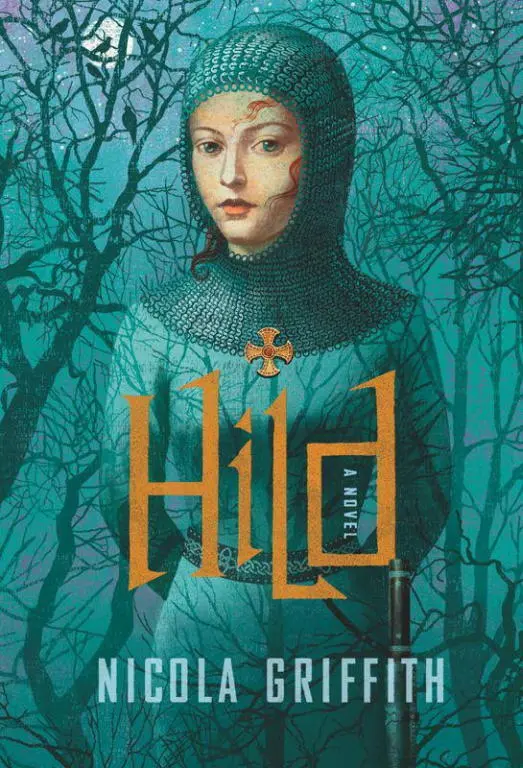
- Название:Hild
- Автор:
- Издательство:Farrar, Straus and Giroux
- Жанр:
- Год:2013
- Город:New York
- ISBN:978-0-374-28087-1
- Рейтинг книги:5 / 5. Голосов: 1
-
Избранное:Добавить в избранное
- Отзывы:
-
Ваша оценка:
Hild: краткое содержание, описание и аннотация
Предлагаем к чтению аннотацию, описание, краткое содержание или предисловие (зависит от того, что написал сам автор книги «Hild»). Если вы не нашли необходимую информацию о книге — напишите в комментариях, мы постараемся отыскать её.
But now she has only the powerful curiosity of a bright child, a will of adamant, and a way of seeing the world—of studying nature, of matching cause with effect, of observing her surroundings closely and predicting what will happen next—that can seem uncanny, even supernatural, to those around her.
Her uncle, Edwin of Northumbria, plots to become overking of the Angles, ruthlessly using every tool at his disposal: blood, bribery, belief. Hild establishes a place for herself at his side as the king’s seer. And she is indispensable—unless she should ever lead the king astray. The stakes are life and death: for Hild, for her family, for her loved ones, and for the increasing numbers who seek the protection of the strange girl who can read the world and see the future.
Hild is a young woman at the heart of the violence, subtlety, and mysticism of the early Middle Ages—all of it brilliantly and accurately evoked by Nicola Griffith’s luminous prose. Working from what little historical record is extant, Griffith has brought a beautiful, brutal world—and one of its most fascinating, pivotal figures, the girl who would become St. Hilda of Whitby—to vivid, absorbing life.
Hild — читать онлайн бесплатно полную книгу (весь текст) целиком
Ниже представлен текст книги, разбитый по страницам. Система сохранения места последней прочитанной страницы, позволяет с удобством читать онлайн бесплатно книгу «Hild», без необходимости каждый раз заново искать на чём Вы остановились. Поставьте закладку, и сможете в любой момент перейти на страницу, на которой закончили чтение.
Интервал:
Закладка:
Paulinus was lifting his arms, finishing his exhortation—iron, stallion, the crumbling of pagan gods!—and raising his face to heaven. Coifi stood.
More gesiths were looking at her now. Coifi wasn’t moving.
She turned to Coifi. Poor Coifi. A lifetime in one throw.
She held out her hand. “I’ll help you.”
Hild nodded for Oeric to hold Coifi’s spear—he’d trip over it, otherwise—and put his right hand on the withers of the king’s third-best stallion. She took his left hand, put it on her shoulder and bent to make a stirrup. He put his foot in it and she heaved and threw him into the saddle. She gave him the reins, made sure he had them in hand, then nodded for Oeric to give him the spear. She turned the horse’s head to face the enclosure.
“There’s no hurry,” she said. “Start at a walk.”
But Coifi, in a panic, kicked harder than he meant, and within a breath was thundering full gallop at the entry posts. Hild gripped her seax and braced herself.
Five spear lengths from the opening, Coifi gave a thin screech and flung the spear into the enclosure.
The stallion, trained to within an inch of its life, knew that a thrown spear meant he should swerve away from the expected reply, and he did.
Priest and horse moved smoothly to the left and the spear, the edged iron, flew into the god’s heart.
Every armed man, even the king, flinched. Hild closed her eyes but there was no flash of light, no last thunderbolt.
The grey stallion came thundering back, white-eyed, Coifi clinging to the saddle horn.
It was the scop who recovered his wits first. “Behold!” he shouted. “Woden is crushed. Christ is God!”
It was a victory cry the gesiths understood. They banged spears on shields and cheered. Hild let go of her seax and flexed her hand to get the blood moving again.
Edwin laughed and clapped the bishop on the back. “Now we persuade Eorpwald to Christ. Then we’ll see who the bishop of Rome calls king of the isle!” Lintlaf brought him his horse.
When the king was mounted, Hild saw Lintlaf fish up something hanging from the string around his neck and toss it aside. She stared at it. God in the nettles.
“Lady.” Oeric, with Cygnet. Horses were wheeling, galloping away.
“Take her back to the vill.”
“Lady?”
“I’ll walk. A god needs a farewell from somebody. I’ll be there for supper.”
When she was alone, she stepped between the entry posts. The spear lay at an angle across the beaten-earth walkway. She picked it up and propped it against the tall wall boards.
The enclosure smelt of weathered wood and soil being moved aside by growing things. The paint, so vivid a year ago, was faded. Many of the thick black outlines were still clear but the bright colours were turning to wood and mud. She walked the spiral corridor, running her hand along the painted horizon—sea, beach, dunes, woods, moors—the journey of her people from over the sea. The story of the Anglisc, woven with Woden back to the dawn of their songs.
Ships. Fire. Bright swords. Kin and kine. Woods and wold. Hearth and home. Where was Christ in this? Christ didn’t fight. Christ didn’t farm.
The totem was taller than she remembered. She walked around the base. Waves, cliffs, a ship’s prow, cut sharp and deep and clear. Cut from wood, not cold stone.
Christ was a carpenter. Why did his priests build with stone?
She followed the rising line of the carving. A cliff, a tall pole with a boar banner flying. Flying banner blending with a tracery of oak branches. Birds flying with acorns in their beaks. Up and up. Windblown leaves. Wild geese. Clouds. Mare’s tails. The horses of the wild hunt. Manes and tails becoming the beard, the beard leading to the chin. Up and up. The mouth. Eyes, gigantic but knowable. The eyes of a god who laughed, who lusted, who drank, who threw knucklebones and lost his temper. Up and up. The helmet crested with the boar. Totem and token of the Yffings. And all would warp and wear and weather into the earth as though it had never been.
She stood alone at the empty heart of a gone god, staff in the crook of her arm, one hand on her seax and the other on her cross. She would not wear and weather. She was Yffing. She would be totem and token for her people, the light of the world.
The next day, Goodmanham still seethed with the controlled chaos of the arrival of the king’s party. Late in the morning Hild left Begu and Gwladus to organise their things and sought out her mother. She wanted to talk about the mad Rhianmelldt, to bring Rheged into Northumbria so that their land would stretch from the North Sea to the Irish Sea, and so that Begu could be happy.
Breguswith stood with Æthelburh in the middle of the flax fields, pointing. The queen was shaking her head, gesturing vaguely south.
Hild hesitated. It was best to approach royalty with answers, not questions. But then the queen saw her and waved, and it was too late. Hild waved back and walked towards them.
The flax came to her hip, as high as it would get, though the seed balls were still small and green. Little tunnelled paths ran through the crop. Voles. If her mother and the queen hadn’t scared them away, there would be a hawk or two soaring over the field.
They greeted her with smiles. “Perhaps you’ll give us your opinion,” the queen said.
Her mother said, “We’re of two minds. Risk or reward one way, steady surety the other.”
Æthelburh cut a stalk of flax with her belt knife and rolled the stem back and forth between her palms. She offered it to Hild.
Hild bent and sniffed. “The fibre’s ripe. But the seed isn’t.” They nodded. That much was obvious. “So. Oil or linen?”
“Trading for oil is expensive,” Breguswith said.
“But so is good linen,” said the queen. “And if we harvest now, we’ll have softer, finer yarn.”
“The sun came early this year,” Hild said. She closed her eyes, imagined herself as a hawk, high above the field. Imagined the field just south of here, the one next to that, and the next and the next, south all the way to the narrow sea. Summer was always earlier in the south. She opened her eyes. “The Kentish and East Anglisc flax harvest will be an abundance of oil, and a scarcity of fine linen.”
The two older women smiled at each other. “Linen, then,” the queen said. “We’ll break the news to Coelfrith. He’ll argue.”
“But the king will take your side,” Breguswith said comfortably, and they both laughed in that womanly way that Hild didn’t understand but that reminded her of the new Begu. They turned to go.
“Help me,” she blurted. They both looked back, surprised. She plunged on. “Rhianmelldt of Rheged needs a husband.”
“Rhianmelldt? But she’s young,” Æthelburh said, frowning. “Isn’t she?”
Breguswith nodded, watching Hild. “But Begu isn’t.”
“Begu wants to marry Uinniau,” Hild said. “He can’t marry until Rheged’s settled. Rheged won’t be settled until Rhianmelldt marries a strong man. We want, my uncle wants, that man to be our ally.”
“We need to find this strong man, one of ours, and offer him to Rhoedd for his daughter?”
“There’d be no hurry, but for Begu,” Breguswith said.
Æthelburh smiled. “I have just the man.”
Hild and Breguswith looked at her blankly.
Æthelburh looked pleased. “He’s young. He’s handsome. He’s brave: He has a ringed sword. He’s respected by Britons and Anglisc alike.” She laughed, delighted with herself. “Oh, oh, he fits like a fist in a glove! He’s a Christian, baptised by soon-to-be Archbishop Paulinus. You haven’t guessed? He saved the king’s life.” Now she looked exasperated. “He’s my godson. Boldcloak himself!”
Читать дальшеИнтервал:
Закладка:
Похожие книги на «Hild»
Представляем Вашему вниманию похожие книги на «Hild» списком для выбора. Мы отобрали схожую по названию и смыслу литературу в надежде предоставить читателям больше вариантов отыскать новые, интересные, ещё непрочитанные произведения.


Обсуждение, отзывы о книге «Hild» и просто собственные мнения читателей. Оставьте ваши комментарии, напишите, что Вы думаете о произведении, его смысле или главных героях. Укажите что конкретно понравилось, а что нет, и почему Вы так считаете.