John Passos - Mr. Wilson's War
Здесь есть возможность читать онлайн «John Passos - Mr. Wilson's War» весь текст электронной книги совершенно бесплатно (целиком полную версию без сокращений). В некоторых случаях можно слушать аудио, скачать через торрент в формате fb2 и присутствует краткое содержание. Год выпуска: 1962, ISBN: 1962, Издательство: Doubleday, Жанр: Историческая проза, Биографии и Мемуары, на английском языке. Описание произведения, (предисловие) а так же отзывы посетителей доступны на портале библиотеки ЛибКат.
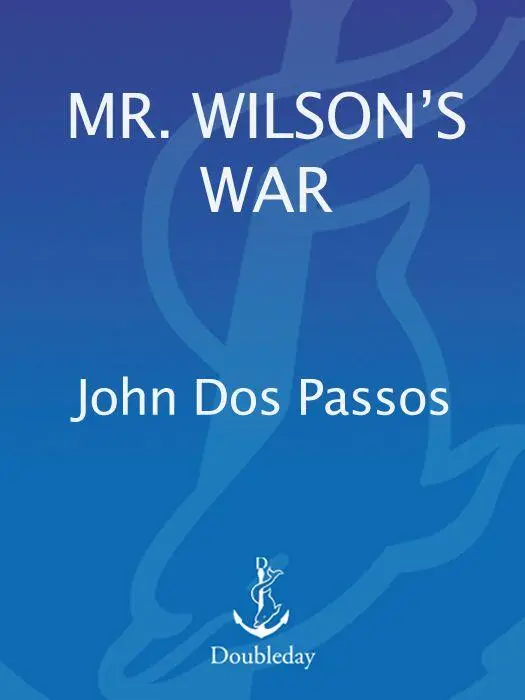
- Название:Mr. Wilson's War
- Автор:
- Издательство:Doubleday
- Жанр:
- Год:1962
- ISBN:9780385028288
- Рейтинг книги:3 / 5. Голосов: 1
-
Избранное:Добавить в избранное
- Отзывы:
-
Ваша оценка:
Mr. Wilson's War: краткое содержание, описание и аннотация
Предлагаем к чтению аннотацию, описание, краткое содержание или предисловие (зависит от того, что написал сам автор книги «Mr. Wilson's War»). Если вы не нашли необходимую информацию о книге — напишите в комментариях, мы постараемся отыскать её.
Foremost in the cast of characters is Woodrow Wilson, the shy, brilliant, revered, and misunderstood “schoolmaster”, whose administration was a complex of apparent contradictions. Wilson had almost no interest in foreign affairs when he was first elected, yet later, in proposing the League of Nations, he was to play a major role in international politics. During his first summer in office, without any…
Mr. Wilson's War — читать онлайн бесплатно полную книгу (весь текст) целиком
Ниже представлен текст книги, разбитый по страницам. Система сохранения места последней прочитанной страницы, позволяет с удобством читать онлайн бесплатно книгу «Mr. Wilson's War», без необходимости каждый раз заново искать на чём Вы остановились. Поставьте закладку, и сможете в любой момент перейти на страницу, на которой закончили чтение.
Интервал:
Закладка:
The American Commission was known to Americans in Paris as the “house party.” They put up at the Hotel Crillon where House occupied what was known as the Thomas Fortune Ryan suite. General Pershing and Harbord were invited there to meet them before they all went together to the first ceremonial. The Crillon hummed with Americans. Grasty of the New York Times , who was among the newspaper contingent, described the colonel as “busy as a squirrel in nutting time.”
“I met the great little man,” Harbord noted in his journal, “the man who can be silent in several languages … He is one of the few men with practically no chin, whom I have ever met, who were considered forceful. He called the committee together and made them what I consider a baldly cynical little speech … ‘We are going to meet this morning. Nothing will be done more than to go through the form of an organization. No speeches for someone might blunder onto the subject of Russia: and some little fellows might ask disagreeable questions … It is our day to smile. Just circulate around among the little fellows and listen to their stories. Be kind and agreeable.’ If that isn’t giving a stone when they ask for bread, then I dunno,” added Harbord.
“Then we drove over to the French ministry of Foreign Affairs … A very large room with long tables with place cards, each delegation to itself. Seventeen Allied nations, such as U.S., Great Britain, Brazil, Liberia, Cuba, Japan, France, Serbia, Montenegro, Italy, Russia, Roumania, Argentine, Belgium, etc. from chrome yellow through brown and black back to clear white in color, a perfect polyglot of tongues … a gathering so little hopeful of unity, that as an investment I suspect the hardheaded Germans would have willingly paid the expenses of it.”
Harbord described the new French Premier as “venerable.” He had once taught school “in Massachusetts” and was reputed to know “the peculiar but amusing and sometimes efficient ways of the Americans. His personal manner is described as very direct and frank … Some months,” Harbord added in the privacy of his journal, “of perfectly direct and frank intercourse with some Frenchmen, however, has shown us that however direct and frank, they are sometimes making mental reservations … So it probably was with the old Prime Minister.” … Evidently the meeting was not quite as short as House and Clemenceau had planned. “I watched it for an hour,” Harbord wrote, “and then left with my Chief.” Colonel Dawes, who had stacks of money, had invited Harbord to lunch with him at the Tour d’Argent. There they ate pressed duck with oranges. Afterwards they went to Brentano’s where Harbord helped his friend spend a hundred dollars on early editions. They were both fond of Napoleoniana.
The Supreme War Council, consisting of the prime ministers and military leaders and their aides, assembled at the Trianon Palace at Versailles. Its meetings proved hardly more productive than those of the Interallied Commission. “I can understand quite readily why Germany has been able to withstand the Allies,” noted House. “Superior organization and method. Nothing is buttoned up with the Allies: it is all talk and no concerted action.”
One thing came out clear. None of the belligerents was ready to make the sort of concessions necessary for a negotiated peace. The governments of each of the fighting nations had decided to try one more round. This was the information that House took home to the President.
PART FOUR
Force Without Stint
Let everything that we say, my fellow countrymen, everything that we henceforth plan and accomplish, ring true to this response till the majesty and might of our concerted power shall fill the thought and utterly defeat the force of those who flout and misprize what we honor and hold dear. Germany has once more said that force, and force alone, shall decide whether justice and peace shall reign in the affairs of men, whether Right as America conceives it or Dominion as she conceives it, shall determine the destinies of mankind. There is, therefore, but one response possible from us: Force, Force to the utmost, Force without stint or limit, the righteous and triumphant Force which shall make Right the law of the world, and cast every selfish dominion down in the dust.
— Woodrow Wilson on opening of Third Liberty Loan Drive in the Baltimore Armory, April 6, 1918Chapter 16
TO MOBILIZE THE MIND
ON the afternoon of December 17 Colonel House’s quiet tread was heard again in the White House corridors. He had smuggled his mission out of France so secretly that the correspondents were astonished. “Of all the molelike activities of Colonel House,” cabled the New York Times man, Grasty, “the climax was his departure … Perhaps the Colonel had made a quiet bet with himself on his ability to take the party of fifteen or twenty persons out of the most conspicuous setting in Paris without anybody being the wiser.”
House found the President waiting for him in his study. They talked privately for two hours. Though the colonel liked to cast an optimistic glow over reports of his operations as diplomat extraordinary, this time he made no effort to disguise the fact that little had been accomplished.
Due to the recalcitrance of the Italians, who still dreamed of turning the Adriatic into their mare nostrum, and to Clemenceau’s lack of interest in anything but fighting the boche , the confidential colonel had failed to induce the Allied authorities to agree on the public statement of sane and liberal war aims which he and the President wanted. His arguments in favor of a central military command had met with evasive replies from Lloyd George, who ever since he had bet on the wrong horse with Nivelle was leery of the military. The hideous butcher’s bill the British Prime Minister was confronted with from Haig’s Flanders offensives made him suspicious of anything which would give that general or his associate General Robertson, the Imperial Chief of Staff, any added power of decision. He stalled and procrastinated. About all that House could report was that the meetings of the Supreme War Council had laid the foundation upon which unified command might, on some more auspicious occasion, be set up.
The President called in Secretary Baker and General Bliss for another conference with House next day. Then he sent him back to New York post haste to assemble the facts and figures the college professors were digging out of the libraries. He needed the peace inquiry bureau’s research as the basis for a fresh statement of war aims.
The Bolshevik seizure of power in Petrograd drastically changed the course of the war of ideas which interested Woodrow Wilson far more than military strategy. One of Leon Trotsky’s first acts in taking over the Ministry of Foreign Affairs, as commissar for the All Russian Congress of Soviets, was to publish the secret agreements among the Allies to carve up Turkey and Austro-Hungary and the various Balkan states for the satisfaction of “territorial ambitions.”
The Manchester Guardian printed the first summary in English of these deals on December 13. They set the British nonconformist conscience to stirring.
Printed in America by Villard’s New York Evening Post , they provided encouragement to the socialists and pacifists whose views Woodrow Wilson was coming to hold in low esteem. “What I am opposed to,” he told an A.F. of L. convention in Buffalo, “is not the feeling of the pacifists, but their stupidity. My heart is with them, but my mind has contempt for them. I want peace but I know how to get it and they do not. You will notice that I sent a friend of mine, Colonel House, to Europe, who is as great a lover of peace as any man in the world, but I didn’t send him on a peace mission yet. I sent him to take part in a conference on how the war was to be won, and he knows, as I know, that that is the way to get peace.”
Читать дальшеИнтервал:
Закладка:
Похожие книги на «Mr. Wilson's War»
Представляем Вашему вниманию похожие книги на «Mr. Wilson's War» списком для выбора. Мы отобрали схожую по названию и смыслу литературу в надежде предоставить читателям больше вариантов отыскать новые, интересные, ещё непрочитанные произведения.

Обсуждение, отзывы о книге «Mr. Wilson's War» и просто собственные мнения читателей. Оставьте ваши комментарии, напишите, что Вы думаете о произведении, его смысле или главных героях. Укажите что конкретно понравилось, а что нет, и почему Вы так считаете.