John Passos - Mr. Wilson's War
Здесь есть возможность читать онлайн «John Passos - Mr. Wilson's War» весь текст электронной книги совершенно бесплатно (целиком полную версию без сокращений). В некоторых случаях можно слушать аудио, скачать через торрент в формате fb2 и присутствует краткое содержание. Год выпуска: 1962, ISBN: 1962, Издательство: Doubleday, Жанр: Историческая проза, Биографии и Мемуары, на английском языке. Описание произведения, (предисловие) а так же отзывы посетителей доступны на портале библиотеки ЛибКат.
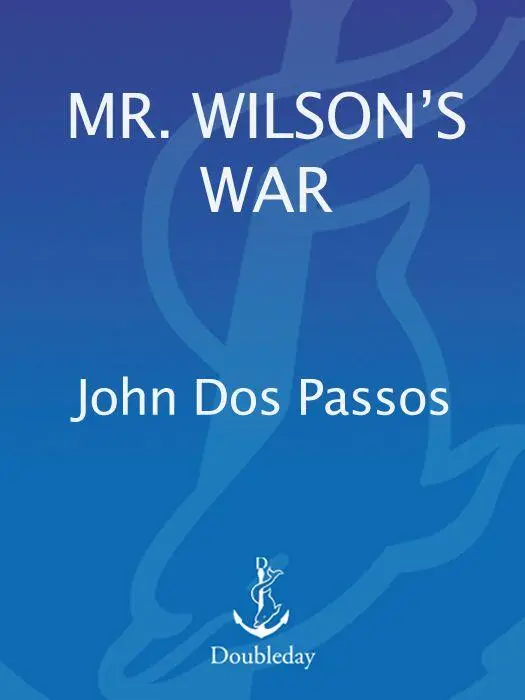
- Название:Mr. Wilson's War
- Автор:
- Издательство:Doubleday
- Жанр:
- Год:1962
- ISBN:9780385028288
- Рейтинг книги:3 / 5. Голосов: 1
-
Избранное:Добавить в избранное
- Отзывы:
-
Ваша оценка:
Mr. Wilson's War: краткое содержание, описание и аннотация
Предлагаем к чтению аннотацию, описание, краткое содержание или предисловие (зависит от того, что написал сам автор книги «Mr. Wilson's War»). Если вы не нашли необходимую информацию о книге — напишите в комментариях, мы постараемся отыскать её.
Foremost in the cast of characters is Woodrow Wilson, the shy, brilliant, revered, and misunderstood “schoolmaster”, whose administration was a complex of apparent contradictions. Wilson had almost no interest in foreign affairs when he was first elected, yet later, in proposing the League of Nations, he was to play a major role in international politics. During his first summer in office, without any…
Mr. Wilson's War — читать онлайн бесплатно полную книгу (весь текст) целиком
Ниже представлен текст книги, разбитый по страницам. Система сохранения места последней прочитанной страницы, позволяет с удобством читать онлайн бесплатно книгу «Mr. Wilson's War», без необходимости каждый раз заново искать на чём Вы остановились. Поставьте закладку, и сможете в любой момент перейти на страницу, на которой закончили чтение.
Интервал:
Закладка:
Next morning they called on Admiral and Mrs. Grayson at the St. Regis and attended divine services at the Fifth Avenue Presbyterian Church. Edith Wilson’s mother and sister went on board with them for Sunday dinner, and so did the discreetly smiling Colonel House.
House was braving the September heat to meet the Marquess of Reading, Chief Justice of England, the son of an East End fruit merchant, risen by brains and tact and skill in the law to the Privy Council, who had just arrived in New York. Reading was one of the Liberals closest to Lloyd George, and after much correspondence with House and North-cliffe, the Prime Minister had picked him as the man most likely to get along with Baruch of the War Industries Board in coordinating the war effort and in bringing home to the Americans the dreadful urgency of the situation the Allies faced on the western front as the result of the Russian collapse. Then too he had to arrange a fresh credit. The British were out of funds again.
Before the meal was served on the Mayflower the colonel managed to buttonhole the President long enough to show him a letter from Lloyd George to House which Reading had brought, suggesting that Wilson send a personal representative to join in the councils of the Allies and that that representative should be House himself. Wilson held the suggestion at arm’s length, and they rejoined the party waiting to sit down at table.
The President returned to Washington by train so as to be at his desk Monday morning. A few days later Lord Reading called by appointment and presented another personal letter from Lloyd George, this time addressed to Wilson directly, urging with some vehemence that the President of the United States be represented at the next interallied conference.
In the first place the decisions made there would directly affect the American Army … “But another reason weighs still more strongly with me,” wrote the Prime Minister. “I believe that we are suffering today from the grooves and traditions that have grown up since the war … Independent minds, bringing fresh views … might be of immense value in helping us to free ourselves from the ruts of the past.” The wily Welshman ended with an encomium of the President’s public statements. “They have recalled to many the ideals with which they entered the war, and which it is easy to forget amid the horrors of the battlefield and the overtime and fatigue of the munitions shops. They have given to the bruised and battered peoples of Europe fresh courage to endure and fresh hope that with all their sufferings they are helping to bring into being a world in which freedom and democracy will be secure, and in which free nations will live together in unity and peace.”
The President’s desk was bombarded in the days that followed with similar requests from the French and the Italians. In early October he asked House to come to Washington to discuss them. House found the President still set against letting what he called “the center of gravity of the war” be transferred to Europe. At the same time he had come reluctantly to the conclusion that he must be represented at the next interallied meeting.
House was the only man he could trust to protect his liberty of action. House must head the delegation, which they now decided should be a fulldress affair, including General Bliss, the Chief of Staff, Admiral Benson, Chief of Naval Operations, and important figures in the administration who could discuss authoritatively the problems of finance and supply, and the allimportant embargo on German trade through neutral nations. Two cruisers and a destroyer would be furnished for transportation. All expenses would be paid through the State Department. As usual the colonel’s instructions were vague.
Without keeping a copy, or sending one over to the State Department for the record, the President wrote out for House what the colonel slyly called his letter of marque. It was a private letter endorsed to the premiers of Great Britain, France and Italy, whom Wilson addressed simply as “gentlemen.” He stated that he had “asked his friend Mr. Edward M. House, the bearer of this letter, to represent me in the general conferences presently to be held by the governments associated in war with the central powers or in any other conferences he may be invited and think it best to take part in.”
On second thought it was decided to ask Lansing to send formal notification of the dispatch of an American mission to the governments involved.
“I shall think of you and dear Mrs. Wilson constantly while I am away,” wrote House from New York where he was hastily assembling his delegation, “and I shall put forward the best that is in me to do the things you have intrusted to me …” He begged the President to take care of his health … “You are the one hope left to this torn and distracted world. Without your leadership God alone knows how long we will wander in the wilderness …”
“I hate to say good by,” the President answered. “It is an immense comfort to me to have you here for counsel and for friendship. But it is right that you should go. God bless and keep you both. My thoughts will follow you all the weeks through, and I hope it will be only weeks that will separate us.
“Mrs. Wilson,” he added significantly, “joins in all affectionate messages.”
Since the mission was turning out to be such a numerous affair, House felt he was entitled to take his family along. He appointed his soninlaw Gordon Auchincloss secretary to the commission. Loulie went as a matter of course, and the indispensable Miss Denton, who was so adept at the private code House and Wilson had worked out between them for their personal communications.
Sir William Wiseman was a very shrewd fellow. He had become an intimate of the House apartment on Fiftythird Street, where he found the richest field for the intelligence on American affairs it was his business to transmit back to Whitehall. Now he was taking every precaution to see that the Americans should be made comfortable when they arrived in the tight little isle: “House is very insistent on not having any public banquets or lunches,” he cabled. “He is not strong physically and has a perfect horror of public functions … May I remind you that Americans hate cold houses, and it is important that the places should be steam-heated as they do not think fires are enough.”
House was privately quite aware that there was something incongruous in this sort of preparation for the comfort and convenience of the topdogs whose mismanagement had brought civilization to such a grievous pass, while the underdogs who were in no way to blame suffered and froze and died in the mud and misery of the trenches. One day amid the fluster and botheration of the commission’s preparations for departure he paused long enough to make a quaintly ruminative entry in his diary: “It is to be hoped that the people of all nations will some day notice that those in authority who are largely responsible for wars and those who fan public opinion to white heat, are seldom hurt. Where among the crowned heads of Europe do we find a fatality? Where among Cabinets and members of parliaments has the war caused a death? Where among the great editorial writers, politicians and public orators has one suffered death on the field of battle?”
The American mission proceeded by train to Halifax and was safely conveyed across the Atlantic, arriving in Plymouth on November 7.
In London they found long faces. House had no sooner digested the full story of Caporetto, with eight hundred thousand Italians killed, wounded or prisoner, when the news came of the collapse of Kerensky’s middleclass government and the seizure of power in Petrograd by Lenin’s Bolsheviks in the name of the workers and soldiers and peasants. One of their first public acts was to demand an armistice from the German High Command.
Читать дальшеИнтервал:
Закладка:
Похожие книги на «Mr. Wilson's War»
Представляем Вашему вниманию похожие книги на «Mr. Wilson's War» списком для выбора. Мы отобрали схожую по названию и смыслу литературу в надежде предоставить читателям больше вариантов отыскать новые, интересные, ещё непрочитанные произведения.




Обсуждение, отзывы о книге «Mr. Wilson's War» и просто собственные мнения читателей. Оставьте ваши комментарии, напишите, что Вы думаете о произведении, его смысле или главных героях. Укажите что конкретно понравилось, а что нет, и почему Вы так считаете.