John Passos - Mr. Wilson's War
Здесь есть возможность читать онлайн «John Passos - Mr. Wilson's War» весь текст электронной книги совершенно бесплатно (целиком полную версию без сокращений). В некоторых случаях можно слушать аудио, скачать через торрент в формате fb2 и присутствует краткое содержание. Год выпуска: 1962, ISBN: 1962, Издательство: Doubleday, Жанр: Историческая проза, Биографии и Мемуары, на английском языке. Описание произведения, (предисловие) а так же отзывы посетителей доступны на портале библиотеки ЛибКат.
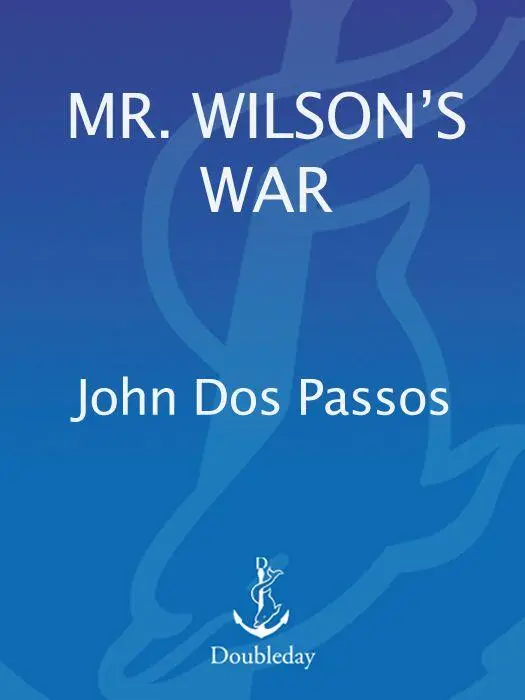
- Название:Mr. Wilson's War
- Автор:
- Издательство:Doubleday
- Жанр:
- Год:1962
- ISBN:9780385028288
- Рейтинг книги:3 / 5. Голосов: 1
-
Избранное:Добавить в избранное
- Отзывы:
-
Ваша оценка:
Mr. Wilson's War: краткое содержание, описание и аннотация
Предлагаем к чтению аннотацию, описание, краткое содержание или предисловие (зависит от того, что написал сам автор книги «Mr. Wilson's War»). Если вы не нашли необходимую информацию о книге — напишите в комментариях, мы постараемся отыскать её.
Foremost in the cast of characters is Woodrow Wilson, the shy, brilliant, revered, and misunderstood “schoolmaster”, whose administration was a complex of apparent contradictions. Wilson had almost no interest in foreign affairs when he was first elected, yet later, in proposing the League of Nations, he was to play a major role in international politics. During his first summer in office, without any…
Mr. Wilson's War — читать онлайн бесплатно полную книгу (весь текст) целиком
Ниже представлен текст книги, разбитый по страницам. Система сохранения места последней прочитанной страницы, позволяет с удобством читать онлайн бесплатно книгу «Mr. Wilson's War», без необходимости каждый раз заново искать на чём Вы остановились. Поставьте закладку, и сможете в любой момент перейти на страницу, на которой закончили чтение.
Интервал:
Закладка:
Now he saw the possibilities of the sort of radical action he dreaded much enhanced by the flood of propaganda the Russian Bolsheviks were letting loose on the world. He saw Socialists, I.W.W.s, pacifists, anarchists of the Emma Goldman stripe all contributing in their separate ways to help enemy aliens and German agents impede the war effort. While he was a stickler for the forms of the constitutional process, he intended to use his powers under the espionage law and draft laws to the full.
His Attorney General was House’s old Texas friend T. W. Gregory, a devout adherent since the days of the Texas delegation at the Baltimore convention. Gregory made his name as a lawyer by conducting the government case against the New York New Haven & Hartford in an antitrust prosecution. House described him as loyal as Caesar’s legion. Now Gregory was zealously backing up the President by sending his assistants far and wide over the country to root out sedition.
Gregory’s fellow Texan, Postmaster General Burleson, was already making life difficult for the hyphenated press. He banned the chief Irish newspapers The Freeman’s Journal, The Irish World and The Gaelic American from the mails for statements disrespectful of the English ally. German and slavic language papers were continuously scrutinized for sedition. The Socialist Leader , published in Milwaukee, a city under suspicion as both a German-American and a Socialist center, was denied mailing privileges. Even the liberal Metropolitan Magazine , among whose contributors and editors were staunch adherents of the New Freedom, had an issue declared unmailable on account of an article by William Hard questioning the Administration’s policy in the Caribbean. Organs of the angry young radicals, such as Max Eastman’s Masses , were put out of business.
The Department of Justice even took action against a motion picture entitled The Spirit of 1776 which was forbidden the screen on account of a scene showing redcoats committing atrocities against revolutionary civilians. The Attorney General was so pleased with the judge’s decision in this case, tried in a federal court in California, that he had it published as a pamphlet.
Gregory’s agents meanwhile were seeking indictments against the seditious and the disloyal. The notorious anarchists Emma Goldman and Alexander Berkman were already in the toils of the law for their opposition to conscription. Enemy aliens were being weeded out of training camps and interned as fast as they could be apprehended. The disaffected were marked for deportation. Indictments were in the works against a college professor named Scott Nearing, who had been dismissed by the University of Pennsylvania for pacifist utterances; and against Rose Pastor Stokes, a Socialist from East Side New York, an old Wilson admirer, who was unable to stomach the Allied war aims as revealed by the secret treaties, and was saying so in public. Warrants were out for leaders of the Non-Partisan League who were too outspoken in their admiration for Senator La Follette. In Akely, Minnesota, a young Socialist let his fear of the Department of Justice so prey on his mind that he blew his head off by biting into a dynamite cap. In Chicago the federal District Attorneys were carefully laying the groundwork for the fulldress state trial of one-eyed William D. Haywood and a hundred and one members of the Industrial Workers of the World.
These “Wobblies” were easier game than the Socialists. The Socialists were respectable people. Their convictions about the sanctity of the democratic process were very near Woodrow Wilson’s own. The Wobblies came from the bottom of the heap.
Their fundamental tenet, like that of the Russian Bolsheviks, was that the exploiting class, as they called the employers of the world, and the working class had nothing in common. Unlike the Russian Bolsheviks who were all for seizing government power, they would have nothing to do with the state, either theoretically or practically. They boasted of their belief in sabotage and direct action. They dreamed of the general strike which, by some mystical process they never got very far towards describing, would peacefully transform society so that the men who did the work would own the tools of production and retain the profits now being siphoned off into the money bags of parasite capitalists. It was a doctrine which appealed to the wild frontier fringe of American labor. It was a doctrine for tramps and freelivers. It smacked of talk around the campfire in hobo jungles and of the independence of the homesteader invading the wilderness with his axe and his gun. As Americans, they claimed, they were born with the right of free speech.
The Wobblies may well at that time have had a million and a half adherents. They encouraged draftdodging and denounced the war as a capitalist device to squeeze profits out of the blood of conscript workers. Their doctrines were prevalent among the lumbermen of the Northwest who were producing timbers for the shipyards and spruce for the airplanes which were so slow in coming into production. They were stirring up strikes and freespeech fights which, it was claimed, impeded the war effort. The trial and eventual conviction of the entire leadership and the brutally long terms imposed by Judge Landis virtually removed the Wobblies’ frontier syndicalism from the lexicon of American Labor.
While Gregory’s federal agents, using what they called presidential warrants when they could not get warrants duly issued by grand juries, and even more zealous state officials, labored mightily to place critics of the presidential policies behind bars, the general public joined in the hue and cry.
Forty authors of standing petitioned the Senate for the expulsion of that wilful man, La Follette. German courses were dropped from schools and colleges. German dishes disappeared from bills of fare. Sauerkraut became known as liberty cabbage, German measles was renamed. German clover appeared in the seed catalogues as crimson or liberty clover. All manifestations of foreign culture became suspect. German operas were dropped from the repertory. The drive against German music culminated in the arrest of Dr. Carl Muck, the elderly and muchadmired conductor of the Boston Symphony Orchestra.
“It is not an army that we must shape and train for war. It is a nation,” Wilson wrote in his draft proclamation. “The whole nation must be a team.” To turn the whole nation into a team it was not enough to punish the expression of the wrong opinions. It was necessary to disseminate the right opinions.
During the first weeks after the declaration of war, at a time when Wilson was distracted by Congress’s refusal to give him, along with his other wartime powers, the censorship of the press, there appeared on the White House desk the sort of document he most liked to peruse when he was trying to make up his mind on some issue. The epistle summed up the arguments for and against official wartime censorship and suggested that what was needed was not suppression, but expression; in other words a publicity campaign to sell the war to the nation.
This brief was the work of a Colorado journalist who had supported the President with such vim, through a set of slashing editorials and a book on the issues, during the 1916 campaign, that Tumulty had him down for a post in one of the departments. The journalist’s name was George Creel.
Creel was a little shrimp of a man with burning dark eyes set in an ugly face under a shock of curly black hair. He came from an impoverished family of Virginians who had moved to Missouri after the Civil War. He had made his way up through Kansas City newspapers and muckraking New York magazines by energy and brass to the position of Police Commissioner in Denver. He was a leader of the reform element among Colorado Democrats. He had graduated from the tubthumping Denver Post to his own Rocky Mountain News. He was married to Blanche Bates, one of the reigning stars of the American stage.
Читать дальшеИнтервал:
Закладка:
Похожие книги на «Mr. Wilson's War»
Представляем Вашему вниманию похожие книги на «Mr. Wilson's War» списком для выбора. Мы отобрали схожую по названию и смыслу литературу в надежде предоставить читателям больше вариантов отыскать новые, интересные, ещё непрочитанные произведения.


Обсуждение, отзывы о книге «Mr. Wilson's War» и просто собственные мнения читателей. Оставьте ваши комментарии, напишите, что Вы думаете о произведении, его смысле или главных героях. Укажите что конкретно понравилось, а что нет, и почему Вы так считаете.