Wu Ming - 54
Здесь есть возможность читать онлайн «Wu Ming - 54» весь текст электронной книги совершенно бесплатно (целиком полную версию без сокращений). В некоторых случаях можно слушать аудио, скачать через торрент в формате fb2 и присутствует краткое содержание. Год выпуска: 2006, Издательство: Houghton Mifflin Harcourt, Жанр: Историческая проза, на английском языке. Описание произведения, (предисловие) а так же отзывы посетителей доступны на портале библиотеки ЛибКат.
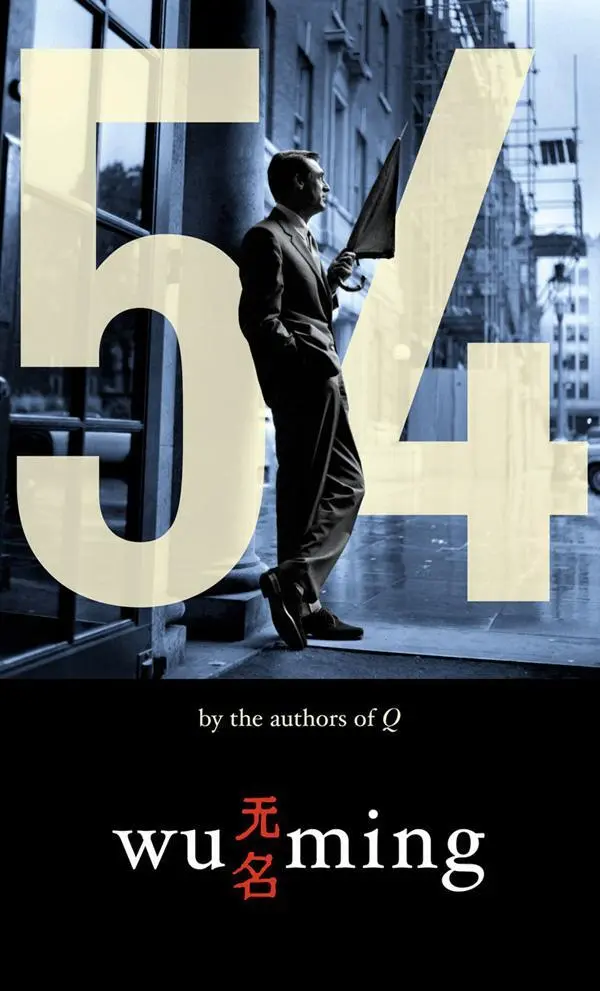
- Название:54
- Автор:
- Издательство:Houghton Mifflin Harcourt
- Жанр:
- Год:2006
- ISBN:нет данных
- Рейтинг книги:5 / 5. Голосов: 1
-
Избранное:Добавить в избранное
- Отзывы:
-
Ваша оценка:
54: краткое содержание, описание и аннотация
Предлагаем к чтению аннотацию, описание, краткое содержание или предисловие (зависит от того, что написал сам автор книги «54»). Если вы не нашли необходимую информацию о книге — напишите в комментариях, мы постараемся отыскать её.
Set during the height of the Cold War-with the world divided into East and West-54 features Italian partisans, KGB agents, Parisian lowlifes, and cameos by David Niven, Marshal Tito, and Grace Kelly. Wu Ming brings us a cinematic romp that is by turns edgy social satire and modern comic send up.
54 — читать онлайн бесплатно полную книгу (весь текст) целиком
Ниже представлен текст книги, разбитый по страницам. Система сохранения места последней прочитанной страницы, позволяет с удобством читать онлайн бесплатно книгу «54», без необходимости каждый раз заново искать на чём Вы остановились. Поставьте закладку, и сможете в любой момент перейти на страницу, на которой закончили чтение.
Интервал:
Закладка:
You know where I met my first American citizen? In Moscow, in the shower. In the Hotel Lux, where foreign communists stayed. The hot water wasn’t on all the time, and when there was any it ran out almost immediately. Moscow isn’t Palm Springs, it was absolutely freezing. To wash ourselves, we showered in pairs. That was how I met Earl Browder, the great leader of American communism. He stood for the presidency if I remember correctly. I don’t know what happened to him in the end, but I’m sure he isn’t getting on too well with that oaf McCarthy. Oh, Stalin took good care of him. What? They killed him? Not physically, but in 1944 he declared that capitalism and communism could coexist, and lost his post as Party secretary. Two years later the Cominform called him a ‘deviationist’ and expelled him from the Communist Party. I don’t know what he lives on now. I see him as a precursor of what we’re trying out. Browder was in favour of an American way towards socialism.
I saw you in that film where you were dressed as a woman. Which one, the one with the leopard or the one with the male war bride? The male war bride. Really good fun. And the one with the Nazi wine cellar. Notorious . Terrifying. You know, my secret services gave me a file on you. Don’t worry, nothing compromising as far as I’m concerned, quite the reverse. You’ve served your country and the antifascist cause in a sector of such crucial importance as entertainment. Cary holds his breath. What I was about to say: in the photographs you wear exceptionally well-tailored suits. I have some too, you know. We working-class children have to acquire elegance. Doggedly. Ever alert, as though we were at the front. At the end of the day this is war as well. Cary is almost moved. He thinks about his childhood in Bristol. He thinks about the mother he thought was dead and who came back from the grave. He thinks about his time as a sandwich board man on stilts, in New York. Just to say it isn’t a silly question. You don’t wear a belt. You don’t wear braces. You haven’t got a pot belly. How on earth do you hold your trousers up? Cary laughs. Tito laughs.
They mention that the Italian tailor and fashion house takes its name from the Islands of Brioni. Strange, isn’t it? I don’t know why. You know, I think we have a lot in common. I know it’s strange, we’ve had very different lives, and yet. Cary expounds his views. Tito surprises him: konspiracija and cinema have forced them to adopt different identities. Let’s try and count them! I have been Josip Broz, Georgijevic, Rudi, John Alexander Carlson, Oto, Viktor, Timo, Jiricek, Tomanek, Ivan Kostanjsek, Slavko Babic, Spiridon Mekas, Walter and finally Tito. I have been, to cite only a few: Archibald Alexander Leach, ‘Rubber Legs’, the magician Knowall Leach, Max Grunewald, Cary Lockwood, Jimmy Monkley, Jerry Warriner, the palaeontologist David Huxley, Sergeant Archibald Cutter, the pilot Jeff Carter, the newspaper editor Walter Burns, Leopold Dilg, Ernie Mott, Joe Adams, the millionaire C. K. Dexter Haven, Johnnie Aysgarth, Mortimer Brewster, Cole Porter, the agent Devlin in Notorious , Mr Blandings, who wanted to build his dream house. To come here I have assumed the identity of ‘George Kaplan’. What I don’t know is who I would be expected to play in the film, if it should happen. Why did you decide to leave the cinema, Mr Grant?
They chat like old friends. Have you stopped drinking, too? Certainly not. Then I shall have them bring a brandy from these islands, an aperitif. This evening you will dine with me, have you told them that?
Cary realises that Tito has not the slightest interest in the bizarre suggestion being put forward by MI6. His game is one of temporisation, waiting to see what’s happening in Moscow, keeping a foot in both camps. He goes to dinner with Her Majesty, and the heretic Djilas is immolated on the Moscow altar. A strategist, a political animal following the trail, scenting the smell of death: every time Stalin is mentioned, a light in his eye goes out for half a second. He hears something. The patter of feet dancing on the tyrant’s grave? In any case, the idea of the film is a load of crap. That or a huge joke. Tito and Cary Grant converse amicably. Can you imagine a more surreal scene? Nothing means anything, apart from the fact that I am here and I feel good. What? Oh, sorry, I was thinking out loud.
Treacherous eyes follow smiles and slaps on the back. Who can tell that the film isn’t going to happen? Elsewhere, people are waiting for reports.
Chapter 52
Between Mljet and Sipan, 30 April
Two in the morning. President Tito left Mljet less than four hours ago. The garden of the villa is so quiet you would think you could hear the tide lapping in the distance.
The shadow emerges furtively from the back door. It creeps past boxwood bushes and palm trees, before crouching down between the hedge and the statue of Hermes, which is smothered in climbing plants.
On its knees, a little case. The shadow opens it carefully, takes out a pair of headphones and puts them on. Expert fingers fiddle with slides and dials. A faint hiss comes from the headphones. Eyes stare alertly at trembling gauges and decipher each oscillation. One hand works delicately to position the circular antenna and the telescopic aerial. The other picks up a receiver and brings it to the shadow’s mouth.
‘Fish in the sea, Varna, fish in the sea. ’ The long-wave beep pierces eardrums. The shadow repeats insistently: ‘Fish in the sea, Varna.’
Broken words. Whistles. A sound like wind in a microphone. The hand adjusts the circular antenna. Indistinct phrases. Thumb and index finger stroke a dial.
The shadow whispers into the receiver: ‘It doesn’t matter if the trawler comes here. There are more fish in the sea around
Sipan, repeat, Sipan, Mediterranean zone, uninhabited, landward side. Tomorrow morning, time unspecified, at least three swordfish, maybe four. The tuna has migrated, only sea bass and swordfish. Roger and out.’
The shadow throws back its head and blows a mouthful of tension at the stars.
It slips off the headphones, closes the case and lightly makes its way back across the park.
The prow of the dinghy scrapes on to the sand, impelled by the last stroke of the oars. Four men jump into the sea and pick it up before dropping it on the beach.
Andrei Zhulianov glances nervously around. He has never liked changing plans at the last minute. Even when the changes seem to make everything easier. He would rather have a big risk calculated down to its tiniest details than a linear action filled with unpredictable possibilities. Mljet was a big risk.
Sipan looks easier, but they’re still going to have to improvise the whole thing.
The map of the place, found on the Varna , doesn’t add a great deal. A nautical chart of southern Dalmatia. Like trying to find a restaurant on a globe.
Zhulianov glances at his watch. Four o’clock. Better act immediately.
First of all, unload the dinghy.
Then hide it.
Finally, find a good observation point, to sight the yacht arriving from Mljet.
Don’t let all that confuse you. In one rucksack, all the scubadiving equipment. In the next, binoculars and telescope. In the third, the instruments. Never forget, I’m looking for a place to hide the dinghy.
Three hours later, twenty or thirty metres along the beach and just a bit more to the east, Pierre will wake up in his father’s bed after a night spent tossing and turning. The first sun of the morning will fill the room, with the promise of a hot day, ideal for swimming.
Pierre will reach the window on bare feet. He won’t be able to keep from thinking about Bologna, the day he left, still cold, damp, wrapped in the last fog, drenched by soft rain, a whitish sky hiding the sun.
Читать дальшеИнтервал:
Закладка:
Похожие книги на «54»
Представляем Вашему вниманию похожие книги на «54» списком для выбора. Мы отобрали схожую по названию и смыслу литературу в надежде предоставить читателям больше вариантов отыскать новые, интересные, ещё непрочитанные произведения.











Обсуждение, отзывы о книге «54» и просто собственные мнения читателей. Оставьте ваши комментарии, напишите, что Вы думаете о произведении, его смысле или главных героях. Укажите что конкретно понравилось, а что нет, и почему Вы так считаете.