Wu Ming - 54
Здесь есть возможность читать онлайн «Wu Ming - 54» весь текст электронной книги совершенно бесплатно (целиком полную версию без сокращений). В некоторых случаях можно слушать аудио, скачать через торрент в формате fb2 и присутствует краткое содержание. Год выпуска: 2006, Издательство: Houghton Mifflin Harcourt, Жанр: Историческая проза, на английском языке. Описание произведения, (предисловие) а так же отзывы посетителей доступны на портале библиотеки ЛибКат.
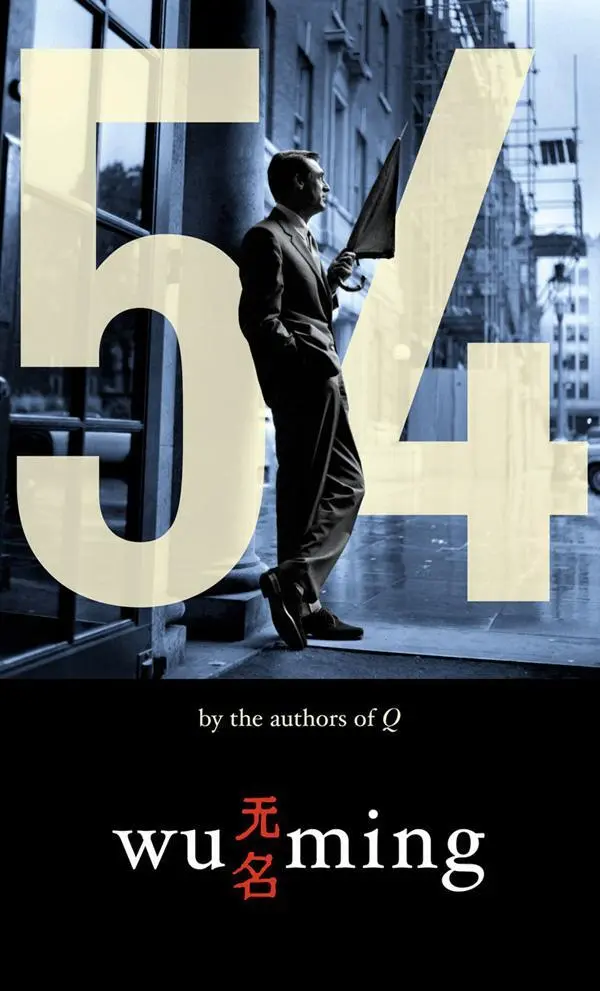
- Название:54
- Автор:
- Издательство:Houghton Mifflin Harcourt
- Жанр:
- Год:2006
- ISBN:нет данных
- Рейтинг книги:5 / 5. Голосов: 1
-
Избранное:Добавить в избранное
- Отзывы:
-
Ваша оценка:
54: краткое содержание, описание и аннотация
Предлагаем к чтению аннотацию, описание, краткое содержание или предисловие (зависит от того, что написал сам автор книги «54»). Если вы не нашли необходимую информацию о книге — напишите в комментариях, мы постараемся отыскать её.
Set during the height of the Cold War-with the world divided into East and West-54 features Italian partisans, KGB agents, Parisian lowlifes, and cameos by David Niven, Marshal Tito, and Grace Kelly. Wu Ming brings us a cinematic romp that is by turns edgy social satire and modern comic send up.
54 — читать онлайн бесплатно полную книгу (весь текст) целиком
Ниже представлен текст книги, разбитый по страницам. Система сохранения места последней прочитанной страницы, позволяет с удобством читать онлайн бесплатно книгу «54», без необходимости каждый раз заново искать на чём Вы остановились. Поставьте закладку, и сможете в любой момент перейти на страницу, на которой закончили чтение.
Интервал:
Закладка:
Chapter 51
Mljet, 29 April
It happened five years ago. Kardelj, who had had dinner with me that evening, was clarifying the issue of Leninist theory in Yugoslavia, and rejecting the accusations of ‘Trotskyism’ issuing from Moscow. The mirror spied on us from the end of the corridor, our lookalikes copying our every move, perhaps preparing to reproach us. Here we were, well fed and clothed, so unlike the days of the konspiracija . Was it just vanity that dictated the stance that would consign us to history? We discovered (at dead of night it’s inevitable) that there was something monstrous about the mirrors. Kardelj said the mirror is an infernal machine, because it separates the individual from the community, stimulating his petty-bourgeois narcissism. I replied, ‘So how do you trim your moustache, by leaning over puddles?’ adding that, on the contrary, the mirror unites the individual with the community, and its admission into proletarian houses has cemented class pride, that sense of decorum thrown back in the bosses’ faces, ‘We have been naught, we shall be all! We can be, and we are, more stylish than you are!’ It was thanks to that decorum, to that pride, that the war was won.
Here I am. In a week I will be sixty-two. My temples are greying, I have a hint of a double chin, but I still get by, I have a young and beautiful wife. Stalin is dead, I’m alive. And I’m no longer an ilegalac . When I look in the mirror, I don’t miss those days. How could I? Two wars, prisons, fights, flight and privations. Lepoglava, Maribor. I haven’t had so much time to read since then. I still remember the smell of each book, the paper with its different colours and typefaces, every single copy brought into the jail. I used to read wearing pince-nez glasses that made me look like an intellectual. Me, a worker, the son of dirt-poor peasants.
And now I’m at the wheel of the new Yugoslavia, I’m wearing a new panama hat and in twenty minutes I’m going to be meeting Cary Grant. The coffee pot is hissing, the coffee is ready. Will he be one of those people who hold up their pinkies when they hold the cup? And what if he wants tea? No, he’s an American now, Americans drink coffee. The first American I ever met. when was that? At the Lux, in the shower, almost thirty years ago. Tell him about that?
White suit, sky-blue shirt, indigo tie matching my socks.
That interview in Life magazine, when we went to the UN. Lovely photographs, but Bebler and Djilas said I looked like a ‘South American dictator’, that I would have to be less ‘showy’ or I would repel Western public opinion. Strange, just a few weeks previously I had been talking to Kardelj about mirrors.
They’re stubborn, they don’t want to understand. They’ve never saved to buy the feathered hat of the gymnastic association. In Kamnik (what would it have been, 1911?) and Vienna, the dancing school, fencing school, skiing. Taking care of every detail, always improving your own way of doing things. In 1913 I became regiment fencing champion, I was admitted into that big tournament, I came second and made such an impression that I was sent on a course for junior officers. Small steps along the way that brought me to see the October Revolution and become a Bolshevik. Could I have led our revolution without a presence appropriate to the task? Small steps, and that hat.
One day even Djilas will understand: the League of Yugoslavian Communists governs this republic with the consensus of the people who founded it, a mosaic of races, religions, traditions. At the top you need rituals and certain roles. Without rituals and shared symbols, without a guarantor of the community’s cohesion, we would be finished. Every detail of my public face is a symbol, it must transmit the message: ‘I am everything and you are everything along with me! ’ The perfect cut of my uniform gives concrete form to the pride of the workers.
Stalin looked as though he was being choked by his jacket collar. The first time I saw him, he looked painfully clumsy. I cut a fine figure even in Buckingham Palace, a real man among bloodless dandies and doddering old fools. Bringing a breath of revolution and a brave new world to Buckingham Palace. Isn’t that a titanic enterprise as well?
Stalin. I’m the only person who can say I contradicted him in public. Other people did it too, of course. Except that they didn’t live to tell the tale. ‘And what are we going to do now?’ everyone asks me. After a long time the first shy signals are coming in from Moscow. Djilas is raising a cloud of dust. Serov’s spies in every corner, in all likelihood. The British are suggesting a film. Very peculiar. A strange way to familiarise the West with our form of socialism. And then I say: bring me Cary Grant.
Ten minutes away.
Will he be bothered by smoke?
Enter Cary. Clean-shaven, finally, and wearing a suit sent from Palm Springs for the occasion. This is the Cary Grant everyone knows, the one Tito imagines he knows, nerves of steel, intent on wiping out a network of Nazis in Notorious . Tito expresses himself in passable English, apart from the occasional faux ami : he says ‘anaemic’ instead of ‘enemy’. Cary doesn’t correct him. As usual when acting the generous host, Tito makes the coffee in person. Cary looks on with amusement. A few mentions of Trieste, the coat recovered in no time at all by the AMG agents. And who is this character Rizzi? A poet. Ah. Tito talks about his first visit to Trieste. He was eighteen, he arrived on foot, eighty kilometres from Ljubjana. He was stunned by the sheer size of the harbour. He felt lost.
Grant asks Tito about the schism with Stalin, adding, ‘That took a bit of nerve, he looked like one of the bad guys in a Disney film!’ Tito laughs and thinks about the wicked witch in Snow White interrogating her mirror. He thinks about Kardelj, about Djilas, about decisions that were so hard to take. He thinks about Moscow, about the purges, about the ever emptier floors of the Hotel Lux. Then he rewards his guest with a few anecdotes. Just after the war a team of Russian film-makers turned up here, also wanting to make a film about our Resistance. They were really a bunch of boozing whores and scoundrels, they got drunk day and night, they caused trouble over the merest trifles, on a number of occasions our police were called to sort them out. The film was an obscenity. Our war emerged from it as a secondary conflict, a diversion to keep the Axis busy while the Red Army got on with the job. And in fact it was we who broke first the Duce’s back, then the backs of the Germans. Your Churchill understood that after the Fifth Offensive, although if he’d worked it out earlier many of the comrades would still be alive. Oh, it’s true, you aren’t English any more, or rather you’re English and a nationalised American. He should have said ‘naturalised’, but Cary doesn’t correct him. He feels good.
Today we’ve got information suggesting that members of the crew were spying for Stalin. It was an initial attempt at destabilisation. They’ve always been afraid of us. Tito finishes, so to speak, with an allusion to his knowledge that he can take care of himself, even when there seems no immediate need to do so. You’re better off not owing anything to anybody. Grant sips his coffee, which is very good, and delights Tito with details of his conquest of artistic and economic independence. People admire Tito, they really do. And what about this film? Tito smiles, lights a cigarette and raises a quizzical eyebrow. No, it doesn’t bother me. You know, I managed to give up, thanks to my wife. I used to smoke, of course I did. Thanks to your wife? What did she do, if you don’t mind my asking? Did she threaten you with not.? The two men laugh. No, no, she hypnotised me. Really? But does it work? I can guarantee it. Your wife is a hypnotist? Well, she tried it and it worked. You know, she subscribes to these oriental disciplines that are so much in vogue in California, less so in Yugoslavia, I would guess. Tito blows out a smoke ring. I’ll set up a commission of doctors. If they can prove to me that hypnosis works, then perhaps one day we’ll make it part of our public health system. If it exists, the people have a right to it. Cary arches his eyebrow. At the end of the day, we are in the East.
Читать дальшеИнтервал:
Закладка:
Похожие книги на «54»
Представляем Вашему вниманию похожие книги на «54» списком для выбора. Мы отобрали схожую по названию и смыслу литературу в надежде предоставить читателям больше вариантов отыскать новые, интересные, ещё непрочитанные произведения.






Обсуждение, отзывы о книге «54» и просто собственные мнения читателей. Оставьте ваши комментарии, напишите, что Вы думаете о произведении, его смысле или главных героях. Укажите что конкретно понравилось, а что нет, и почему Вы так считаете.