Wu Ming - 54
Здесь есть возможность читать онлайн «Wu Ming - 54» весь текст электронной книги совершенно бесплатно (целиком полную версию без сокращений). В некоторых случаях можно слушать аудио, скачать через торрент в формате fb2 и присутствует краткое содержание. Год выпуска: 2006, Издательство: Houghton Mifflin Harcourt, Жанр: Историческая проза, на английском языке. Описание произведения, (предисловие) а так же отзывы посетителей доступны на портале библиотеки ЛибКат.
- Название:54
- Автор:
- Издательство:Houghton Mifflin Harcourt
- Жанр:
- Год:2006
- ISBN:нет данных
- Рейтинг книги:5 / 5. Голосов: 1
-
Избранное:Добавить в избранное
- Отзывы:
-
Ваша оценка:
54: краткое содержание, описание и аннотация
Предлагаем к чтению аннотацию, описание, краткое содержание или предисловие (зависит от того, что написал сам автор книги «54»). Если вы не нашли необходимую информацию о книге — напишите в комментариях, мы постараемся отыскать её.
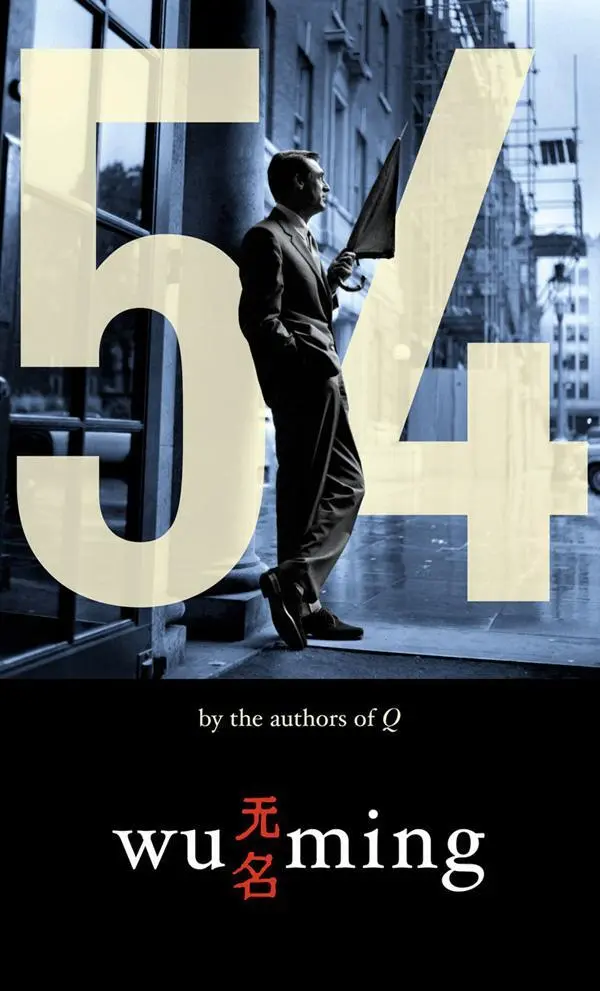
Set during the height of the Cold War-with the world divided into East and West-54 features Italian partisans, KGB agents, Parisian lowlifes, and cameos by David Niven, Marshal Tito, and Grace Kelly. Wu Ming brings us a cinematic romp that is by turns edgy social satire and modern comic send up.
54 — читать онлайн бесплатно полную книгу (весь текст) целиком
Ниже представлен текст книги, разбитый по страницам. Система сохранения места последней прочитанной страницы, позволяет с удобством читать онлайн бесплатно книгу «54», без необходимости каждый раз заново искать на чём Вы остановились. Поставьте закладку, и сможете в любой момент перейти на страницу, на которой закончили чтение.
Интервал:
Закладка:
‘If it goes on like this,’ added Pierre, ‘they’ll need more than a local stadium. He’ll be European champion in two years.’
The first fighters of the evening entered the ring. Bernardi came from Ferrara. There was, amidst a chorus of whistles from the locals, fallout from the football-based hatred between Bologna and Spal Ferrara. Malavasi, on the other hand, was born within the city walls, but many people remembered him wearing the uniform of the fascist Black Brigade. The insults of the comrades were all directed at him. The referee for the clash was Signor Cinti from Ancona.
Clash? Depends what you mean. After the first two rounds, ‘Pumpkin-seeds’ started to complain to Pierre.
‘Call this boxing? They’re rubbish, them two.’
Pushing, hugging, jerking, no real punches to speak of.
By the time of the fourth, after two cautions for fouls from the referee, the crowd started whistling. They shouted that the Ferrara boxer would have been better off ‘breeding eels’, and someone asked if he could get up into the ring to teach the fascist a lesson. So the match, while it languished in the ring, spread into the ringside seats.
A short, squat bloke, red face like a baboon’s arse, came over to Pierre with a menacing look.
‘And as for you, my handsome lad, you go and tell people in your bar that Malavasi tried to fight and the other guy didn’t.’
‘You call that fighting?’ said someone a few inches away from his nose. ‘Bullets are too good for you fascists.’
The right hook thumped into Pumpkin-seed’s cheek in a flash. He hadn’t been the one talking, that had been someone with huge great shoulders, far too big for that short-arsed wanker of a fascist. Pierre threw himself at the troublemaker, whacking him in the jaw with his elbow. The man fell back with Pierre on top of him, while the fray began all around them.
On the other front, the referee stopped the fight. Renato Torri of Sempre Avanti took the microphone to ask the audience to be calm, threatening to interrupt the evening immediately.
At the thought of losing Cavicchi, Pierre loosened his grip on his adversary, abandoning himself to the arms that were trying to pull him away. He took a hefty kick in the stomach, just as he was moving away. He replied with a spit, aiming at the little guy’s bald head, and then he too was immobilised and carried away, still bellowing.
‘You’re Pierre from the Bar Aurora, aren’t you? Brother of Nicola Capponi?’
The guy who had threatened the fascist was standing behind him. Pierre straightened up and replied, ‘Yes, that’s me. And who are you?’
‘I’m Ettore. I believe you wanted to speak to me.’
Cavicchi’s arrival was greeted with an ovation. Pierre forgot to applaud. ‘Shall we do it now, or wait for them to finish?’
‘Let’s wait,’ said Ettore. ‘We’ll see how Checco gets on, and then go and get a drink.’
The first round ended with the German Wiese on the ropes. Cavicchi was burying him beneath an avalanche of punches, waiting for the right moment to land one of his famous left hooks. Filled with admiration, Pierre watched the fluent and devastating action, trying to plan what he was going to say, his head filled with awe and fisticuffs.
In the interval between the fourth and the fifth rounds, he turned to say something to Ettore, but Ettore had already moved away, and was engaged in intense conversation with two men.
As the bell sounded, he looked towards the ring once more. His excitement was mounting. Not because of the boxing match, which was dominated by Cavicchi, but because of the business with Ettore, and its possible consequences. Would he find a way to get to Yugoslavia? And where would he lay his hands on the money to pay for the journey? Would it be very dangerous? And what about Angela? If he stayed away for a while, would it bring them closer together or persuade her that it was better if they parted? And Nicola? What would he tell him?
Wiese’s trainer didn’t ask himself quite so many questions, and threw in the towel in the sixth round.
Pierre realised he had missed something. He looked around. Ettore was beckoning him over. A gap opened up, and he joined him.
As they walked along the street they exchanged a few words, just to choose where to go.
The restaurant beneath the city towers was rather crowded, late as it was. They found a corner table, tiny and somewhat discreet, sat down and ordered two brandies.
Ettore sat back, lit a cigarette and took two drags on it.
Pierre cleared his throat and decided to get straight to the nub.
‘I need to go to Yugoslavia, and Gas, Castelvetri, says —’
‘Calm down, now,’ Ettore interrupted. ‘I don’t like getting involved in stuff I don’t know about. We always have a chat first, and if you’re ok you’ll win, I’ll be that much happier to help you.’
A few tables away, a girl laughed loudly, above the gabble of voices. The arrival of the waiter helped Pierre out of his embarrassment. He gripped his glass, turned it around in the palm of his hand, sniffed his brandy and took a sip.
Ettore started talking again. ‘Your brother was in the 36th, wasn’t he?’
‘That’s right, in Kaki’s company.’
‘And what about you?’
‘Not a bit of it,’ said Pierre, his throat burning. ‘I was little more than a child. I’m twenty-two now, but if I’d been at least sixteen in 1944 I’d have gone, sure, it’s a family habit.’
‘It’s one that I have too, but a bad one if you’re as young as that. It’s not worth risking your life at the age of sixteen.’
Pierre looked Ettore right in the eye. For a moment he felt as though they were alone in the restaurant. He leaned forward and lowered his eyes. ‘My father said you shouldn’t always stand and
watch.’
A couple of people at the nearby tables glanced over at them.
Pierre lifted his elbows from the table and leaned his chair against the wall.
‘Your father was in the mountains too, wasn’t he?’ asked Ettore.
‘Yes and no. He ended up fighting in Croatia, with the Italian army. Then his company mutinied and went over to Tito’s side. My father fought with the Resistance there, between Zagreb and the coast, and then he decided to stay, because socialism had triumphed there, and also they’d given him some important jobs to do.’
He said these words quite openly. But Ettore wasn’t the kind of person to start arguing about whether Tito was a fascist or a comrade, whether or not he was a traitor. He sat there in silence, drained his brandy and lit another cigarette. Pierre did the same. They talked about other things for half an hour. The illusions of the partisans and the directives of Togliatti, Bologna football team and Cavicchi. When Ettore started talking about his father again, Pierre realised that it was time to move on to business.
‘I’ve always longed to hug my father again,’ he began, ‘but there are too many obstacles in the way: the journey, the money, the documents. For many years I’ve made do with his letters. Then there was silence, then nothing for months, and now mine have started coming back. So I made up my mind: I’ve got to go, find out what’s happened, find an answer to all those questions. That’s why I turned to you.’
‘A journey, perhaps undercover.’
‘Exactly.’
‘It’s risky. If they get you, you’ll spend a few years in jail.’
‘Only fools end up inside,’ Pierre announced, trying to look tough.
‘Then perhaps you’re about to do something foolish.’
‘Fine.’ Pierre tried to smile, but managed only to raise a corner of his mouth. ‘So let’s say it’s worth the trouble. As it was worth the trouble for you, my brother, my father and everyone else to do your duty when the time came. Sometimes it’s worth it.’
Читать дальшеИнтервал:
Закладка:
Похожие книги на «54»
Представляем Вашему вниманию похожие книги на «54» списком для выбора. Мы отобрали схожую по названию и смыслу литературу в надежде предоставить читателям больше вариантов отыскать новые, интересные, ещё непрочитанные произведения.






Обсуждение, отзывы о книге «54» и просто собственные мнения читателей. Оставьте ваши комментарии, напишите, что Вы думаете о произведении, его смысле или главных героях. Укажите что конкретно понравилось, а что нет, и почему Вы так считаете.