Wu Ming - 54
Здесь есть возможность читать онлайн «Wu Ming - 54» весь текст электронной книги совершенно бесплатно (целиком полную версию без сокращений). В некоторых случаях можно слушать аудио, скачать через торрент в формате fb2 и присутствует краткое содержание. Год выпуска: 2006, Издательство: Houghton Mifflin Harcourt, Жанр: Историческая проза, на английском языке. Описание произведения, (предисловие) а так же отзывы посетителей доступны на портале библиотеки ЛибКат.
- Название:54
- Автор:
- Издательство:Houghton Mifflin Harcourt
- Жанр:
- Год:2006
- ISBN:нет данных
- Рейтинг книги:5 / 5. Голосов: 1
-
Избранное:Добавить в избранное
- Отзывы:
-
Ваша оценка:
54: краткое содержание, описание и аннотация
Предлагаем к чтению аннотацию, описание, краткое содержание или предисловие (зависит от того, что написал сам автор книги «54»). Если вы не нашли необходимую информацию о книге — напишите в комментариях, мы постараемся отыскать её.
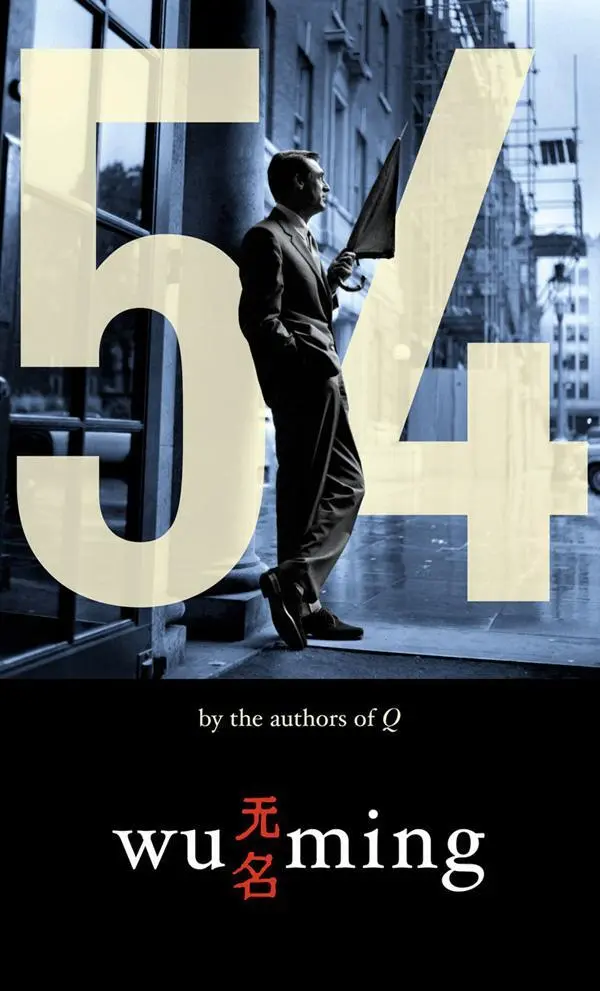
Set during the height of the Cold War-with the world divided into East and West-54 features Italian partisans, KGB agents, Parisian lowlifes, and cameos by David Niven, Marshal Tito, and Grace Kelly. Wu Ming brings us a cinematic romp that is by turns edgy social satire and modern comic send up.
54 — читать онлайн бесплатно полную книгу (весь текст) целиком
Ниже представлен текст книги, разбитый по страницам. Система сохранения места последней прочитанной страницы, позволяет с удобством читать онлайн бесплатно книгу «54», без необходимости каждый раз заново искать на чём Вы остановились. Поставьте закладку, и сможете в любой момент перейти на страницу, на которой закончили чтение.
Интервал:
Закладка:
Pierre was six years old when his mother died of tuberculosis. Her second pregnancy, the one that had led to his birth, had tested her beyond endurance. Perhaps, as Fanti said, a secret sense of guilt gave form to the memory, based on the little that had stayed in his mind. An extreme attempt to make her survive.
He remembered her smiling, a modest and angelic smile, watching down over him, murmuring a phrase, something to calm the impetuosity of a precocious and agitated child. Nothing but a sensation.
Rosa Montanari was a slim and very beautiful woman. She came from a poor family in Solarolo. She had married Vittorio Capponi in 1920, when she was only eighteen. Pierre’s father, first a daylabourer and then a worker from Lugo, born in 1901, was a veteran of the 1919–20 riots, the ‘Two Red Years’, and bore carved into his flesh the marks of the destiny that he had chosen for himself: the blows of the agrarians, membership of the newly born Communist Party, the name of his first son, who had arrived a few days after the death of Lenin and been called Nicola in honour of the great revolutionary. Except, Pierre reflected, Nikolai hadn’t been Lenin’s real name. That was Vladimir Ilyich Ulyanov. And Joseph Stalin also had a very long and complicated name that no one could remember. To pass into history your name has to be simple, short and incisive.
Robespierre was born in 1932, registered as ‘Piero’ on the fascist register. It was a bad time for the family. His father hadn’t taken the Fascist Party membership card, and he would pay for his choice to the bitter end. Poverty persecuted the Capponis for a decade, with few moments of respite.
Rosa had died in 1938. Pierre remembered very little of those times; his father with his head in his hands and Nicola running upstairs. That was all.
From time to time that memory came back in Pierre’s dreams. When he awoke he fantasised, wondering how his life would have been if his mother had survived. From that day onwards, Nicola had locked himself away in a funereal silence. His character had changed, he had become confrontational, with a terrifying temper. Vittorio had wept for days, cursing God and swearing at the heavens, crazed with grief. That much he remembered clearly.
During that same period, one evening a drunk had sung the praises of Stalin in the village square. The fascists pounced on him, seven against one. Vittorio hurled himself into the scrum and knocked someone out, but he was overcome and beaten till he bled.
So Pierre learned to hate them.
A few days later, Vittorio took Pierre and Nicola aside and, with his black eye still half closed, he outlined the most categorical and incisive teaching of his life, something that would always be associated with the figure of Vittorio Capponi. He pierced them with his eyes: ‘Never stand and watch.’
Then the Capponis moved to Imola, to the apartment that Aunt Iolanda had found directly opposite her own. It was thanks to her that the family managed to keep its head above water. She took care of everything, without poking her nose in where it wasn’t wanted. She dedicated herself heart and soul to her nephews, without confusing them with the children she didn’t have. She supported her brother without acting as his wife.
Father and sons treated her with great affection, and she treated them with attentiveness and pride. She was the only person Nicola ever confided in. Vittorio involved her in all important decisions, and Pierre did everything he could think of just to please her.
When, in April 1941, Vittorio Capponi was called up as a reservist to fight on the Yugoslav front, the presence of Iolanda ruled out any chance of exemption; it was true that his sons had lost their mother, but the elder boy was working, and their aunt ‘catered to their every need’.
The nephews’ needs did not keep Iolanda from doing her part in the fight against fascism. On 29 April ’44 she went down into the square with the women of Imola; on 13 May she tended to those who had been injured in the bombing; a few months later she hid two partisans and let Nicola follow them into the mountains.
He was twenty years old. He had endured the abuses of power for too long. He could no longer stand and watch.
Pierre didn’t see him again until the war was over, limping, thin as a rake, a steely glint in his eye.
One day in 1945 a letter arrived from Yugoslavia, and Pierre discovered that his father was a war hero. Shortly after arriving in Croatia, Vittorio Capponi had killed the vice-commander of his unit, and joined the Yugoslav Resistance. After 8 September 1943, he had recruited hundreds of Italian soldiers to the the ranks of Tito’s army. He had taken part in the liberation of Zagreb, and received a medal for military valour from the Marshal in person.
Shortly afterwards, Pierre, Nicola and Iolanda hugged him for the last time.
He came back undercover, like a thief, hiding for two nights in the cellar of an old friend.
He risked serious punishment in Italy: charges of insubordination and homicide. Furthermore, he was a member of the Yugoslavian Communist Party, there was a country to build, a socialist country, a revolution to take to its conclusion. He couldn’t pull out.
Pierre listened in as Vittorio and Iolanda discussed his future. If they had asked him he wouldn’t have been able to decide whether to go with his father or stay in Imola. For that reason alone he let them choose on his behalf. Nicola chose to stay.
Pierre stayed too. Yugoslavia was too risky. His father promised to see him at least once a year. He never came back: too dangerous. They went on writing to each other, in the rhythm that the post allowed: a letter every five or six months.
Pierre and Nicola clung to those letters, which brought them news of their father in the broadest terms: he had been given an important job, he had remarried, this time to a Yugoslav partisan, and he had opted to stay with Tito even after 1948 and the break with Stalin.
The last two choices poisoned Nicola’s blood. The world could clear off as far as he was concerned, and he never wanted to hear his father mentioned again.
In the meantime he had been offered the job of manager of a bar in Bologna. Nicola Capponi was a war invalid and a hero of the Resistance, and the Party had put pressure on comrade Benassi to let him manage the Bar Aurora. So Pierre, too, was able to leave his workshop, say goodbye to Aunt Iolanda, and move to the city.
Pierre sat down at the table. Gas was savouring his vermouth, lost in his thoughts. He stared quizzically at the boy. Then he worked out that he wanted something. His businessman’s sixth sense allowed him to read other people’s minds. At least, so he thought. He stretched out on his chair and snapped his American lighter a few times. The smoke from his cigarette twirled over his gleaming bald head.
Pierre remained serious, he hadn’t come to buy lighters.
He said, ‘If you talk to anyone about it, I’ll track you down and break your legs.’
Gas smiled and puffed out a series of smoke rings.
‘I am bound by the rules of professional secrecy, you should know that. Without discretion, no trust. Without trust, no business. I would shut up shop before you knew where you were.’
He was always satisfied when he was able to rattle off his maxims of business philosophy.
They stared at each other again for a long while.
Then Pierre said, ‘How would you go about getting into Yugoslavia?’
Gas nodded to himself thoughtfully, taking another few puffs, as though he had been asked an existential question.
‘As an entrepreneur I can point you towards the right people. But I would have to warn you that these characters don’t stand any nonsense. Not the sort of people you want to get on the wrong side of, if you catch my drift.’
Читать дальшеИнтервал:
Закладка:
Похожие книги на «54»
Представляем Вашему вниманию похожие книги на «54» списком для выбора. Мы отобрали схожую по названию и смыслу литературу в надежде предоставить читателям больше вариантов отыскать новые, интересные, ещё непрочитанные произведения.






Обсуждение, отзывы о книге «54» и просто собственные мнения читателей. Оставьте ваши комментарии, напишите, что Вы думаете о произведении, его смысле или главных героях. Укажите что конкретно понравилось, а что нет, и почему Вы так считаете.